Welcome to BookView Interview, a conversation series where BookView talks to authors.
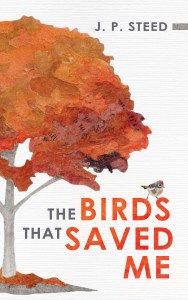
Recently, we interviewed J. P. Steed about his writing and his recently released debut book, The Birds That Saved Me: An Introduction to Birding for Self-Improvement. (Read the review here.) Jason’s stories, poems, and articles have appeared in a wide variety of publications.
Jason Paul Steed grew up in Oregon. He holds a B.A. from Brigham Young University, an M.F.A. from the University of Idaho, a Ph.D. from the University of Nevada Las Vegas, and a J.D. from the University of Texas at Austin. He was an English professor for several years, before going to law school, then he was a practicing attorney for fourteen years—until recently he decided to return to academia as a law professor. His stories, poems, and articles have appeared in a wide variety of publications. This is his first book.
What inspired the premise of your book?
I talk about this in the book itself—how first I started going for walks, and then I started birding after I had this cool, revelatory experience with the Pileated Woodpecker, and then I had the idea that I should write about this experience, and create a collection of written experiences. And the book just sort of grew and developed from there.
How many rewrites did you do?
Well, I started out with a basic structure in mind, and the biggest rewrite was when I decided to restructure everything—the whole thing. After that, I would say each chapter got at least one full rewrite, and then lots of rounds of revising and editing.
Which chapter is your personal favorite—and why?
That’s really hard to say. I don’t think I can pick just one. But my favorites include the chapters on the Eastern Bluebird, the Red-winged Blackbird, and the Cedar Waxwing. Those chapters make me cry a little, every time I reread them. All the chapters are deeply personal to me, but those three chapters are tied to my three eldest children. They were both easy and hard to write, and they get me every time.
How many unpublished and half-finished books do you have?
I have notes and outlines for probably a dozen—at least a dozen—different books, including nonfiction, novels, and short story collections. I know most of those projects won’t ever get off the ground. But I do have a story collection that is pretty far along, and that I would like to finish. And I have a lot of notes for another bird book, and for a book about the Supreme Court—I plan to finish both of those projects over the next year or two.
Do you find writing therapeutic?
It depends on the type of writing I’m doing. If it’s personal, like The Birds That Saved Me, then yes, there’s something therapeutic about it—working through personal emotions and experiences, and coming out the other side feeling emotionally enlarged, satisfied, or fulfilled. And sometimes there can be something similarly therapeutic about writing fiction, depending on the nature of the story. But if I’m writing something more academic in nature—or if I’m writing a brief for a case that I’m working on—then no, I wouldn’t say that there’s anything therapeutic about that. That’s not the word I would use.
How many hours a day do you write?
It all depends on what you count as “writing.” Narrowly speaking, if we’re talking about the number of hours that I spend actually moving my fingers across the keyboard and putting words on a page, then there are lots of days when I don’t do any writing at all—and then there are lots of days when I spend eight to twelve hours writing. But I think the writing process is much broader and includes a lot more than just those hours that I’m moving my fingers across the keyboard. It includes a lot of thinking and feeling and living—all with an eye toward eventually putting words on a page. And in that sense, there are only a few hours every day when I’m not writing.
Is writer’s block real?
Yes, I think so, but I don’t really think about it or struggle with it very often. I think the way around writer’s block is to shift your focus and work on something else—either some other project entirely, or some other part of the same project. Do something you can do, when it feels like there’s something you can’t do.
After the writing’s finished, how do you judge the quality of your work?
I try to get other people to do that, or to help me with it. We all tend to drink our own Kool-Aid so it’s hard to know when to trust your own judgment. I think Hemingway was the one who said all writers should have a built-in, shock-proof shit detector—but even Hemingway had an editor who told him when something needed changing. Ultimately, it’s going to be someone else—the Reader—who judges quality. I just try to get it to where I’m satisfied with it, and where I can’t find anything else that I want to change about it, and then I call it done. But I think it was Valéry who said an artist never really finishes their work—they merely abandon it. And that’s definitely true for me. I can always find a word or a sentence to tinker with, so eventually I just have to move on. Deadlines are helpful in that way.
What is the biggest challenge you’ve faced as a writer?
So little time. All the other aspects of life. All the things that can fill my day so quickly, so that another day goes by and I didn’t get enough words on the page. Finding or making time to write is by far the hardest thing.
Would you rather read a book or watch television?
I don’t have a strong preference here. I love stories—good dialogue, an emotional arc, a humorous insight—and you can find that narrative experience in books and on television. I like both, and I consume both.
Are you a feeler or a thinker?
Both. I sometimes overthink things and I sometimes overfeel things. Sometimes I need to stop thinking and just let myself feel, and sometimes I need to let go of the feelings and think my way through. For me, the trick is to keep my thoughts and feelings in balance—to not get too caught up in one or the other.
Is there anything you want to unlearn?
Yes. All the bad lessons that trauma teaches.
***
 BookView Review
Leave a comment