Welcome to BookView Interview, a conversation series where BookView talks to authors.
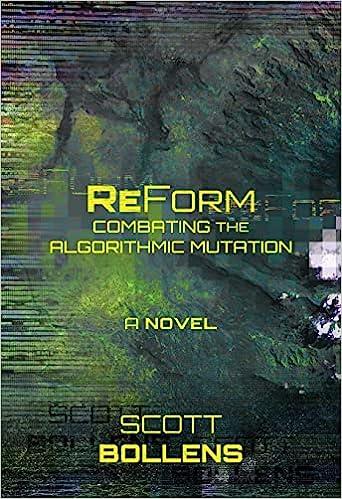
Recently, we interviewed Scott Bollens, Professor of Urban Planning and Public Policy and Warmington Endowed Chair of Peace and International Cooperation, University of California, Irvin, and author of ReForm: Combating the Algorithmic Mutation, a highly intriguing and compulsively readable dystopian tale. (Read the review here.)
Scott Bollens is Professor of Urban Planning and Public Policy and Warmington Endowed Chair of Peace and International Cooperation, University of California, Irvine. For 25 years, he has studied urbanism and political conflict in contested cities throughout the world. His most recent scholarly book is Bordered Cities and Divided Societies (Routledge, 2021). ReForm is Bollens’ second work of fiction, inspired by his research and by over 850 miles trudging the Pacific Crest Trail. The prequel, ReStart: Stories of the Cairn Age (Atmosphere Press), was published in 2021.
Website: https://www.citydivided.com/
Facebook: https://www.facebook.com/SBollens
LinkedIn: https://www.linkedin.com/in/scott-bollens-b2354a46/
Goodreads: https://www.goodreads.com/author/show/708727.Scott_A_Bollens
Twitter: @ScottBollens
Addiction to technology is a big theme in ReForm: Combating the Algorithmic Mutation, which obviously mirrors real life (if to a more severe degree). What compelled you to write a series addressing this real-life concern in a fictional format?
ReForm and its prequel ReStart: Stories of the Cairn Age (2021) have a lot to do with how far AI-produced algorithmic stimuli can go in influencing our beliefs and our actions in this world.
I started writing fiction during Trump’s commandeering of his followers’ minds and during the QAnon phenomenon. I thought, ‘How can people believe these things?’ Well, they firmly believe them because of the input they’re getting all the time on social media. Algorithmically-created ‘echo chambers’ in which they are only hearing about things that strengthen their pre-conceived perception of ‘reality’.
The antagonistic storylines that reinforce our tremendous political polarization today are social and political constructions, and more and more the creation of curated algorithms which we allow to penetrate us daily. Ignorance is no longer simply not knowing something, more and more it is constructed through fabricated falsehoods that are addictive and gripping.
The novels ask–What happens to humans and our ability to independently think if we’re flooded by algorithmically-curated input 24/7 through chip implants? Is it possible to resist the addictive drip of algorithmic storylines?
What kind of research did you have to do to write this book? What did that process look like?
Two life experiences formed the foundation for the two novels.
First, I’ve interviewed more than 350 individuals in nine different war-torn cities in my academic work. This gave me insight into conflict settings and sensitized me to how individuals cope with conflict. I used this understanding in creating my fictional world of conflict in the two novels.
Second, I’m an avid hiker and have trekked more than 800 miles along the Pacific Crest Trail. These experiences in wilderness, and what it can do in cleansing one’s mind, gave me the setting for ReForm.
Beyond these two anchors, I developed the novels based on the absurdities I found by simply reading about daily news events. The pandemic reaction by some in the U.S. and the previous President’s rhetorical flourishes provided a delicious stew of dangerously farcical material.
Do you believe human technology might be headed in a direction that’s explored in ReForm: Combating the Algorithmic Mutation, especially considering all the recent developments in AI?
ReForm and ReStart take place in the near future (2030s-2060s). I think near-future futurist fiction is best able to illuminate fundamental realities of today. It sensationalizes them and maybe exaggerates them, but the basic, fundamental dilemmas portrayed in ReForm and the prequel are those that we’re dealing with today.
We are at the cusp of something entirely new–creating artificial intelligence (AI) that could become smarter than us and may independently act in ways not conducive to human well-being. Are we approaching the so-called “singularity”, when technological growth becomes uncontrollable and irreversible, causing unpredictable changes to human civilization? A recent May 2023 report warned, “Mitigating the risk of extinction from AI should be a global priority……..”
That’s scary stuff.
A lot of times when I tell people the ideas in this book about the influence of AI and social media in our lives, their most common response is, ‘Wow. It sounds like today.’
If there’s no break in what’s happening, and if algorithmic stimulation just intensifies through the years and decades, are we headed toward the catastrophes portrayed in my novels? That’s what I want a reader to contemplate. I sure hope these fictional works are not predictive.
How did you create the character of Jared?
He is an amalgamation of many of my own traits, unfortunately. He is a troubled, kind of messed up guy who wants to do right and is constantly challenged, at times by external things, at other times because he is his own worst enemy. He is quite the unreliable protagonist. I learned a lot about how my mind ticks (gulp) as I was developing Jared.
Outside of your writing career, you are a professor of urban planning and public policy. Has any of your work in those academic fields inspired ideas or plotlines in ReForm: Combating the Algorithmic Mutation?
Yes—I used a lot of my academic experiences in war-torn cities in creating my characters and plot-points. I changed names when I borrowed from actual interviews and I exaggerated certain personalities. The real world—filled with conflict, violence, and lack of understanding of the ‘other’– helped me with the fictional world building.
What have you learned from your academic writing that you’ve carried into your fiction writing?
I’m a recovering academic and I’m learning and growing as a fictional writer. To show and not tell. To develop storylines through characters and not describe in rational, linear ways. To leave openings in the story for the reader to wonder and not try to explain everything.
I’ve learned how much academic writing uses its own enclosed, self-referential vocabulary that shuts normal folks out. In many ways, academic writing creates its own world of pseudo-reality of sophisticated meta-language. I’m trying to move away from that.
With these novels, it has been refreshing and cathartic to write fiction and shove off all the scholarly pretense. ReForm is freer of the scholarly tone than is ReStart. This shows I am learning.
ReForm is the second installment in the Jared’s Journey series. Can you give us a sneak peek into what to expect in the next installment?
At the moment, I am thinking of going backward in time, to the late 2020s when the inter-connected supercomputer, when first directly connected to our brains, started to mentally entrap citizens and turned them against one another in a catastrophic civil war. I want to explore the early indicators that things weren’t quite right and that people were losing control over their thoughts and behaviors.
***
 BookView Review
Leave a comment