Welcome to BookView Interview, a conversation series where BookView talks to authors.
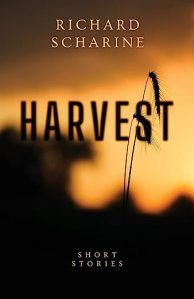
Recently, we interviewed Richard Scharine about his writing and his recently released book, Harvest, a solid, dense literary collection of short stories that leaves a mark. (Read the review here.)
Richard Scharine was born in the back room of a Wisconsin farmhouse, went to a one room grade school, and rode a school bus 52 miles to high school. He is currently a professor emeritus in the University of Utah theatre department, where his honors include University Professor, University Diversity Award, and College of Fine Arts Excellence Award. Dr. Scharine has published two scholarly books, five book chapters, and a score or more articles. A Fulbright Senior Lecturer at the University of Gdansk in Poland, he has directed a hundred plays and acted in seven foreign countries, including the title role in Oedipus at Colonus in Athens, Greece. The smartest thing he did was to marry Marilyn Hunt Scharine. Read more about Richard Scharine and his work at rscharine.com.
Facebook: facebook.com/richardscharine
Website: rscharine.com (author’s website)
Where do the inspirations for your stories come from?
Some are easier than others. “Harvest,” the title story of the second book, centers around a nine-year-old working his first grain harvest in 1947, as I did at that age. The last story in the book, “Vicki and the whispering children,” was based on a hallucination I had when I was in a hospital being treated for cancer (one of many hallucinations). If the stories aren’t based (ever so slightly) on family history, they usually reveal particular interests of mine, e.g. wartime PTSD, film making, and radio production in “The Peacemaker.”
Were there any stories that you initially wanted to include in Harvest, that you later had to cut?
Actually, it was the other way around. I was worried that Harvest was only half as long as The Past We Step Into until Atmosphere Press assured me that they preferred their books shorter. The first two stories of The Past We Step Into were standalone—if much exaggerated—tales of family history. Chapters three through twelve focused on fifty years in the lives of Rik and Lynne Temple. If I could re-write The Past those ten chapters would be the book, with anything we needed to know about Rik and Lynne from the first two stories added to those ten chapters.
What story in the collection was easiest to write? Which one was the hardest? Why?
“Change of Pace” begins with the theme, “For athletes and ingenues, middle age comes early.” There’s an implied early ending in that phrase. The two major characters, a baseball pitcher and an actress, have focused all their lives on a single action which they will have to give up at an age when the rest of us are just getting started. What if we have two lovers who don’t reach that age at the same time? It’s an unhappy ending that’s easy to anticipate. “Harvest” was the hardest to write for two reasons: (a) Even though I experienced the harvest, it was 75 years ago and there were technical elements I just didn’t remember. (b) There are characters in the story who have real life models whose relatives might be upset because I wrote them doing things that they didn’t do (or did do) in real life.
Harvest is your second foray into writing a short story collection. What did you learn from writing your first collection, The Past We Step Into, that you carried into the process of writing Harvest?
As I pointed out in question #2, the first two stories in The Past didn’t fit into the structure of the rest of the book. In addition, since I’d written eleven of the twelve stories—everything but “Danton on the Kaw”—before I knew what that structure was, I had to go back and rewrite stories where I’d repeated an incident from one story in another. The simplest solution to that was to have each story in Harvest stand alone. (In truth I had written “Change of Pace” and “The Peacemaker” before I knew there was going to be a second book.)
Did you always plan on writing two story collections, or did you decide after The Past We Step Into was finished that you needed to continue your work in a follow-up collection?
I did decide to write Harvest after Atmosphere Press accepted The Past We Step Into, although I had already written two stories that went into the second collection. However, I had tried to write the story “Harvest” back before I ever borrowed the title of The Past We Step Into from Amanda Gorman’s Inauguration poem. The only story that took longer to write was “Danton on the Kaw,” which was inspired by events that had happened fifty years earlier. “Harvest” would have been a great opening for The Past We Step Into, had I been able to write it earlier. I have a third book in mind which takes its title from the first story, “The Woman in the Third Floor Front,” which was inspired by Southwest Airlines abandoning me for ten days last Christmas. I have two other long stories for which not a word has been written. One was inspired by the last great stars of network radio in 1953: actors, writers, directors and producers Elliot and Kathy Lewis. I have less hopes for getting the copyrights for a story about Johnny Mercer, the lyricist and singer (“Moon River,” “Days of Wine and Roses,” etc.) Late in his life Johnny worked the night club circuit, even though a brain illness affected his memory. The title is another song by Mercer, “I Remember You.” I have some Utah-based shorter stories which could fit in.
Outside of your writing career, you are an actor, director, and professor of theater. Have you learned anything from the medium of the stage that proved helpful in writing Harvest?
Go through Harvest and you’ll notice that I write in scenes which I try to end with a punch line. The title story occurs over eight days, from the day before the harvest begins to a wedding dance and its consequences the night after the harvest ends. The country and western music played at the wedding dance tells you a great deal about what’s going on in the minds and relationships of the people there, even though the boy who observes it doesn’t always understand what’s going on. As was common in such dances, there is a play during the intermission which mocks both the people there and the idea of marriage itself. Considering that the characters are ordinary laborers, the story is dialogue heavy. The boy gets his information from both an insider—a cousin who can’t wait to tell us what he heard eavesdropping on his parents—and an outsider—a hired man who carries a bullet wound from a love affair, who has deserted from the army, and who changes his name from one job to the next. In my stories we never learn too much too soon. In “The Bulbeaters” a Mormon matriarch tells the same family tales each holiday to her eagerly listening offspring, but the reader never learns the facts until they can have the greatest emotional effect. (Incidentally, one of these stories is based upon my mother’s experiences in early 20th century Wisconsin.) “Submitted for your Consideration” is part Rod Serling and part Franz Kafka—scene after scene of a man being oppressed in what is clearly Utah but for reasons never explained until the last line of the story.
If you could say one thing to your readers before they pick up Harvest, what would it be?
One of the Harvest proofreaders became obsessed with “The Peacemaker” and couldn’t believe that it wasn’t true until she examined the historical references in scene after scene. What I’ve written are stories, but I’d like the reader to believe that they could happen. For example, two of the incidents in “The Peacemaker” are actually scenes written for a movie and a television show, and yet they had implications and effects for the “real” people in the story. My stories do not necessarily end happily, but they do end believably. In “Harvest” and in “Submitted for your Consideration” people who whom we have come to identify are banned from their community. In “Change of Pace” lovers are parted. In “The Peacemaker” a man has made an impossible effort to achieve a moral and artistic goal—and succeeded! Then drops dead. In two separate stories of “The Bulbeaters” women make every possible sacrifice and die—but not without making it possible for others to follow in their footsteps. “Vicki and the whispering children” is a fantasy derived from a medically based hallucination. And yet I would like the reader to believe that within the conditions of the story (which include a seventy-year suspended animation) such things could happen.
***
 BookView Review
Leave a comment