Welcome to BookView Interview, a conversation series where BookView talks to authors.
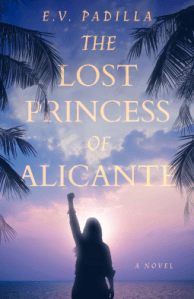
Recently, we interviewed E. V. Padilla about her writing and her recently released novel, The Lost Princess of Alicante, a poignant, entertaining, and thoroughly gripping historical tale that will linger in readers’ minds long after they turn the last page. (Read the review here.)
E.V. Padilla, born and raised in Kansas City, Missouri, after earning a bachelor’s degree in English, headed for New Mexico to teach at a US Government school for Native American students, primarily from the Navajo tribe. Two years later, she followed a calling to a position with the New Mexico Department of Human Services, specializing in Children’s Protective Services. Family concerns brought her back to Kansas City after twenty-nine years in New Mexico. While remembering with fondness the culture and cuisine of the American Southwest, she finds contentment back in her hometown, with family and five rescued cats competing for her attention.
Facebook: elizabethpadilla/facebook.com
Website: elizabethvpadillaauthor.com
At times, The Lost Princess of Alicante almost reads like a character study, because so many of the story’s main players have such thorough development and nuance. Can you tell us a bit about your process of character creation and development?
Having based characters on people I have gotten to know over the years, I keep them in mind when they are “on stage” in the story – their mannerisms, personalities, physical characteristics, and the sound of their voices.
What was your favorite part of the process of writing this novel?
Creating the most dramatic scenes was stimulating – hearing the dialogue in my mind, visualizing the characters and their behavior.
What’s one thing you learned through the process of writing The Lost Princess of Alicante, that surprised you to learn?
I was surprised to learn that when proofreading my copy, what I thought was the best way to portray people and events was not always right, that I had to rethink conversations, descriptions, and actions of my characters.
How much of The Lost Princess of Alicante’s setting and background is rooted in real history, and how much comes from your imagination?
Real history provided a platform for the story, which came from my imagination.
You have spent quite a bit of your live living in New Mexico, and of course that area of the country is important to the setting of The Lost Princess of Alicante. What drove you to set your book in the Southwest, as well as in the Caribbean?
Memories of New Mexico inspired me to use this area as the opening setting. Much of Hispanic and Indigenous culture permeates the culture. It seemed the logical location for the characters as Hispanic immigrants who would have felt more comfortable as strangers in this setting. Sending them off to the Caribbean provided a startling contrast to the arid climate of the Southwest, setting the stage for rapidly developing events and a dramatic change in direction for the protagonist’s life.
Who are your literary influences and inspirations? Any particular authors or books?
One of my all-time favorites in literature was Jane Eyre. In addition, I enjoyed reading Thomas Hardy’s novels. Of contemporary authors, I admire most the style of Cormac McCarthy, because of his clean, concise prose, his way of describing events which evokes emotions in the reader. I try to emulate this writing style. Rather than have a character go on and on describing his or her feelings, I prefer to describe events, places, conversations and allow the reader to react, rather than telling the reader how to react. Another favorite author is Marie Benedict, who tends to write in this fashion.
What’s next for you?
I’m hoping to finish a book based on stories I heard growing up about the experiences of my parents and grandparents in a rural setting early in the 20th Century. Although appropriate for a YA audience, adults might enjoy reading of these experiences. They may have heard stories from their elders about life in those times.
***
 BookView Review
Leave a comment