Welcome to BookView Interview, a conversation series where BookView talks to authors.
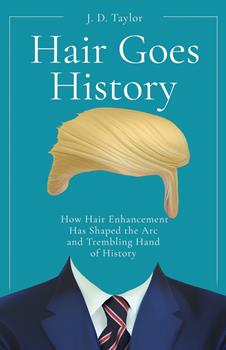
Recently, we interviewed J. D. Taylor about his writing and recently released book, Hair Goes History, Vastly comprehensive and delightful read. (Read the review here.)
J.D. Taylor is a former high school, adult education and college adjunct history instructor. He has published articles and letters in major newspapers, magazines and won a Fellowship from the National Endowment for the Humanities. J.D. received a B.A. from the University of Maryland, an M. Ed from the University of Virginia and an M.A. from Georgetown University. J.D. is a veteran of the 82d Airborne Division and a former court-appointed humane investigator. JD has published two other books. He lives in Alexandria, Virginia.
What inspired you to write Hair Goes History? Did an idle interest lead to serious writing pursuits, or something else?
Historical ratiocination of a ravaging blight: the White House soon to be occupied by a tyrant. I was further buffeted by Robert F. Kennedy’s robust quote: “Some men see things as they are and ask “why”? I dream of things that never were and ask, “why not”? And the great Vince Lombardi said, in effect, always seek perfection which will never be attained; but along the way, you will achieve excellence. Thus, analogous to Hair Goes History an excellent historical narrative.
The styles and fashions of hair is something that is often overlooked by clothing/fashion historians. Why do you think that is, and what do you think we can gain by studying hair through the ages?
Throughout the ages hair has shaped the arc and trembling hand of history. Hair styles reflect the changing dynamic of culture, persona and a specific epoch. Hair has been overlooked by choice or by historical ignorance. We glean historical insight by studying hair’s impact on humankind.
Were there any anecdotes or examples you wanted to include Hair Goes History that you later cut? How did you decide what historical figures and hairstyles to include and discuss?
The one cut I regret is the out-of-touch political Edsel and American history disavower, the dishonorable Gov. Ron DeSantis whose dictionary says “We didn’t invent it {Slavery} or it wasn’t that bad, or it was a free job training program.” (The Washington Post, July 20, 2023, A23.) DeSantis wears an ill-fitting brown right-parted hairpiece. I decided to include as many historical figures impacted by hair enhancement as possible. I appreciate ‘50s and ‘60s hair styles and dislike current male and female hair buns.
Was it important to write this history of hair for a general audience rather than for an audience that is more specialized or academic, even considering your background as a professor?
Hair Goes History is for both: general audience and academic historians who have not linked hair to history. As a teacher of history, this phenomenon never caught my attention—until I became a writer and Trump observer.
Do you have any predictions for what power hair may hold in the future, and what that might look like?
Because of Trump’s malignant vanity, I predict that if media and historians reveal “The Donald’s” $60,000 hair system, he will vanish and hide like a cat in his proverbial woodshed. Chapter Four of my book has all the details and evidence about his hair system. Otherwise, says Brynn Tannehill of The New Republic: “If Trump returns to the White House he plans to become an elected king with unlimited powers.” Thus, Hair Goes History is the book that saved American democracy.
What’s next for you?
A true story entitled: The Narrative of an Intrepid One-Man Wolf Pack. Then to re-publish Beauregard Canine Warrior.
***
 BookView Review
Leave a comment