Welcome to BookView Interview, a conversation series where BookView talks to authors.
Recently, we interviewed Rebecca Jane about her writing and her recently published book, She Bleeds Sestinas, a verbally and visually stirring poetry book that draws from art and spirituality. (Read the review here.)
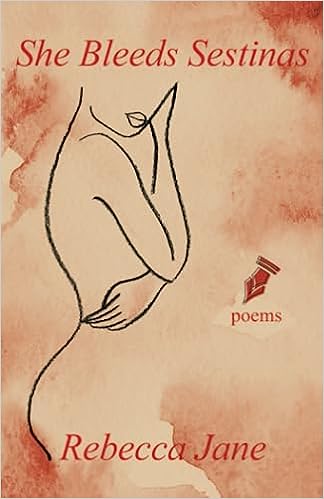
Rebecca Jane’s work has appeared in The Journal for Expressive Writing, TARKA, A Year in Ink, Vol. 14, The Guilded Pen Ninth Edition, Spirit Voyage, Feathered Quill, US Review of Books, and Earshot Jazz. This is her first book of poetry.
Facebook: https://www.facebook.com/profile.php?id=723672213
Website: rjanepoetry.com & rebecca-jane-writer.com
She Bleeds Sestinas is described as a poetry collection that explores “the intersection of spirituality and art.” What did that exploration look like in its early stages, and how did you come to write a full collection?
This collection started with combining two daily practices: one somatic (yoga) and one contemplative (writing sestinas). The collection grew over time and went through many incarnations. Summer of 2021, every morning, I would complete my personal yoga routine that includes chanting the Durga Dwatrinshanamala then practicing a series of yoga asanas then a breath and visualization meditation; these are practices that I have learned over a lifetime and from a variety of traditions. My whole morning routine takes about one hour. Then I sit quietly and just let the first six words that pop in my head become the sestina’s teleutons (or end words). I would write a sestina from those words. And this was a beautiful way to practice contemplative writing, a way of self-inquiry. After a few months, I had gathered lots of poems; only some I felt confident to share and workshop with fellow poets and other readers. So, it all started as a daily practice, a discipline that was keeping my mind from dwelling on sadness.
Although you have published poems in the past, She Bleeds Sestinas is your first poetry collection. When did you know you wanted to put together a collection to share with the world? Was there anything about the process that surprised you?
I was surprised by the way the poems started to fit together, as if they were telling a story but in a circular way. Writing sestinas challenged my mind in ways that felt compatible with the challenges to my body that come with yoga and meditation practice. The collaboration invited body and mind into co-contemplations. As my body gained strength and flexibility, so did my mind and my creative energy. Also, the sestina is a strict, austere form, and yogis love austerities. The poetic line must end on a particular word. Doing that daily, I got to a point where it felt the form was playing with me or was teaching me. That is when it started to feel like the poems were revealing messages, messages that felt like oracles in and of themselves. At some point, it also felt like I was not writing the poems. The poems had their own consciousness, their own joyful way of expression that felt like a dance with my body. This realization gave me a new and deeper appreciation for the consciousness permeating all forms.
Who (or what) are your poetic inspirations?
My poetic inspirations are many and varied, and I love to be inclusive and all-embracing. I am inspired by The Upanishads, Kavitha Chinnayan’s Shakti Rising, Edwin Bryant’s translation of The Yoga Sutras of Patanjali, The Vijnana-Bhaiarava–Tantra, Emily Dickinson, Hafiz, the Chinese Tang dynasty, Pu Songling, the Ming dynasty’s “historian of the strange,” as he’s called. I am inspired by the Druid teacher, Kristopher Hughes and his books From the Cauldron Born and Cerridwen. I am inspired by poets Tania Pryputniewicz, Yusef Komunyakaa, Langston Hughes, W.S. Merwin, C.D. Wright, Allen Ginsberg, Walt Whitman and too many others to list here. I adore mystics, especially mystics who are poets. I have learned a lot from shamans, plant medicine, and jazz music. So, the list is long, unending really. It includes The Tarot of the Orishas, and any book by Dr. Nida Chenagtsan. Plus, my own daily practice and studying languages: Chinese, Sanskrit, and Gurmukhi. I’d love to learn Tibetan.
Were there any poems you wanted to include in the collection but later decided to cut?
There are many poems I have written that I would not share out of respect for readers’ time, attention, caregiving loads, and minds. A lot of what I write is contemplative and private to me, and there is much usefulness in those writing exercises to me alone: writing poetry, to me, is a lot of self inquiry and self discovery. Most of my writing journey is solitary, and I am grateful for that. I feel like I thrive in my solitary space. I had a teacher once who used to say, “that which is sacred is always kept secret.” That makes sense to me. Published writing and audience approval are honorable and essential, and I aspire to connect with and find readers who enjoy what I write. At the same time, I wish to pause here for a moment, to make a plug for, and to acknowledge how important it is to write privately and keep some writing private. Also, for me it is perfectly beautiful to dream I am writing but write nothing at all. As paradoxical as it may seem, I like to extend a silent round of applause and high praise to all the private poetry of the world. Then if-and-when a poem does meet a reader, in that intimate space inside the mind, well, I bow in reverence and gratitude to that meeting.
I can absolutely see this collection being used as a guide for or in tandem with meditative practices. Was that your intention, or a pleasant byproduct of your writing style?
My intention was to pay homage to meditation practices from various wisdom traditions. The poems contemplate transmigration of the yogi’s subtle body. The poems travel through and attempt to hold space for teachings from the Bardo, in-between spaces, off-beat characters, transitions between life-death-rebirth, achieving the rainbow body, processes that involve advanced meditation on the subtle energy of the body and processes that feel cyclical. I felt the sestina form is a kind of mirror for a lot of esoteric ideas I have studied over the years.
If you could tell readers just one thing before they pick up She Bleeds Sestinas, what would it be?
Before you pick up She Bleeds Sestinas, please light a candle for your ancestors and thank yourself and them from me. Anyone who reads this collection, I adore you and your generations past and yet to come! May peace and joy be with all of you, always!
What’s next for you as an artist?
These days I am playing with different forms, new contemplations, and practices that are new to me. What I am working on now could perhaps have the working title He Tackles Tankas. We will see if it becomes a collection. Imagine a series that use all the pronouns in the titles. Oh, I hope I have not shared too much too soon. Thank you for your questions. I appreciate your time and attention!
***
 BookView Review
Leave a comment