Welcome to BookView Interview, a conversation series where BookView talks to authors..
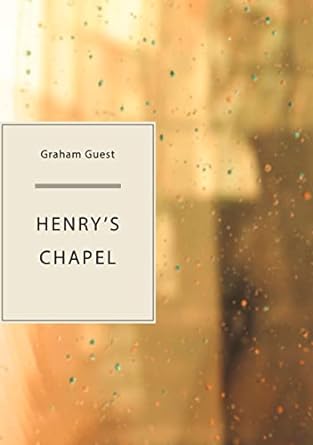
Recently, we interviewed Graham Guest about his writing and his recently released, Henry’s Chapel, a tale of literary fiction that delves deep into the mind-bending territory of societal taboos, including incestuous relationships, abuse, and mental illness. (Read the review here.)
Graham Guest is the author of Winter Park (novel). He also plays guitar, sings, and writes lyrics & music for the band, Moses Guest. He has a BA in Philosophy from Wesleyan University (CT), an MA in Philosophy from Boston College, a JD in Law from University of Houston Law Center, an MFA in Writing from California College of the Arts, and a PhD in English Literature (writing, literature, theory) from University of Glasgow, Scotland, UK. He lives with his family in the San Francisco Bay Area and teaches in the English Department at Dominican University of California. Henry’s Chapel published by Sagging Meniscus Press in February 2022.
Facebook: www.facebook.com/graham.e.guest/ and www.facebook.com/GrahamGuestSolo/ and www.facebook.com/mosesguest/
Website: www.graham-guest.com and www.mosesguest.com
Henry’s Chapel is an interesting take on metafiction, where the novel format explores a film format through its characters. Was it confusing to write this piece of metafiction? Did you have to employ any organization strategies to keep all the details straight?
Once I figured out how the novel would work and got going on it in earnest, I did have the concern with Henry’s Chapel that I was writing in a genre – metafiction – that had been played out. Indeed, once I got going on it, I realized that the novel’s structure was an awful lot like Mystery Science Theater, where the TV audience watches these weird creatures sit in the audience of a film, which they comment on, laugh at, etc. But this parallel did not deter me; it just became yet another intertext that the book explores.
Setting the narrator up as someone watching a film and commenting on it helped me control the metafictional melee. The narrator can watch the film and relay its contents to his audience (the readers) as if they are all simply watching the film, or the narrator can go off on whatever ideas he wants. The narrator serves as the fulcrum that supports the film and whatever comes into his head. The book, then, is about a film, which is a fictional story about a dysfunctional East Texas family, and it is about whatever comes to the narrator’s mind, which often seems to be non-fiction. This makes the book a hybrid of film and fiction, and of fiction and non-fiction.
As I wrote the book, a question for me became: who is the narrator? At one point, I thought about making him or her a fictional character as well, but ultimately, I decided that the narrator was essentially me. So, all the stuff the narrator says comes from my head and my life. A really big formal idea I had for the book was to try to include everybody in it: fictional characters (he, her, they), a non-fictional narrator (I, me), and a reader-audience, who watches the film with me (we) and to whom I can turn and ask questions (you).
What were your inspirations for this story? Do you have any experience in filmmaking, or were you inspired to write such a story by something else?
My overall inspirations for the story came from fiction, film, philosophy, and music, and a desire to see them all in action in one place. Specifically, I was inspired by Faulkner’s As I Lay Dying and David Foster Wallace’s Infinite Jest and Oblivion; all of David Lynch’s films, Slingblade, plus a bunch of other films; both continental philosophy and some analytic philosophy; and all sorts of music. In Henry’s Chapel, I make a big deal out of soundtrack moments versus non-soundtrack moments in order to highlight how music in film puts the director’s thumb on the scale of interpretation and how music-less or “silent” backgrounds can impregnate a scene with existential angst (see Jim Jarmusch’s film Stranger Than Paradise).
I do not have any real experience with filmmaking, but Henry’s Chapel was originally a sparsely written reportage piece (a la Robbe-Grillet’s Jealousy) called Grass (2007), which I tried to turn into a film script (2009). After that, the manuscript lay dormant until I started reading David Foster Wallace (in around 2013). I had read a lot of Faulkner in my life before that, but once I read Wallace, I felt like I had found my voice as a kind of Faulknerian-Wallaceian blend, and Henry’s Chapel turned out to be the perfect venue for that blend: the film of the novel, Lawnmower of a Jealous God, is Faulknerian; the narrator is Wallaceian.
How long did it take you to write Henry’s Chapel? Were there any roadblocks you had to get around?
It took me twelve years, on and off, to write Henry’s Chapel. I started it in 2007 and finished it in 2019. It was finally published by Sagging Meniscus Press (Montclair, NJ) in 2022. The reason it took so long was that the issues of voice and formal structure didn’t resolve for me until 2015-2016, after I’d read all of Wallace’s stuff and had re-read As I Lay Dying. Once I realized that a Wallaceian narrator could be added to the Faulkerian film, then the code was cracked. From there, I wrote steadily on it until its completion in 2019.
Is there a character in the book you cherish most, or at least one that you hold particularly close to your heart?
The Emily character in Henry’s Chapel – Henry’s long lost twin sister – is very, very close to me. My wife, Jen, and I lost a child (before birth) in 2006, whose name was going to be Emily. I put Emily in the book as (possibly) a ghost accordingly. I feel like the Emily character drives the book more than the Henry character does a lot of the time. She lives somewhere between life and death and wields an immense power, especially over and within Henry. I feel a lot of profound love for Emily.
What’s one thing you know now as a writer that you wish you had known when you were writing your first novel, Winter Park?
There are two big things I know now as a writer that I didn’t know when I wrote Winter Park (though by the way, I also wrote Tailgater (2014), a collection of weird stories that connect to Winter Park in a Faulknerian/Yoknapatawpha kind of way, between Winter Park and Henry’s Chapel). First, I now have the advantage of having found my Faulknerian/Wallaceian voice. When I wrote Winter Park, I was not so lucky. Not that the voice in Winter Park is a mess or anything; it’s just not distinctly my own yet. Second, I now have a lot more patience when I write. I don’t push things as much. I made what I think is a mistake in Winter Park. It’s probably pretty hard to discern from the reader perspective, but it’s there, and I wouldn’t have made it had I had more patience.
Aside from being an accomplished writer, you are a musician in the band Moses Guest. Is there anything you’ve learned from writing music that you carry with you into writing prose, and vice versa?
I have carried music into Henry’s Chapel via the soundtrack ideas in the film of the book, Lawnmower of Jealous God, and I hope that I bring a certain musicality and rhythm to my fiction writing, both formally and at the sentential level. I can’t say that I’ve carried a lot of prose writing ideas into my music, but I can say that I have tried to bring philosophical thought into my music. For example, Moses Guest has a song called “Bird in My Hand,” which is a direct “musicalization” of an artery of Quine’s philosophy about language, creativity, and identity.
What are your favorite books/who are your favorite authors?
In fiction, my favorites are As I Lay Dying, Faulkner; Infinite Jest and Oblivion, Wallace; Wuthering Heights, Emily Bronte; Post Office, Bukowski; Notes From Underground, Dostoevsky; Child of God, McCarthy; Jealousy, Robbe-Grillet; all Marie Redonnet books; The Driver’s Seat, Spark; American Genius, Tillman. In philosophy, my favorites are Perception and Origins of Objectivity, Tyler Burge; Heidegger, Being and Time; Nietzsche, Beyond Good and Evil; Norberg-Schulz, The Concept of Dwelling and Genius Loci; Word and Object, Quine; Zen Mind, Beginner’s Mind, Suzuki. And in psychology, Snakes in Suits, Hare and Babiak.
What’s next for you in your writing career?
I have just finished writing my PhD dissertation in philosophy for the University of Dundee (Scotland), which is entitled Primitive Perceptual Concepts. I hope to publish it as a book in the next year or so. I have also been thinking about writing a long poem called Truck: American Hubris.
Can you provide links to any of these:
Facebook: www.facebook.com/graham.e.guest/ and www.facebook.com/GrahamGuestSolo/ and www.facebook.com/mosesguest/
Website: www.graham-guest.com and www.mosesguest.com
 BookView Review
Leave a comment