Welcome to BookView Interview, a conversation series where BookView talks to authors.
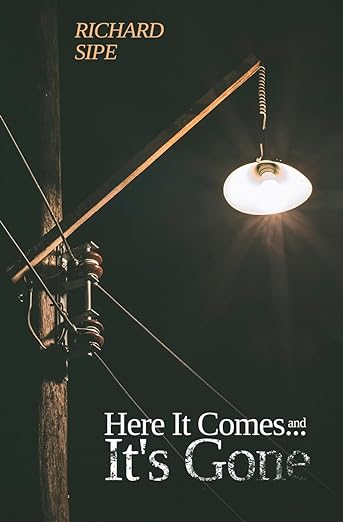
Recently, we talked to Richard Sipe about his writing and his recently published book, Here It Comes…and It’s Gone, a gorgeous collection of poems that offers a unique and captivating perspective on life, daring readers to embrace the intangible elements of life. (Read the review here).
Richard Sipe lives with his wife on Orr’s Island in Maine. He is the author of the poetry collection Lovely Dregs. His work has appeared in numerous journals over the years. He is a poetry and audio editor for The Café Review, an art and poetry quarterly published out of Portland, Maine. On Wednesdays, he is the head chef at the soup kitchen in Brunswick, Maine.
Tell us about the process of putting together this poetry collection. Did you start with a concept and then write the poems to fill that concept, or did the overarching themes become clear only after you wrote the poems?
I think that I have always been drawn into the ephemeral nature of life and things. The book’s title poem—which also leads off the book—is over twelve years old. And the rest of the poems that comprise the arc of this collection range from then to the present time. So, I guess that the “theme” has always been with me, and it just became time to put a shape to it.
Are there any poems you had to cut from the collection? If so, why did you decide to cut them?
There was a poem I wrote at the very end—after the book was in the first stages of the publishing process. I saw the poem as a sort of denouement to the whole thing, so I sent it in as an add-on. But it really was unneeded, which I came to understand after a good discussion with the editor. Sometimes, you just need to know when to get off the stage!
Reading Here It Comes…and It’s Gone brings up a lot of conflicting emotions about the passage of time, our impermanence, and perhaps even coping with the inevitable. As the poet, was it difficult for you to contend with these emotions as you were writing? Did it bring a sense of catharsis to put these feelings to paper?
As I mentioned before, these emotions and conflicts have always been with me, so, in many ways, I see the book as a reckoning of sorts. And there was a sense of catharsis—not so much as I wrote the individual poems, or even as I put them together—but in the end as I’ve gone over the book as a whole, multiple times, in the editing and proofing process. I mentioned an “arc” earlier: I’m satisfied with the arc of this book.
As the author of a poetry collection before the release of Here It Comes…and It’s Gone, as well as an editor for a literary journal, poetry is a mainstay of your life. How did you discover and develop your passion for poetry?
Although I can’t say the specific time that the “light went on”, I’ve been interested in poetry, and writing poetry, since grade school days as well as through high school and college days. But the first thing you need, once you understand that you’re a “poet”, is a job doing something else! I spent my career in the defense industry, and would write from time to time, even make it into a journal here and there along the way. Ever since I retired a few years ago, I’ve been able to devote more time to this passion of mine. Like any discipline, its development improves with practice.
How have you developed your poetic “voice” throughout years of writing poetry?
We come back to the “practice”. One of the things that I like to do is to look back on earlier work of mine. I do this for many reasons. Sometimes, I’ll find an idea or theme that I may not have fully developed at the time, and I’ll take up that theme again. And what I also see when looking back is the progress that I’ve made in the structural process of poetry. Things like the line and line breaks, and the interplaying of sounds throughout the poem. Practice, working with other writers, and attending workshops over the years have all helped me in the evolution of my “voice”.
What’s next for you as a writer?
In the immediate future, I plan on working to get this new book “out there” as much as I can. Down the road, as far as the next project goes, I seem to have a body of what I’ll call “dystopian” stuff in my archives. It’s possible that these poems may want to hang out together in a chapbook, or some future collection of weirdness. We shall see.
***
 BookView Review
Leave a comment