Welcome to BookView Interview, a conversation series where BookView talks to authors.
Recently, we talked to Roger Maxson about his writing and recently released book, Pigs in Paradise: A fairy story most absurd (Read the review here).
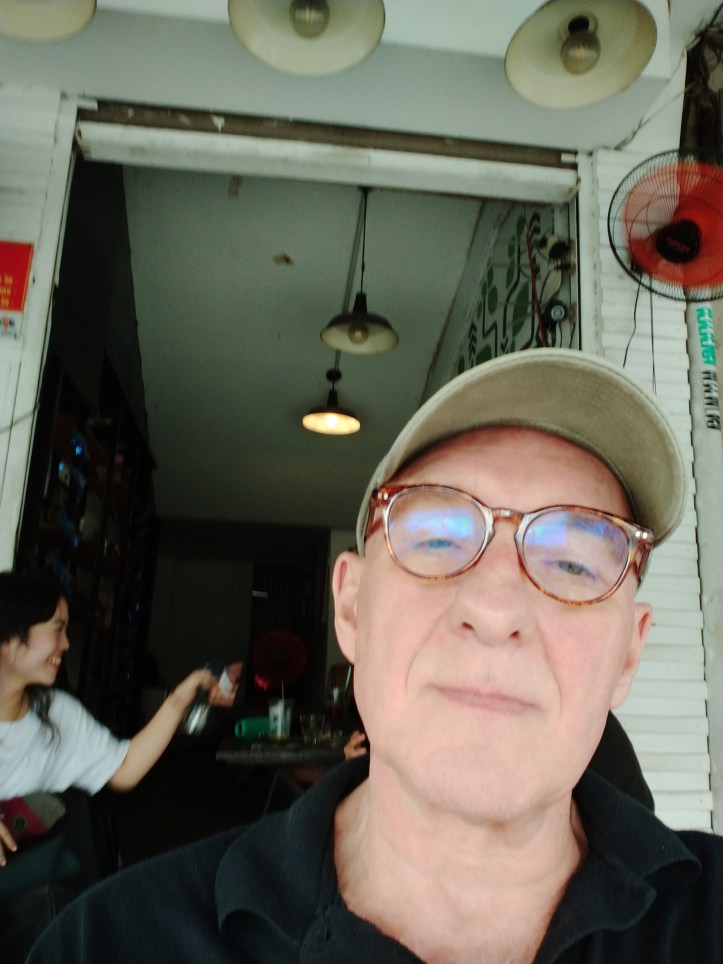
Roger Maxson earned a bachelor’s degree in English from Indiana State University in 1987. Although he has continued to write over the years, which includes a feature-length screenplay, Pigs in Paradise is his first novel. He lives in Thailand with his wife Mong.
First of all, thank you for inviting me. I’ve just returned from spending two weeks in Albania, so I realize I’m a little late with this interview/questionnaire.
If asked, what would your friends and family say about you?
I’m the black sheep and proud of it. I did not follow the conformist safe easy and fearful approach to life.
Would you rather read a book or watch television?
Read a book unless it’s a documentary. My earliest learning experience was visual not verbal.
If you could only change one thing about yourself, what would it be?
My ADD or ADHD. Or how I can’t make up my mind.
Are you a feeler or a thinker?
On one level, I’m hyper-sensitive. On a more mature level, I’m a thinker.
What is your greatest failure?
I am a procrastinator and perfectionist, which have led me to be all my life a late-bloomer.
What did you learn from that failure?
I cannot allow feelings of inferiorly or mediocre education and intellect impede my progress and growth.
Tell us some more about your book.
I consider Pigs in Paradise, a fairy story most absurd as my magnum opus, my one great work. After writing his masterpiece Catch 22, Joseph Heller continued to write other novels, but never another Catch 22. Or like Harper Lee with To Kill a Mockingbird, Pigs in Paradise may become my Catch 22. As for inspiration, Pigs is my Animal Farm, politics of the 21st century.
What inspired the premise of your book?
Ideas for controversial political cartoons. Since I am not a cartoonist, I wrote a book instead where the cartoons appear as works of art in chapter 21, “Pigs in Paradise.” My cartoons were in direct response to the Muslims who attacked the Dutch cartoonists for portraying Mohammed in the Netherlands, and assassination of Leo Van Gogh.
How many rewrites did you do for this book?
I tried to write a clean, polished first draft. I did not to become overwhelmed by the enormity of it all, having ADD, procrastinating, and being a perfectionist. This was not a good approach. I do not recommend it for anyone. In writing such a long and ambiguous first novel, at any time during the process, it was always easier to stop.
Tell us a little about how this story first came to be. Did it start with an image, a voice, a concept, a dilemma or something else?
During the first decade of the 21st century, three major events occurred that sent me and I finally had had enough. After years of thinking what I could do about exposing the harm, the evangelical religious movement was having in America, three events that gave me focused and the creative project I was in search of found me. I do not recall what event happened first, but I think the attack on the Dutch cartoonist and the assignation of Leo Van Gogh was the breaking point. Before that there was the hypocrisy of Ted Haggart (sic) minister of the megachurch in Colorado Springs, “Life Church,” when the preacher of “marriage is between a man and a woman, and subject of the documentary “Church Camp,” was outted for his homosexual dalliances with a male prostitute in Denver. The other event was the domestic terrorist attack and murder of Doctor George Tiller, the women’s healthcare provider in Wichita, Kansas, when he was ambushed in his own church on the Sunday that he was an usher. That murder of a medical doctor who performed abortions in a hostel environment – an intolerable place in America, coupled with the two other events the creative project I was in search of, found me.
How do you come up with names for your characters?
Considerable thought is given to many of the characters. Blaise the Jersey Cow and unsung heroin of the novel is named after Blaise Pascal, the 19th century philosopher; Mel, the mule, because I liked the sound of it and later Mel the Mule becomes Pope Magnificent. Julius is the real name of the comedian Groucho Marx, and I tried my best to channel him for the charter of the wisecracking voice of reason and non-belief, Julius the Jew parrot, as Mel, the catholic Mel calls him. In Book Two, it was important to name the one other “small” voice of reason Leonard Small, my spokesperson in book two, having taken the place of Julius after Book One.
Which character was most challenging to create? Why?
Julius was difficult because of who he was and his personality as the main character/protagonist in Book One, but because he also had to die, I could not have him in every scene of chapter; and instead, interspersed him throughout the first part of the book. As the lone voice of reason, in a dogmatic world, as such he had to die because it is my firm belief that the only tool the ridiculous religious have is violence and all arguments or reasoning will lead to acts of violence as recourse. Therefore, the same is true in Book Two with another singular voice of reason and another difficult character of Leonard Small, for he, too, has to die in an act of violent recourse.
Which scene or chapter in the book is your favorite? Why?
Okay, I have several favorite scenes and chapters. Also, the process of writing certain scenes and chapters were also a pleasure, each of which was a milestone.
Which scene was most difficult to write? Why?
Chapter 22, “The Ambush” had to be a vicious and violent attack on Julius that Mel and others witness with either glee or indifference. Mel relishes the violent spectacle just do as the Muslim attackers.
Which scene, character or plotline changed the most from first draft to published book?
Chapter 18 became a new chapter and was chapter 23; chapter 18, I think was new and rose out of the writing process, appearing. Chapter 25 was a milestone and extra scenes were added to that as it was being written. I added the two Jewish friends Levy and his friend Ed to the “question and answer” scene with Pope Benevolent and am glad I did. Chapter 20, the suicide bombers chapter “An Interlude” remains a favorite for the flashbacks in the chapter and tone.
What’s next for you?
July 21, my wife Boonprakong (Mong) and I will celebrate our fourth wedding anniversary. I finished the book June 9, 2020, approximately exactly! Nine years after I started writing the content of the novel in June 2011, after crossing into Thailand from Cambodia by land after the airport had closed the day before March 18, 2020 due to fears of spreading the Corona Virus, Covid-19. I would like to write a memoir of that time and our story of meeting online at Thai Cupid after I was offered a teaching job in Thailand and left Ho Chi Minh City one month later. Mong and I were married five months after meeting online while I was still in Vietnam and married only 4 months after coming to live with her in Thailand. The title of the memoir is “When Corona Come,” a love story. Thank you for this opportunity to share my story, Roger Maxson
***
 BookView Review
Leave a comment