Welcome to BookView Interview, a conversation series where BookView talks to authors.
Recently, we talked to Praneet Menon about his writing and recently released fantasy, The Staff of Beckoning (A Symphony of Spheres Book 1), an addictively readable fantasy that combines classic archetypes with nuanced characterization and moral ambiguity. (Read the review here).
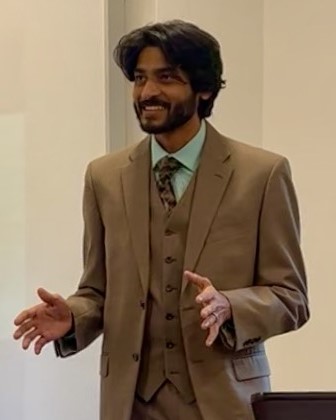
Praneet Menon has been interested in writing from an early age, influenced by his life. Having spent almost sixteen years growing up in India and the rest of his life in five different U.S. states, he’s had the opportunity to experience firsthand the sheer variety of culture, language, and spirituality that make up this world.
Praneet’s formal education in aeronautical and mechanical engineering, along with his work as a flight instructor, brings meticulous attention to detail to his writings. The precision needed in engineering and the situational awareness required of pilots aid his efforts of blending technical realism with unconstrained imagination. As a lifelong student of philosophy and psychology, his narratives explore the age-old themes of identity, purpose, and destiny that are still relevant in today’s world.
What was an early experience where you learned that language had power?
I grew up in Mumbai, India, speaking English, Hindi, and Malayalam—my family’s native language from Kerala. I remember visiting my grandfather in Kerala for the first time when I was 3 or 4. According to my father, my grandfather had assumed that my upbringing in Mumbai, where Hindi is most often spoken—followed by Marathi and English—had given me a tentative grasp of Malayalam and was a little worried about communicating and bonding with me. This was a time before we had phones, so I hadn’t spoken to my grandfather before this visit. However, when I spoke to him in our native tongue, he was so proud of me that he took me around the village, showing me off. Conversing with the other villagers in Malayalam instantly formed a bond, a kinship, a familiarity that could only be felt through its movements, sounds, words, and idioms.
That is when I learned of the power of language to unite.
Can you tell us a little more about your book? Something you wouldn’t read in the blurb …
My goal with this book and the series at large is to paint human stories with an epic fantasy brush as a means to explore philosophy and psychology. Though the book mainly follows Adir Nathar, it is told from many perspectives to convey the message that it takes several worldviews to get to the truth of a matter. And even then, not all of it may be revealed.
The narrative explores how the characters are shaped by culturally instilled beliefs, stories about those viewed as outsiders, and their own lived experiences. All of this occurs in the fantastical world of Leakarha, where its inhabitants have varying levels of understanding of its true nature, much like our own.
In this book, you will experience the cultures and beliefs of Leakarha through the eyes of a troubled father and his angry son, a ruler working to ensure her legacy, an heiress obsessed with knowledge, a woman in love, a man with a hidden past, and a noblewoman caught between two worlds. I hope you enjoy them all.
Where do your ideas for this story come from?
The ideas come from myriad places. Sometimes, I personify abstract concepts and try to imagine what kind of a backstory would lead to a character arc. At other times, it’s a lived experience—something I’ve seen, heard, or lived through—that takes a life of its own and works its way into a scene. Perhaps a piece of music or an unexpected fragrance can stir words that bring a scene to life, evoking emotions that shape the narrative in unexpected ways.
What’s more important: characters or plot?
Definitely characters, for that’s where the real stories are. The plot, for me, is a vehicle for character development. But a good plot can certainly add something extra to well-written characters.
What was the best money you ever spent as a writer?
Scrivener! Hands-down! In my humble opinion, it’s the best writing software out there.
Trying to write something as large as this series, A Symphony of Spheres, I have a massive amount of notes on character arcs, lore, religion, locations, plot points, and outlines. I also usually end up with multiple drafts of every scene. Scrivener, whose interface resembles “coding software” (a remnant from my past life), has been fantastic at being able to manage all of that and keeping my project well-organized.
I have no affiliation with this product or company. I’m just a very satisfied user.
Were any of the characters in the book inspired by people from your real life?
Yes, quite a few of the characters are loosely based on people I’ve met throughout my life, though all are really amalgams of several personalities/concepts, making them unique in their own right. Rein Maranda (Adir’s best friend) and Arvan Nathar (Adir’s father) were inspired by one of my college friends and his father, respectively. Ekren Arinol (the Regent of Ostarium) is loosely based on a teacher I had in 8th grade.
What are you working on now?
I am stuck in a loop right now of writing my drafts and rearranging the outline for the second book in the series. I’ve been here before, so hopefully, I can remember what happened last time that pulled me out of this cycle. It’s starting to get dizzy!
***
 BookView Review
Leave a comment