
From the Blurb:
Whoever heard of a talking cow? Meet Cinnamon, who in Cinnamon: a dairy cow’s (and her farmer’s) path to freedom, tells us about the joys and sorrows of her life. She has difficulty warming up to the farmer who “owns” her. Cinnamon reflects that “everybody knows that humans eat cows,” but overcomes her trust issues to pursue a friendship with Jody the farmer. Cinnamon trusts that it will somehow help her to become friends with the farmer and she is right. Cinnamon gets to know the farmer by spying on her through the kitchen window.
Cinnamon’s special cow friend Spice has a health emergency, which jolts the farmer into awareness. She is nursing Spice back to health only so that she can be sent to slaughter, with the other dairy cows, in a few years. As Spice recovers, she and Cinnamon have lively conversations in the field: What is money – and what does it have to do with them?
Cinnamon, the cow, and Jodi, the farmer, become friends and by loving Cinnamon, Jodi (nicknamed Sunflower by Cinnamon) discovers she can no longer eat animal products. Meanwhile, she finds that by eliminating animal products from her diet, she is able to heal her own health issues. As her previous unhappiness disappears, Jodi concocts a plan to turn her small farm into an animal sanctuary where Cinnamon, her special cow friend Spice, and the others can live out their natural lives in peace and harmony.
Cinnamon: a dairy cow’s (and her farmer’s) path to freedom is Janet Mason’s third novel from Adelaide Books. Her novels THEY, a biblical tale of secret genders and The Unicorn, The Mystery were published by Adelaide Books in 2018 and 2020 respectively. Her book Tea Leaves, a memoir of mothers and daughters (Bella Books; 2012) was chosen by the American Library Association for its 2013 Over the Rainbow List. Her novel Loving Artemis, an endearing tale of revolution, love, and marriage was published by Thorned Heart Press in 2022. She is a lay minister for the Unitarian Universalists of Mt. Airy in Philadelphia and her talk which includes an excerpt from Cinnamon and was given on International Pig Day can be found at Pig Day Revisited — #GoVeganForLent or just #GoVegan #amreading Janet Mason, author (wordpress.com)
Buy now
Book review
Chapter One
Wow! Look at her go! She should have a racing stripe down that fork. Not to mention how she shovels it in. I’ve seen farmers bale less hay before it was done by machines. I could stand here until the chair under her collapsed if I had the time. And they call cows fat!
I swatted a fly with my tail nonchalantly as I looked through the window at the farmer. I had snuck out of the pasture and was spying on our captor. I kept peering into the window until I saw another person standing in front of the stove. The back of the shirt was a mixture of sky blue and deep violet. It was the color of a periwinkle flower I had eaten.
Still sitting at the table, the farmer turned toward me. I ducked my head and followed the light fragrant scent of a white daisy.
Chomp. Chomp. Chomp.
Without thinking about it, I went from smelling the daisy to eating it. The bristly yellow center tasted slightly bitter. The pure white petals tasted so sweet it was like eating goodness.
Mmmm.
I was so hungry even the center tasted good as I finished it off.
It didn’t look like there were any other flowers left to eat. There had been a few others, but I ate them earlier. I got bored waiting with my head down, so I nosed around and found three more daisies I hadn’t seen before! I ate them immediately. People think that we’re chewing our cuds. But maybe we’re munching on secret things the humans don’t know we’re eating, like carefully tended flowers.
I probably ate too much in those days. I’d been trying to cut back and eat less of the feed they gave us in the barn and eat less grass. But I always eat more when I let myself become ravenous. This time, I joked to myself that I was so hungry that I could eat a human. Then I felt nauseous. I don’t know if it was hunger or the thought of eating a human that made me feel queasy. The feeling passed, and I ate the flowers.
I figured if I slimmed down, I wouldn’t have to be milked so often. Maybe the farm hands would overlook me when it came time for inseminating us so that we could give them more calves to make milk. I’m sick of the farmhand’s entire arm going up my you know what. That’s only a little better than when they used to bring the male cows in to hump us. Apparently, that didn’t work, so the farmhands got involved.
Chapter Two
The next day, I heard a young cow emit a long whimper.
She had given birth just the other day – and had been sighing ever since.
I was facing the opposite direction in my slot in the barn, but had my ears turned back so that I could hear everything.
The cow in the last place next to her stall told the new mother that if she didn’t get up, the farmhands would assume she was sick and send her away.
“And then what?” asked the young mother. Her voice was distant. It sounded as though she was still lying in the stall that was at the end of the long area where we stood side by side in a line when we were hooked up to the milking machines.
I had seen her just minutes before, when I had been herded to my milking space, which was much narrower than the birthing stall. I imagined her big brown eyes looking up inquisitively as she spoke.
“Will they send me somewhere special and help me get better?” she asked plaintively.
“They’ll send you someplace special for sure – the slaughterhouse,” the standing cow replied, with the deeper voice of the two.
I remembered her as black and white but mostly black around the shoulders and face, with black spots dotting her white mid-section.
“My advice is to toughen up. They’re going to keep you pregnant for as long as they can so that you provide them with milk.”
“How long will that last?” The new mother with the higher voice sounded young. This must be her first time giving birth. I felt sorry for the poor thing. I was still standing in my slot on the other side of the aisle and had already been hooked up to the machine to be milked, so I couldn’t turn around.
The standing cow with the deeper voice sounded like she had been around for a while. I strained to hear what she had to say.
“After we give birth, we can produce milk for close to a year. So, it’s a long time,” said the standing cow.
“I guess that’s the amount of time I should have been with my baby,” sniffed the younger cow. “I was barely able to lick off the placenta before they whisked him or her away.”
“Oh. It must have been a boy,” said the cow with the deeper voice.
“Whatever do you mean?” The younger cow’s voice was suddenly higher.
“I didn’t mean anything,” said the cow with the deeper voice. “I was just speculating.”
I surmised that the older more experienced cow, as jaded as she seemed, didn’t want to tell the young cow that if her calf was male, he would be sent away immediately.
“We’re pregnant for nine months,” said the cow with the deeper voice. “That’s almost a year and it’s a long time to be carrying our young. Of course, we develop feelings for our calves when they’re still inside of us.”
The other cow whimpered.
“That’s why I feel so badly,” she said sadly. “Of course, you feel bad,” replied the older cow. “We all feel bad. It doesn’t help to wallow in your pity. Stand up and be counted. Instead of feeling sorry for yourself, do something to change your circumstances,” said the older cow with an edge of irritation.
Her tone wasn’t lost on me. It seemed like the young cow heard it too.
“But what should I do?” The young cow’s higher voice trembled.
“If I knew the answer, would I be standing here?” The older cow with the deeper voice snorted and then said, “You have to figure it out for yourself. I can’t do it for you.”
“It might help if I knew what was going to happen to me next,” said the younger cow.
“If you stand up, the farmhands will assume you’re healthy. Then they try to make sure you get pregnant again – and you hope you do …”
“Why would I do that?” Youngsters are apt to be impertinent, and this one was turning out to be no different.
“So, you can give them what they want—more milk. This will buy you more time to figure out what to do before it’s too late.” I heard the dullish stamping of hooves against dirty straw and cement. The cow who was talking must be stamping her feet in frustration.
“Do I have to tell you everything?” the standing cow asked with an edge in her voice.
“I’m afraid you do,” answered the new mother. “There was an older cow whom I used to stand next to when I grew big enough to go to the pasture. She was like a mother to me. I was taken from my own mother. I assumed something happened to her.”
“All of us have been taken from our mothers. Hopefully, your mother was able to get pregnant at least two more times and give milk for almost a year between each pregnancy. Then she would’ve gotten sent away.”
The sound of the standing cow’s voice was kinder.
“Sent away? – that doesn’t sound so bad. Where did they send her?” asked the young cow with the higher voice. I heard hope in her voice.
The older cow sighed. It didn’t sound like she was going to try to sugarcoat her answer.
“Whenever you hear the term ‘sent away,’ it’s never good. It almost always means that someone is
going to the slaughterhouse. We all get sent away eventually. Most of us get eaten by the humans.”
“Ohhh,” whimpered the young cow. “How terrible.”
Even standing behind them, I felt the sadness in the young mother’s whimper.
“But you’re still young,” said the standing cow. Her deeper voice softened with compassion.
“Maybe your mother’s still here…”
The older one was silent for a moment as if considering not saying what followed.
“There’s even a chance that I’m your mother.”
“Oh?” said the younger one.
“Don’t get your hopes up,” said the standing one rather crossly. “I can’t make everything better. And it’s too late for me to nurture you. All I can tell you is to stand up before one of the farmhands reports that you’re sick – and you get sent away.”
“I am young. I bet I’m the youngest one in this section of the barn. My play mother/friend in the pasture was very sweet. She never would have told me such horrible things.”
The milking machine chugged away. It was the only sound in the air. I could feel the tension under the mechanical sound. The older, more experienced cow probably felt insulted. I imagined that she was thinking the horrible things she told the younger one were true. Her only crime was telling the truth.
What she had said sounded right to me. I had given birth twice and was used to the milking machine. I was horrified at the thought that I only had a few years left – if I could get pregnant again. But a year was a long time and two years – well, I knew enough math to know that two years was twice as long.
I still felt bad for the young mother. I didn’t feel any less bad for her because she had insulted her elder. She was too young to know that insulting someone wasn’t going to change her reality. I knew that even if the young cow was too inexperienced to know much.
There were some interesting-looking yellow grains on the concrete floor outside of my area. It looked like some feed had spilled on the floor. I could hear the sighs of relief as the others down the line were unhooked from the milking machine. I would be unhooked from the milking machine soon. I thought about kneeling after I was unhooked from the milking machine so I could reach it with my long tongue but sighed. Even if the grain was good, what was the point?
Eating the yummy-looking grain wouldn’t change anything.
Despite my lethargy, I began to think of what I could say, when I walked by after I was unhooked from the milking machine on my way out of the barn, to make the young mother feel better. Finally, the farmhand took the clamps off me. Relief. I backed up and walked by the stall with the young cow in it. I noticed that she had taken the older cow’s advice and was standing.
“Don’t worry,” I murmured when I walked by.
There was much to worry about. I felt ashamed that I hadn’t been honest with the young mother.
I stopped and looked down.
The straw under my feet was filled with dung. This wasn’t unusual.
Lately, there was more dung than hay. I had heard one of the farmhands – the one who traveled with a ham sandwich in the front of his overalls – claim that he had cleaned out our barn when he had done no such thing. I assumed he hadn’t felt like it the first time. Then when he found he could get away with it, not cleaning out the barn became a habit.
Even though it stank to the high heavens, I lowered my head to my front leg as if I were scratching my leg with my nose so I could speak to the young mother.
“It will be okay. When you leave the barn – in a week or so after you’re done milking –you will pass by the calves’ stall at the other end of the barn. It’s always good to see them even if your little one was already sent away. Don’t worry, you will have another one.”
I stood up and looked over quickly as I stood waiting in line to get out of the barn and be herded into the pasture. The young cow looked determined – suddenly strong like young mothers often look. I noticed that her legs were still spindly. She almost looked like a calf herself.
As the line started to move, I still felt a little guilty. I hadn’t been able to tell the young cow the truth. I just told her what she needed to hear to go on with her life. But it wasn’t the entire story. Hamburger. Steaks. It’s all the same thing to me. I’ve heard the term “beef cattle” used but I call it what it is: murder.
That’s how we lived our lives then. But at the same time, there was our daily reality of breathing in and breathing out while we stood in a rolling green pasture. Sometimes we were doing other things too.
Chapter Three
I got bored and snuck out of the pasture again.
Since I had almost gotten caught last time, I was extra careful when I spied on our captor in the farmhouse.
I had reasons for my spying – other than boredom. I figured I might learn a thing or two from our captor. Maybe I would learn the answer to how we could get free. But to tell you the truth, I spied on the farmer because I was intrigued by her.
I knew she had her limitations – she was human after all – but I wanted to find everything out about her that I could.
I took care because I didn’t want her to catch me watching and send me back to the pasture – or worse yet, back to the crowded and smelly barn. It was still morning. A certain silence hung in the air under the hum of cicadas. The plants were still dewy with possibility (even if it was just going turn into another day or worse) – and it was drawing close to the first milking time of the day. Those mechanical milking machines that they hooked us up to in those days were painful, not to mention cold!
They say cows are dumb animals. It’s true we’re animals. Aren’t we all? But we’re not dumb in the sense of being stupid like human animals. We might be dumb in the sense that we are unwilling to talk – most of us are too angry to speak, especially to humans. But we grumble among ourselves, and we warn other animals – including birds – when they need to be warned.
I was still bored. Even though I had escaped from the pasture and was outside of the farmhouse where I could spy on the farmer, it felt like I had been standing out in nature for an eternity and nothing had changed. But the fact is that a lot had changed. For one thing, I was suddenly surrounded by machines that creaked and wheezed. The humans used to wheeze too. But at least it was an animal sound. That meant there was always the chance they would recognize they weren’t that different than us. However, the machines didn’t know a thing!
I sniffed the air and swatted a fly with my tail. I’m a Jersey cow – so I’ve heard—which is why I’m a copper color instead of being black and white like most of the cows who were in the pasture and the barn. I noticed over the last six months or so that there seemed to be a shift in consciousness. The grumbling of the cows was, at times, deafening. The birds that sat above on the wire – like clothespins on a line – told me that all the humans hear is loud mooing. But there was rebellion in the air. Just last week, several of the younger cows escaped and ran out onto the road. I overheard the farmhands laughing and talking when they brought the cows back. One farmhand said to the other that the cows must have hidden behind a truck or a tractor and then escaped when the gate was raised.
The other farmhand said that the cows were lucky they weren’t hit by one of the vehicles zooming by on the road. What a mess that would’ve been! Metal and flesh everywhere! It wouldn’t have mattered who the flesh belonged to. Flesh is flesh, right? But the rebellion wasn’t going to work that way. I knew it even then. I could feel it in my bones as I observed and strategized, thinking there has to be a way to get out of here. There must be a place to go.
But I had to admit I liked it here. The rolling green pasture was home to me. I knew its nooks and crannies – where the cleanest spurts of water came from, where the tastiest grasses grew, and the best places to prance with my friends. And my friends were there!
I even liked it when the farmer came to visit, when I poked my head under the top rail of the wooden fence, and she petted my long nose from behind my big nostrils to the soft place between my eyes just the way I liked it. I liked the barn – even though I complained about it being cramped and smelly. It had the potential to be a decent place. There were hoot owls who lived in a nearby tree. Their reassuring calls lulled us to sleep. We could even see when the moon was full because its splash of white light came through the opening high at the end of the barn. If it had been cleaned regularly so that it had more straw than dung in it, the barn would have been pleasant. But it wasn’t. Plus, there were too many of us cows in too small of a place. There was no room to spread out and dream.
I didn’t hold it against the farmer, though. I liked her. She was bright and sunny. She always had a good word. But as I learned more about what happened to us, I began to think of her as our captor. Still, I thought if I learned more about her it might help.
That’s why I was standing there – an escapee from the pasture – spying on my captor. The coast was clear. I moved over a few steps to the right so I could look back into the window of the farmhouse. The farmer was sitting at the table with her eyes closed. She seemed to be inhaling the aroma from several red and white strips on her plate. The person standing behind her at the stove had turned around again and faced away from me to the stove. With a swat of my tail on my other side (it felt like another fly), I wondered briefly if the person at the stove was male or female. Was the person a husband, a partner, or both? He or she appeared to be some sort of companion who liked to feed the farmer.
I realized that it didn’t matter. My world of us and them has always been almost genderless (except for the poor male calves). There are basically only humans and bovines – that is human animals and bovine animals. Even if we are, in many ways, the same – we are still very different. For one thing, bovines don’t eat humans. And we don’t lock them in the pasture or the smelly barn.
I assumed because the woman at the table lived in the farmhouse that she must own the farm. But did she own me? Maybe she just thought that she owned me. Perhaps she’ll come to realize that she was mistaken. After all, can one animal really own another one?
I think not.
The house cat found the red-and-white strip of flesh on the farmer’s plate to be very interesting. The orange fluff ball bounded up from the floor onto the table beside the captor’s plate and sniffed. I saw the cat part his or her lips and stick out a pink tongue. That fast, the captor shoved the cat off the table.
Through the closed window, I heard the captor exclaim: “Bad kitty. I told you, Tangerine, no jumping on the table!” Then the cat jumped from the floor to the table again and my captor said, “Good jumper, Tangerine! Well, I guess you deserve a treat for that.”
Then my captor held out the strip of flesh to the cat who eagerly nibbled on it.
I found the scene confusing, even if it was the cat who was getting mixed messages. My captor couldn’t even stand up to a cat!
I widened my nostrils and took a deep inhale of the sweet and tangy scented air. Bacon! The dead-flesh scent had drifted out of the house making me forget why I had taken my deep breath. I was going to wish my fellow creatures well – as I exhaled. But when I discovered what she was eating I decided to forget about wishing her well. BACON!!
I’ve heard that humans like to eat pigs and call the strips of flesh bacon but have never seen it before. I had just smelled it one morning in the pasture when my cow friend from childhood remarked, “Oh, the smell of bacon is particularly strong today.” Then she proceeded to tell me what bacon was. When I looked horrified, she said simply, “Don’t worry, I never heard of cows being turned into bacon.”
“As if that solves the problem,” I had retorted. But my friend had already turned away and was
headed to the bales of hay. It did look sweet that day – all light and clean as if the baler had picked it especially for us. But I didn’t join my friend. How could she eat after what she just told me?
Don’t get me wrong. I was relieved that the human on the other side of the window wasn’t eating a cow. After all, the strips of flesh could come from us. I hadn’t heard of cow bacon, but that didn’t mean that it didn’t exist. If people eat us in other ways – I’m sure it wouldn’t be that hard to make bacon from us too. We’re not that different from pigs, after all.
I’ve always been as self-absorbed as the next creature. It’s a cow-eat-cow world. But how would the human like it, if I were to eat one of her friends?!
“Well, there goes Martha,” she would say, maybe adding, “I never liked her anyway. Or perhaps she would say, “It’s a shame, but I bet she tastes too good not to be eaten.”
Or maybe she would be outraged like me.
***
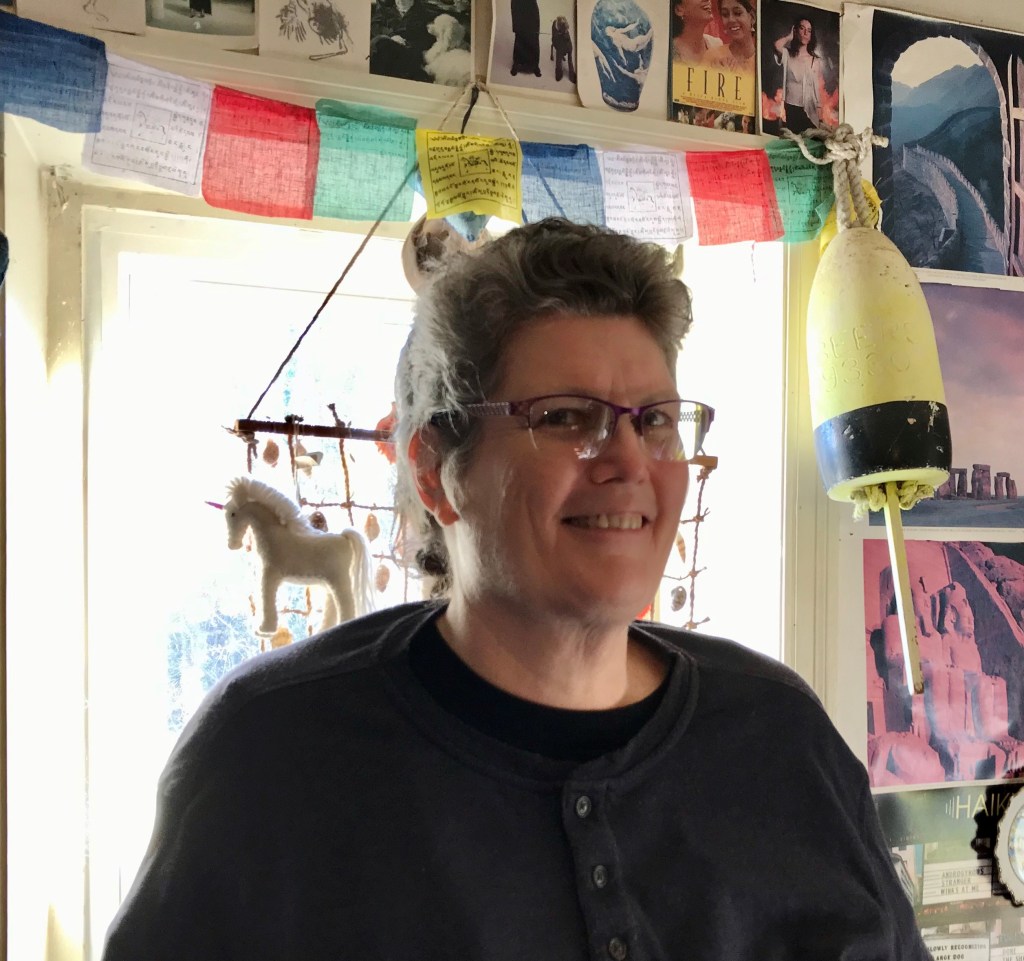
Janet Mason is an award-winning creative writer, teacher, and occasional blogger for such places as The Huffington Post. Her book, Tea Leaves, a memoir of mothers and daughters, published by Bella Books in 2012, was chosen by the American Library Association for its 2013 Over the Rainbow List. Tea Leaves also received a Goldie Award. Her work has been nominated for a Pushcart Prize, and her novel THEY, a biblical tale of secret genders (Adelaide Books – New York and Lisbon) was featured at the 2018 Frankfurt Book Fair. Adelaide Books also published her novel The Unicorn, The Mystery late in 2020. Her novel Loving Artemis. an endearing tale of revolution, love and marriage was published by Thorned Heart Press in August of 2022.
 BookView Review
Leave a comment