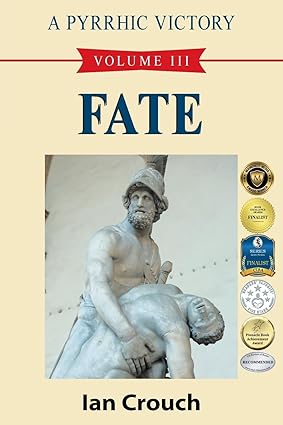
From the Blurb:
A Pyrrhic Victory Volume III: Fate follows the first two award-winning volumes in the historic trilogy A Pyrrhic Victory by Ian Crouch. In 279 BC, Pyrrhus has just won the bloody battle of Asculum against the Romans in the battle that gave rise to the expression “A Pyrrhic Victory”-one that comes at such a great cost that the victory may not have been worth the ordeal that was suffered. While punished, the power of the legions has not been broken. The road to Rome is still barred to Pyrrhus. His peace terms are again rejected. He must gather greater strength to break the deadlock, and accepts the invitation of the powerful Greek cities in Sicily to lead them against the invading Carthaginians. In return, they offer him their support in his war against Rome.
Pyrrhus was described by Hannibal as the finest commander the world had seen, after Alexander himself.
“Writing with great style, Dr. Crouch brings this ancient age to life once more, maintaining an expert balance between historical accuracy and creative imagination. Dr. Crouch succeeds splendidly in conveying a compelling interpretation of the lives and loves, the achievements and aspirations of great men in a great age.” – Dr. Eoghan Maloney, lecturer in ancient history, University of Adelaide
Buy now
Book review
PROLOGUE TO VOLUME I: THE SHAPING OF DESTINY.
The great battle that is known to some as Gaugamela and to others as Arbela changed the world forever. Alexander had defeated the army of the Great King of Persia for the third time and had made himself the master of the empire of the Persians. Darius the Third was dead soon after, slain by one of his own officers. True, there was more fighting to come. Alexander had to fight the assassin, Bessus, who had killed his king. He had to consolidate the empire that he had won, and there was the dream of extending his power to India itself, but the cultural axis of the eastern Mediterranean and beyond was altered irrevocably.
The stage had been set for the Hellenization of the east, but Alexander would not live to see his dream come to fruition. Alexander died in Babylon in 323 BC at the age of thirty-two. The following years would be ones of continuing rivalary and warfare among the Macedonian generals, the Successors or Diadochi, many of whom would die in these struggles.
By 301 BC, those years had resulted in four great Hellenistic kingdoms, in addition to Macedonia itself. In this year, they would once again do battle for their survival. These years were perhaps the greatest period of political and military high adventure that the world had yet known, and there were other great figures from the Greek world who would join in the contest.
One of these figures was Pyrrhus, the young, disinherited king of Epirus, who would later be described by Hannibal as the most capable military commander the world had seen, after Alexander himself. It also fell to Pyrrhus to open the struggle between the Greeks and the Romans for domination of the eastern Mediterranean world and to forsee the great contest between the Romans and the Carthaginians in the west.
PROLOGUE TO VOLUME II, DESTINY UNFOLDS.
At the end of the first volume, Pyrrhus is at peace in Epirus, confident in his role as king. His onetime friend, Demetrius, has become hostile to him, and Pyrrhus has just repelled an attack on his allies, the Thessalians, by Demetrius’ army under the command of Pantauchus.
One of the reasons that Demetrius can treat Pyrrhus this way is the recent death of Deidameia, Pyrrhus’ sister and Demetrius’ wife. She is the greatest tie between them.
Pyrrhus is to suffer another loss, while Fate rewards him with a return to the grand stage of international politics and intrigue. The first acts of this second volume centre on his dealings with Demetrius and the great country of Macedonia; the later acts take us to Italy, where Pyrrhus creates the fame that still endures.
While continuing his quest to be known as a great captain of history, he also pursues his ideal of achieving personal happiness.
PROLOGUE TO VOLUME III, FATE.
Volume II ended with Pyrrhus’ victory over the Romans at Asculum in 279 BC. The Roman legions were punished but not broken, and the road to Rome is still closed to Pyrrhus. His own army suffered severely, giving rise to the expression, a pyrrhic victory, one that comes at such a cost that it threatens to destroy the victor.
Pyrrhus will again propose terms of peace to Rome, to enable them to face Carthage together as allies, as well as providing security to the Greek world. When the struggle continues, Pyrrhus embraces the friendship of the great Greek cities in Sicily. If he can push back the Carthaginians, they will help him force a treaty of peace onto Rome.
A Pyrrhic Victory. Volume III, Fate.
Chapter I.
It was late in the second day of the Battle of Asculum, where Pyrrhus had crushed the Roman legions but at a great cost to his own army. The Romans were retreating as fast as they were able, and Pyrrhus’ men had taken possession of their camp and secured the battlefield and the prisoners. Thousands of Pyrrhus’ men were now attending to the wounded men of both armies, and later they would gather the dead. All this was under the direction of Pyrrhus’ subordinate commanders and the generals of his Samnite and Lucanian allies.
Pyrrhus, for his part, was lying on a cot in the rear of the field hospital within the fortified encampment outside Asculum. Leather straps bound his hands and wrists. He was also to be restrained by three strong hospital attendants and Menestheus, his friend and the commander of the left wing of his army.
In the late stages of the battle, Pyrrhus’ phalanx had broken the centre of the Roman line, and the Consuls had been forced to take men from both wings of the army to help hold the centre. Aware that they were vulnerable, they sent an elite force to kill Pyrrhus, where he was fighting alongside his Royal Foot Guards. Pyrrhus’ death would be the only thing that could save the Roman army before they received the final attack by the elephants and cavalry. They were beaten off, but in the fighting, Pyrrhus received a severe wound to his shield arm, and his friend Eurypylus had been mortally wounded.
Pyrrhus had said goodbye to Eurypylus a few minutes ago, and now his army surgeon and personal physician, Machaon, was preparing to deal with his wound. He asked Pyrrhus to drink three goblets of wine, and after removing his armour, he laid him down on this cot.
“That is good, Sire. Please rest your head on this pillow. Let me look at your wound and clean it. I will then deal with it as needed.”
Pyrrhus’ face was pale and sweaty, and he replied, “I am in your hands, my friend. Do what you must.”
Machaon was ready to remove the field dressing that had been applied to the upper part of his left arm. The tight dressing had kept the blood loss to an acceptable amount, but the wound had to be formally cleaned and treated. Machaon looked at the preparations before removing the dressing. Several cautery irons were satisfactorily red hot in the fire, wine and hot water were at hand to wash the wound, and plenty of dressings and sutures had been made ready.
“Sire, I will place these straps around your wrists and ankles now. If the bleeding is brisk when the bandages are removed, I may need to act immediately.”
Pyrrhus nodded and smiled at Machaon.
Menestheus took his place at Pyrrhus’ right side, taking a firm grasp of his hand, both out of friendship and the need for physical restraint. The three attendants also took their places, and a medical colleague was at Machaon’s side to assist him.
When all was in readiness, Machaon soaked the bandages with warm water and gently unwound them. Quickly washing the blood and clot from the arm, he was able to assess the wound. There was a deep cut across the outside of Pyrrhus’ upper arm, the result of a wild sword stroke. Beneath the lacerated skin, a large vein had been severed, and half the muscle had been cut. The bleeding was rapid, but there was no pulsatile flow from a major artery. It was also unlikely that an important nerve had been damaged.
Machaon washed the wound with wine and said to Pyrrhus, “Sire, this wound will heal, and your strength will return. I must cauterise it now to stop the bleeding and then suture the skin.”
Pyrrhus squeezed Menestheus’ hand, waiting for what would come.
Machaon’s colleague passed him one of the cautery irons, glowing brightly at its tip. The surgeon took it in his right hand and told his attendants to hold Pyrrhus tightly.
Pyrrhus let out a loud groan as the iron touched the wound, and he struggled convulsively against his restraints. The smell of burning flesh gave a hint to the pain he was suffering. Although intense, this moment was short. Machaon looked at the wound with satisfaction. The bleeding areas had been dealt with. He could now finish cleaning the wound properly and suture the underlying muscle and the skin.
Fortunately, Pyrrhus had lost consciousness after the cautery was performed and remained drowsy while the remainder of the surgery was done. He became more clear-headed as fresh bandages were being applied.
“Thank you, Machaon. Are you finishing now?”
“Yes, Sire. This wound will do well, but it will take several months for your strength to return fully. I will dress the arm each day until the skin heals, and I wish you to keep the arm in a sling for a while. Let us wash you and get you into some clean clothing. After you have had some food, I will leave you to speak to Menestheus. I believe all is in hand with the army.”
“Bless you, Machaon,” said Pyrrhus.
Pyrrhus was too tired and in too much pain to attempt to rise. After he had been bathed and dressed in a clean tunic, Menestheus returned to his side, while servants brought food and wine for them both.
The two men enjoyed their meal, as they had both been in the field all day with no respite until the final collapse of the Roman army. The wine helped dull the pain from Pyrrhus’ arm. As he lay back on his pillows, Pyrrhus asked Menestheus to tell him about the state of the army.
“The men are aware of your great triumph, Sire, and they are proud of our victory today. There is much sadness though. We lost several thousands of men, and the Romans lost twice our number. There are many wounded to deal with. The good news is that the army remains fully cohesive, and all the able-bodied men are doing their best.”
“That is good. I will leave you to look after the men today, Menestheus. I hope to visit them tomorrow. Would you excuse me if I slept for a while?”
A Pyrrhic Victory. Volume III, Fate.
Chapter II.
Pyrrhus awoke at dawn the next morning. Although he had slept well, his night’s rest had been disturbed. He became aware of the day slowly, as if he was rising through a thick mist. Machaon had given him a final goblet of wine last night, laced with herbs. That had dulled the pain and enabled him to sleep, but his dreams had been vivid and threatening.
Time and again, he saw several thousands of his men lined up on parade, fine in their manhood and presentation. At the front of the parade were his friends and generals, cheerful in the anticipation of the great deeds the army would do. He saw Eurypylus there, proudest of them all, standing next to Telecleides. These were his dead friends, soldiers and officers who had died in his two great battles against the Romans.
The dream went on. To the side of this grand gathering was another formation of fine soldiers, Roman this time. There were so many of them, and at the front of their line was his friend Hoplax, whose body had been burned on the royal funeral pyre after the first battle at Heraclea.
When he felt most fearful of delerium, Machaon put his hand on his shoulder. “It is all right, Sire. The worst has passed. Today will be less severe.”
Pyrrhus grasped the hand of his physician. “Thank you, Machaon. I thought I was about to go mad.”
“The day and the company of the living will bring you comfort, Sire. You and your army have done great deeds, and you have become part of history.”
Pyrrhus was content to hold the hand of his physician for a moment while he regained some of his composure. Fortunately, Menestheus chose this moment to enter his king’s tent, bringing with him a part of his irresistible cheerfulness.
“Good morning, Sire. I hope I see you rested and in good spirits. If you are well enough, Cineas is desperate to greet you.”
“Menestheus, please bring him in. You three friends have saved my sanity.”
Cineas entered, managing to disguise his misgivings. “I am glad to see you so well, Sire. I bring the goodwill of all the men in the army. In practical terms, I present you with the best breakfast that an army on campaign can offer. There are men of ingenuity in your command who have been guided by Machaon. I would like you to accept this meal of toasted bread, slowly roasted duck, and preserved peaches. It is intended to hasten your recovery.”
Pyrrhus sat back and rested his head on his pillow, exhausted. “Thank you, Cineas. I would be happy with that for my last supper, combined with Machaon’s cocktail from last night. Firstly, Menestheus, is all well with the men?”
“Yes, Sire. All I need tell you now is that all is well with the army. The Romans have made a defensive encampment three miles from here and have no desire to mount a counterattack. We are dealing with the wounded as well as we can.”
Pyrrhus thanked his god for giving him Menestheus. He could remain in a tent, motionless, for days, and Menestheus would take care of everything, with the help of Cineas.
The low fever that had begun in Pyrrhus had made him acutely sensitive.
“My friends, you have something else to say?”
Cineas was the one to reply. “Yes, Sire. As Menestheus said, all is well with the army, and the Romans are in a defensive position. Despite this, we must withdraw to Tarentum as soon as we can.
“We have won a great victory over the Roman army, but it has retreated and remained intact. The legions will soon be reinforced, while we are in a vulnerable position, with many wounded to care for. Most of all, Sire, there is your wound. Your army needs your inspiration to achieve its great deeds, and you will not be able to fight for months. We must retire before we have to run.”
Pyrrhus knew that Cineas was right. His army could not fight the Romans a second time without their king. He almost found the heightened awareness of his fever to be an advantage.
“Cineas, you are right as always. The Romans are on the defensive. Let us maintain our dignity by a proper funeral pyre tomorrow morning. Please invite their officers to attend. Once that is done, let us get back to Tarentum as soon as possible.”
***

I am a doctor, living in Adelaide, South Australia.
I have always lived here, apart from a year spent working in England in the early days. From my early days in Medical School, my abiding interest has been Greco-Roman history.
With regard to the choice of Pyrrhus as the subject of the books, he stood out for a number of reasons. He was a critically important figure of his age and represented a fulcrum in world history. He was one of the last Greeks who could have maintained the political dominance of the Hellenistic kings and resisted the ever-increasing power of Rome. Also, as a subject, he presented something of a blank canvas, unlike other great figures such as Alexander the Great and Julius Caesar whose exploits have been written about many times.
Website: theshapingofdestiny.com
 BookView Review
Leave a comment