Welcome to BookView Interview, a conversation series where BookView talks to authors.
Recently, we talked to Larry Z. Daily about his writing and recently released book, The Minstrel and the Prophet: Book One of the Chronicles of the Lawbreaker, a tense and insightful journey into the dynamics of power, self-discovery, and fate (read the review here).
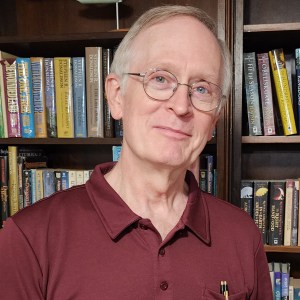
Larry Daily was born in Covington, Kentucky and currently resides with his girlfriend Sandi in the eastern panhandle of West Virginia. He holds a Ph.D. in Psychology and teaches psychology classes at Shepherd University. The Chronicles of the Lawbreaker is the result of a decades long love of fantasy inspired by J. R. R. Tolkien, Ursula K. Le Guin, Patricia McKillip, and Mary Stewart. In his spare time Larry builds HO scale model trains, plays folk music on six- and twelve-string guitars, and devours fantasy novels.
Website: http://www.larryzdaily.net/
Who and what ultimately inspired you to become a writer?
The easy answer is Tolkien, but that’s not an entirely accurate answer. I can’t really say who or what inspired me to write. I kept a journal in high school, and I often mentioned stories I was writing in my entries, so whatever it was, it happened before then. A friend introduced me to Tolkien in 1973 or so. The Lord of the Rings enthralled me, but it was something that Tolkien wrote in the Forward to the Fellowship that took that desire to write and gave it focus. He said that the prime motivation in writing LotR was “the desire of a tale-teller to try his hand at a really long story.” That resonated with me in a way that nothing else had and gave birth to a love of fantasy literature that has never faded. I’ve wanted to write my own fantasy trilogy ever since.
Tell us a little about how this story first came to be. Did it start with an image, a voice, a concept, a dilemma or something else?
It started with a character. I remember getting my high school ring while I was reading The Lord of the Rings. I’m pretty sure that I was sick soon after I got my ring, so I was confined to bed with plenty of time to read. Magic and rings were on my mind, and it was during that illness that I saw a young man with a ring like mine leading a group of people out of a forest into a battle with a huge army of dark beings. As he stepped out of the tree line, the stone in his ring kindled into red flame…
That was my first glimpse of Lauren. He didn’t have a name, and I had no idea what he was like or who the bad guys were, but that was the beginning. By the early 1980’s, Lauren had a name, and I had developed several other characters. I also had a few individual scenes that involved Lauren and one of the other characters interacting, but I had no idea how they all fit together. In the early 1980’s, I started trying to fit the puzzle pieces together. I drew a map of my “world” and developed names for some of the kingdoms. Out of that came a draft of what are now chapters one through seven of The Minstrel and the Prophet. I stalled out then because I was missing one small detail: an actual plot. I had no idea who my antagonist was or what that person’s motivations were and without that, there was nothing to drive the story forward.
I never gave up on the story, though, and I had a notebook where I kept track of ideas that I had about my world. Then everything changed. In 2005, I figured out the origin story of my world. With that came the identity and motivation of my antagonist. Over the years, I’ve also learned some things about the real world that shaped my ideas on evil and refined the character of my “bad guy.” It took a few years to work out an outline of the entire trilogy, but then I scanned in those old typewritten pages and began editing the older material to fit the outline. It took me until 2024 to get all three books written, but I was able to release The Minstrel and the Prophet in September of that year.
What authors do you like to read? What book or books have had a strong influence on you or your writing?
Wow! There are so many that I’ve enjoyed over the years, among them writers like Ursula K. Le Guin, Patricia McKillip, Mary Stewart, Stephen Donaldson, Terry Brooks, and Kelly McCullough. And that’s just the start. I have five floor-to-ceiling bookcases in my office stuffed with fantasy and a growing stack on the floor that I’m trying to find space for. And that’s not counting the books I’ve read in other genres. Probably the most influential authors were the first three that I named. I can’t say how many times I’ve reread their books. Tolkien may have sparked my love of fantasy, but Le Guin, McKillip, and Stewart fanned it into full flame. It meant more to me than I can say that a friend who I recently shared the Earthsea and Riddle-Master books with said that she could see their influence on my writing.
Are any of your characters based on real people you know?
“Based on” might be too strong a description. “Inspired by” might be more accurate. Four or five of the characters go all the way back to when I was a teen, and they had their roots in people I knew. Back then, they looked like the people I knew, but they were all one-dimensional. Each one had one thing they were – Dalach, for instance, was just a drunken jerk – and that was it. Since then, they’ve grown and while they still look like those people (at least in my mind), they don’t behave anything like the folks who inspired them.
What sort of a relationship exists between you and the characters you created in this book?
As I’ve said, I started thinking about this story when I was in high school. By the early 1980’s, all I really had was a handful of characters and a series of vignettes involving my main character and one or more of the others. Those characters – Lauren, Dalach, Peg, Ryan, Ambrose, Anders, and a few others – have been living in my head for 50 years. They’re old friends now and while I’m glad that I’ve finally been able to share their story, it feels a little odd to have them out there in the hands of other people. To some degree, they’ve taken on a life of their own. For instance, in writing book three, I was considering how to resolve a particular plot point. I thought I knew how I was going to wrap it up, but as I was writing a scene with another character and Lauren, that other character’s dialog took a twist, and she let me know exactly how she felt about what I was thinking. I ended up going a different way with the story.
Which scene, character or plotline changed the most from first draft to published book?
That would have to be Ryan. When I wrote the first draft of this book in the early 1980’s, Ryan mostly served to get Lauren to the minstrel’s college and hand him off to Ambrose. It was Ambrose who was really going to shape who Lauren became. When I really got serious about trying to finish the story, I realized that Ambrose made no sense as a character. We all hold contradictory beliefs, but the 1980’s version of Ambrose seemed to be completely different people depending on which scene you were reading. I took a good bit of that and moved it over to Ryan and he’s now got an important role to play throughout the trilogy.
Do you try more to be original or to deliver to readers what they want?
Do I have to be one or the other? I didn’t study the market to figure out what’s selling and then try to write that, but to the extent that I’m a “typical” reader of fantasy, I wrote something that I’d enjoy reading. I hope other people will, too. I also tried to bring something original to the genre. As I’ve thought about and planned the story over the years, I realized that I wanted to say something about the nature of good and evil. I don’t mean to be disrespectful of Tolkien or anyone else, but bad guys like Sauron no longer make sense to me. I can’t wrap my head around the whole evil for the sake of evil thing anymore. I mean, here’s Sauron with all this awesome power and he chooses to live in a place like Mordor? I’m hoping that by the end of my trilogy I’ll have added something a bit new.
***
 BookView Review
Leave a comment