Welcome to BookView Interview, a conversation series where BookView talks to authors.
Recently, we talked to D. K. Kristof about his writing and recently released book Red Dirt Part I: The Star Bearer, a gripping and emotionally rich SF saga that follows the last echoes of humanity across the Martian dust (read the review here).
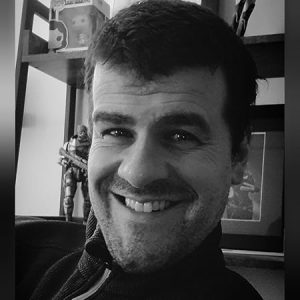
Born in Budapest, Hungary to a family of creatives, D.K. Kristof came to the United States as a refugee following the collapse of the Iron Curtain and the end of the Cold War. An avid writer and reader since early childhood, he earned his BA from the University of Washington in 2010. Following a creative hiatus and the COVID Pandemic of 2020, he returned to focus on writing and poetry in 2024 with several ongoing projects, including the “Red Dirt” series and illustrated poetry book, “Stardust”.
He is a lover of science fiction and an avid collector of sci-fi related video game and film memorabilia. You can follow him on Instagram @d.k.kristof and his website dkkristof.com
Do you find writing therapeutic?
Yes. Over the years, writing became a tool that helped me cope with anxiety and grief. I started writing short stories in elementary school, as early as 1st grade, and Language Arts was the subject I did the best in; unlike math, which I struggled with. I had an abusive father up until I was around eight years old or so, and my imagination was always running wild and kept me preoccupied. When I realized that I could put these ideas and narratives I always had on my mind into writing, I started creating all these different worlds and characters at a young age, and the act of creating became a way for me to detach from the world when I needed a little breathing space.
If you could tell your younger writing self anything, what would it be?
Don’t stop. Don’t give up. I gave up on my creative endeavors because I didn’t see myself succeeding. Good things take time. I was very impatient. I got frustrated easily. I took constructive criticism far too personally. I was young. So, if anything, I would go back and tell the younger me to stop, breathe, and remember that sometimes the sweetest of fruit takes the longest to ripen.
What’s more important: characters or plot?
Characters and plot rely on one another. If you have an amazing idea for a central plot, but the characters are too flat, unoriginal, and lack depth, they won’t be strong enough to carry and convey this amazing story. If the opposite is true and you create these amazing, deep, fun characters but a plot that is paper thin, you now have nothing for them to do and the reader doesn’t care. Amazing characters deserve an amazing plot, and intricate plots require deep, intricate characters.
What do you hope readers will take away from this story?
I want them to really evaluate what it is that makes us human and why; to challenge our perceptions. Is being human something tied to our organic nature or is it something beyond that? Something that maybe we don’t understand? I wrote the book in a way where the reader is essentially put into a position where they have to feel and connect with a machine; to see them as more. If you can do that with a fictional character, what happens when, one day, you are faced with that scenario in real life? With the advent of A.I. and the rapid development of technology all around, this isn’t going to be science fiction for much longer.
What life experiences have shaped your writing most?
Grief and regret. I have lost several mentors; strong, wonderful women. I am very close with my mother, so this exploration of maternal bonds, dealing with loss, and carrying forth legacy is prevalent in all my writing.
What makes this book important right now?
Everything we are seeing with A.I., but also this idea of humanity being its own worst enemy. The book I wrote takes the worn out trope of Man vs Artificial Intelligence, throws it out the window, and presents something completely new entirely. I think as a species we are crossing a threshold where we are no longer inseparable from our technology, but despite the world getting smaller and more interconnected, we are somehow allowing ourselves to be incredibly divided. The book addresses war, identity, legacy, and reflection on who we are as a species, and our relationship with technology.
***
 BookView Review
Leave a comment