Welcome to BookView Interview, a conversation series where BookView talks to authors.
Recently, we talked to MM Desch about her writing and recently released debut novel, Tangled Darkness, a sharp, emotionally charged story that blends psychological suspense with medical intrigue and personal reckoning (read the review here).
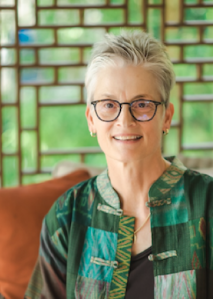
Mary Desch, writing under the pen name MM Desch, brings a wealth of psychiatric expertise to her psychological thrillers. She draws from her extensive career as a general and addiction psychiatrist across multiple states to craft relatable characters facing intense psychological and physical dangers, infusing her writing with authenticity and suspense through her thorough understanding of human motivations, conflicts, and trauma recovery.
A lifelong mystery enthusiast, Mary’s passion for the genre evolved from childhood fascination with Alfred Hitchcock’s Mystery Magazine to a deep appreciation for detective fiction in college. This enduring love for suspenseful storytelling naturally led her to write psychological thrillers.
Mary’s debut thriller, Tangled Darkness, is the first book in her Portland Murders series.
When not working on her next novel or novella, Mary enjoys hiking, long walks with her wife and their spirited mini schnauzer, exploring local food scenes, golfing, and following women’s professional basketball.
Threads
https://www.threads.net/@m.m.desch?xmt=AQGzP66VD8kcFAvY_17dS7gdkt3eKFIIEH3gikVJWaVB2vE
https://www.facebook.com/MMDeschWriter/
https://www.instagram.com/m.m.desch/
BlueSky
https://bsky.app/profile/mm-desch.bsky.social
Linked In
https://www.linkedin.com/in/mary-m-desch-a391479/
Website: https://marydesch.com/
Pre-order eBook and Paperback:
Pre-order book
https://books2read.com/u/bwgvYO
GoodReads
https://www.goodreads.com/author/show/51031502.M_M_Desch
BookBub
Tell us some more about your book.
Tangled Darkness is a psychological-medical thriller that chronicles a psychiatrist’s desperate fight to save her career, marriage, and ultimately her life when a web of deceit and corruption ensnares her. When a psychiatric clinical assistant is found dead, psychiatrist Dr. Leslie Schoen finds herself the prime suspect—a situation made worse by damaging allegations that threaten to destroy her medical career.
What begins as a professional nightmare soon becomes a life-threatening personal crisis. As Leslie investigates to clear her name, she uncovers a dangerous corruption scheme affecting her mental health practice. Colleagues she trusted daily reveal themselves as participants in unthinkable acts.
The book examines the psychological burden of deception—both external and self-imposed. Leslie’s inability to confront her own buried past fuels a cycle of dishonesty that threatens her marriage and her pregnant wife, even as external dangers literally invade their home. I’ve crafted a narrative where professional ethics collide with personal survival instincts, where a psychiatrist trained to help others must confront her own vulnerabilities.
Tangled Darkness invites readers into a world where nothing is as it appears: a medical assistant’s mysterious drawing holds the key to murder, unscheduled patients signal a criminal operation, and a colleague’s billing irregularities mask deadly secrets. As Leslie peels away these layers of deception, she must also confront the most difficult truth—the one she’s hidden from herself about her past actions during her struggle with alcoholism.
What inspired the premise of your book?
The premise of Tangled Darkness emerged from my years working as a psychiatrist in small mental health practices, where I observed the fascinating dynamics between providers sharing closely interconnected professional spaces. I became intrigued by how quickly trust can erode in these environments when suspicion enters—particularly how allegations of misconduct can upend both professional standing and personal identity.
One afternoon, I was reflecting on the paradoxical vulnerability of psychiatrists: we help patients navigate difficult truths while sometimes avoiding our own. This sparked a compelling question: what happens when a psychiatrist with her own unacknowledged past—like Leslie’s history with addiction and theft—faces accusations that threaten to expose what she’s buried? How would someone trained to help others process trauma respond when her own carefully constructed life begins to fracture?
This collision of professional crisis and buried personal history formed the foundation for Leslie’s character. I wanted to explore how a provider who understands psychological defense mechanisms would react when those same mechanisms begin operating in her own life. The small practice setting created the perfect pressure cooker for examining how corruption can flourish in medical environments, and how quickly professional relationships disintegrate when criminal elements enter the equation.
The story evolved from there, incorporating the dangerous intersection of addiction and access to controlled substances in medical settings, the vulnerability of healthcare systems to exploitation, and the psychological toll of maintaining secrets. I became fascinated by how Leslie’s recovery journey from alcoholism would be tested when confronted with both external threats and her own unresolved shame. The narrative naturally expanded to explore what happens when criminal elements infiltrate a medical practice, using its legitimate functions as cover for illegal activities, and how a practitioner’s instinct to protect patients can become a powerful motivator for seeking truth, even at great personal risk. This complex web of professional integrity, personal recovery, and the fierce protection of family created a solid foundation for a psychological thriller where nothing—and no one—is exactly as they appear.
What kind of research do you do, and how long do you spend researching before beginning a book?
My research for Tangled Darkness was methodical and multi-layered, mostly undertaken as I wrote the first draft. My years as a psychiatrist provided foundational knowledge and some real opportunities for crafting this book.
I had an unusual afternoon one day while practicing in Phoenix when I was visited by a DEA agent conducting an unannounced inspection of my practice. I’d previously qualified for prescribing buprenorphine under my DEA registration because I was doing hospital consultations on medical-surgical patients. My idea was to be prepared for treating hospital patients in opioid withdrawal, but my consultation practice ended before I had an occasion to recommend using it.
I had a nice chat with the DEA agent that day after explaining I did not have any patients taking the drug. It was an education I never knew at the time I’d use years later.
Because of the education needed to get the buprenorphine “waiver,” as it was called, and my addiction psychiatry credentials, I knew about safeguards against diversion relating to pharmacies, outpatient office samples, and the like. Because I served on the medical board’s impaired physician committee, I heard many stories of opioid diversion and learned about the vulnerabilities in the system. Understanding these helped me craft Bryce’s operation with realistic detail.
To accurately portray the police investigation of Damon’s murder, I consulted with a retired police commander with thirty years’ experience in law enforcement, including homicide cases. I am lucky as well to have a sister who’s a pathologist. Chatting with her about the death scene and the possible mindset of a medical examiner viewing the scene was invaluable. I carefully reviewed the toxicology of heroin and oxycodone (again!) to be certain about Dr. Taylor’s (the Deputy ME in Tangled Darkness) comments about the autopsy report.
These conversations were invaluable for understanding how investigators might evaluate healthcare workers as suspects and the specialized forensic methods used.
I also researched the psychological profiles of individuals like Michelle, consulting case studies of those wounded by trauma and developing dissociative disorders to ensure her character’s mental state was portrayed accurately rather than sensationally.
My research continued throughout writing, ensuring medical, procedural, setting, and psychological authenticity remained at the heart of the thriller.
Tell us a little about how this story first came to be. Did it start with an image, a voice, a concept, a dilemma or something else?
Tangled Darkness began with the vision of Bryce Nelson as a villain. I watched countless YouTube videos, read articles, and attended workshops. I studied the various types of villains and their character arcs.
A very good friend of mine, one with whom I’d been meeting for tea or the occasional golf game, offered to read my first sixty pages. She’s an excellent writer now about to publish her third novel. She gave me great feedback that ultimately led me to make a story outline and begin to study story structure.
By that time I’d developed a rough sketch of Leslie and Izzy, and the characters in the mental health clinic. Eventually I pondered: What happens when a recovering addict who happens to be a mental health professional faces an accusation that threatens their career? It was only much later that it occurred to me that the threat could also expose her shameful past. This ethical and psychological knot fascinated me—how someone whose professional identity is built on truth and healing might be driven to deception when their past and present collide.
The character of Leslie became more three-dimensional from this dilemma, a psychiatrist whose recovery journey I could explore with nuance and authenticity. I wanted to create someone whose professional training complicates her ability to confront her own truths—she understands the psychology behind her behavior too well, making self-deception more sophisticated.
The setting of a small psychiatric practice was natural—they say “write what you know,” and I absolutely knew this. The Psych Recovery clinic and Leslie’s practice offered the perfect closed environment where relationships are interdependent and boundaries less clearly defined than in larger institutions. I was drawn to how this setting would intensify Leslie’s isolation when accused.
The thriller elements evolved organically from there. I’ve always been interested in how legitimate medical practices can be exploited for drug distribution, and this created a natural framework for escalating stakes. As I developed Damon’s murder and the mysterious drawing, I realized I had the ingredients for a story that worked simultaneously as a psychological exploration and a page-turning mystery.
The marriage element—Leslie hiding the accusation from her pregnant wife—added another layer of emotional complexity that anchored the external threats in deeply personal stakes.
Which character was most challenging to create? Why?
Michelle was undoubtedly the most challenging character to create in Tangled Darkness. I had to be careful to avoid mental health stereotypes and show her character unfolding into a believably very ill person—one who has become adrift from their usual state, unanchored from their sense of right and wrong.
The complexity lay in balancing Michelle’s calculated participation in Bryce’s drug scheme with her deteriorating psychological state. I needed to show how someone could function professionally while harboring severe trauma that ultimately manifests destructively. This required developing a detailed backstory about her abusive father that would never fully appear on the page but would inform every aspect of her behavior.
I struggled with how much of Michelle’s psychological fragmentation to reveal early in the narrative. Finding this balance required countless revisions of seemingly innocuous interactions between her and Bryce, and others.
The final confrontation scene where Leslie must psychologically outmaneuver Michelle to save her wife underwent many revisions. I needed to show Leslie using her psychiatric training in a crisis while maintaining suspense about whether she could successfully reach through Michelle’s delusional state.
Creating Michelle required walking a tightrope—portraying mental illness with compassion and accuracy while acknowledging that severe mental illness can lead to tragedy.
Which scene was most difficult to write? Why?
The most difficult scene to write was undoubtedly Leslie’s confession to her wife about her past theft of medication during her active alcoholism. This pivotal moment arrives after Leslie has already endangered their relationship through weeks of deception about the current accusations, and just after a frightening assassination attempt has demonstrated the very real dangers they face.
The difficulty stemmed from the emotional complexity. I needed to convey Leslie’s shame about her past actions while showing how her professional identity has made that shame more toxic—as a psychiatrist, she feels she should have “known better” or been “stronger” than her disease. Simultaneously, I had to capture her wife’s reaction: feeling betrayed by the recent deception while processing this new information about Leslie’s past, all while pregnant and having just experienced threats to their safety.
The scene required weaving together multiple timelines—Leslie’s active addiction years ago, the recent months of hiding the accusation, and the immediate aftermath of violence—while maintaining emotional authenticity. Getting the dialogue right was crucial; these are two intelligent, articulate women having the most difficult conversation of their relationship. The words needed to carry the weight of their history while revealing new vulnerabilities.
What made it particularly challenging was knowing this confession doesn’t resolve their crisis—it actually precedes Leslie’s wife’s disappearance. Balancing a moment of emotional catharsis with the knowledge that greater danger lies ahead required a type of calibration between hope and foreboding.
After many revisions, I believe the scene achieves what I intended: a raw emotional reckoning that shows how recovery isn’t a destination but an ongoing journey in pursuit of rigorous honesty. It’s an ideal to which imperfect humans constantly navigate.
What do you hope readers will take away from this story?
I hope readers will take away several interconnected insights from Tangled Darkness, beyond the suspenseful entertainment. First, I want them to consider how secrecy and shame can be more destructive than the truths we hide. Leslie’s journey illustrates how concealing past mistakes—even with the intention of protecting loved ones—often creates greater vulnerability than honesty would have.
The novel explores addiction recovery as a non-linear process. Leslie’s professional success and years of sobriety don’t inoculate her against old patterns when under extreme pressure. I hope readers gain compassion for how recovery remains a daily practice, including for individuals who may appear to have “solved” their addiction.
I also wanted to illuminate the pressures faced by healthcare professionals who develop substance use disorders. The medical community often stigmatizes addiction among its members, creating barriers to seeking help. Leslie’s story highlights how fear of professional consequences can drive harmful secrecy.
The relationship between Leslie and her wife demonstrates that genuine intimacy requires radical honesty, even when that honesty is frightening. Their ultimate reconciliation suggests that relationships can not only survive difficult truths but grow stronger through them.
Finally, I hope readers recognize how systems designed for healing—like mental health practices—can be exploited in devastating ways when oversight fails. The opioid crisis has many dimensions, including the corruption of medical practices from within, a reality that affects communities nationwide.
Above all, I hope readers find in Leslie’s journey a compelling argument for the transformative power of facing one’s own truths, however painful they may be.
What makes this book important right now?
Tangled Darkness addresses several issues that resonate powerfully in our current moment. Most obviously, it engages with the ongoing opioid crisis from a unique angle—examining how legitimate medical practices can become vectors for distribution when corrupted from within. As communities nationwide continue grappling with prescription drug abuse, the novel offers insight into the complex systems that can enable or combat this epidemic.
The book also speaks to the evolving conversation around addiction and recovery in professional settings. As medicine slowly moves toward recognizing substance use disorders as health conditions rather than moral failings, Leslie’s story illustrates both the persistent stigma healthcare workers face and the possibility of redemption and continued contribution to their field.
LGBTQ+ representation in thriller fiction remains relatively limited, particularly portrayals of same-sex marriage that aren’t defined solely by sexuality. Leslie and her wife’s relationship—with its ordinary stresses, deep commitment, and expected child—normalizes queer family structures while placing them within a compelling narrative that appeals to all readers.
The exploration of how trauma manifests differently across individuals feels especially relevant as our society develops a more nuanced understanding of mental health. Michelle’s character, while ultimately responsible for her actions, demonstrates how childhood trauma can create vulnerability and distortion that sometimes leads to tragedy without appropriate intervention.
Finally, at a time when trust in institutions continues to erode, Tangled Darkness acknowledges legitimate concerns about systems failure while ultimately affirming that integrity and accountability—both personal and professional—can prevail even in deeply compromised environments.
What in particular attracted you to this genre?
I’ve always been drawn to psychological thrillers for their unique ability to explore people’s shadow sides. In this psychological-medical thriller, the genre allows me to examine what happens when the same psychological insight that enables healing becomes weaponized or corrupted. This tension creates a particularly compelling narrative framework for exploring questions about power, trust, and ethical boundaries in mental healthcare.
The medical setting provides natural life-and-death stakes that amplify psychological suspense. In Tangled Darkness, the combination of psychiatric practice with substance use issues creates multiple layers of vulnerability—the patients seeking help, the providers with access to controlled substances, and the systems designed to protect both groups.
I’m particularly attracted to how the psychological thriller allows me to explore addiction recovery through a different lens than literary fiction might. Leslie’s recovery journey becomes intertwined with external threats, creating a propulsive plot while still examining the internal psychological terrain of shame, accountability, and growth. The genre conventions push characters to extremes where their core values and vulnerabilities are exposed.
As someone familiar with mental health settings, I’m also drawn to countering stereotypes about psychiatric conditions while acknowledging real complexities. Michelle’s character allows me to explore how trauma can distort perception without resorting to simplistic “psycho killer” tropes that stigmatize mental illness.
Finally, I appreciate how the thriller format enables me to address serious social issues like the opioid crisis through an engaging narrative that reaches readers who might not pick up nonfiction on these topics. The page-turning quality of psychological thrillers creates an accessible vehicle for exploring complex ethical and psychological terrain.
How did you decide on this title?
The title Tangled Darkness emerged after considerable deliberation about what would best capture the novel’s core themes and atmosphere. I wanted something that evoked both the complex web of deception at the heart of the story and the psychological shadows that drive the characters’ actions.
“Tangled” perfectly represents the intertwined nature of the plot—how Leslie’s personal recovery history becomes entangled with Bryce’s drug operation, how Michelle’s trauma becomes fatally intertwined with her perception of Damon, and how Leslie’s marriage becomes caught in the dangerous web. It also reflects the labyrinthine nature of the investigation itself, with its mysterious drawing, false accusations, and hidden connections that Leslie must untangle to find the truth.
“Darkness” works on multiple levels. Most obviously, it suggests the shadowy world of illegal opioid distribution operating beneath the surface of a respected medical practice. But it also represents the psychological darkness that each character navigates—Leslie’s shame about her past addiction, Michelle’s traumatic history with her father, and Bryce’s moral corruption.
The combination creates a metaphorical framework for Leslie’s journey: she must navigate through tangled darkness—both external threats and internal shame—to emerge into light and truth. The title also evokes the emotional atmosphere I wanted to create—a sense of claustrophobic tension where discerning truth from deception becomes increasingly difficult.
Several alternative titles were considered, but Tangled Darkness ultimately captured both the psychological nuance and suspenseful atmosphere that define the novel.
What does literary success look like to you?
Literary success for me centers on creating connections through authentic storytelling. When a reader tells me they couldn’t put Tangled Darkness down, but also that Leslie’s struggles with addiction recovery resonated with their own experience or helped them understand a loved one’s journey better—that’s the pinnacle of what I hope to achieve.
Being named to the 2023 Chanticleer Clue Awards shortlist for Tangled Darkness represents meaningful validation from the mystery/thriller community. This recognition affirms that the book succeeds not just in its psychological depth but also in delivering the page-turning suspense that genre readers expect. However, these accolades matter most because they help connect the book with readers who might benefit from or be moved by Leslie’s story, and primarily readers who are entertained by the entire story.
I hope to measure success by the conversations the book could generate—discussions about addiction stigma in healthcare, about how shame perpetuates cycles of deception, about the vulnerability of medical systems to exploitation. Should it turn out that Tangled Darkness provokes reflection beyond its entertainment value, I will feel honored as a writer.
Success also means representation—showing a same-sex marriage and expected child as central to a mainstream thriller without making LGBTQ+ identity the focus of the story. If readers from these communities see themselves reflected in genre fiction where they’ve often been invisible or marginalized, that’s a valuable achievement.
Ultimately, literary success means creating stories that entertain while illuminating something meaningful about human experience—particularly the struggles that often remain hidden beneath professional veneers and social expectations.
What’s next for you?
I’m currently deep into my second psychological thriller, which introduces Leslie’s second cousin Grace as the protagonist. While not a direct sequel to Tangled Darkness, it continues the series I’m working on: The Portland Murders.
I have written a prequel novella to book two in the series, and it is available for purchase at several retailers here: https://books2read.com/u/mY2X5x.
Several readers have asked whether we might see Leslie again. So far, she has a ‘cameo’ role in book two, although I can’t guarantee her role will stay that small. I have book three in the series outlined, and Leslie + Izzy (and their little one) will be more prominent in that story. I’ve become intrigued by how Leslie’s reconfigured practice and new parenthood might intersect with her investigative instincts. That could go in a number of directions.
My fundamental goal remains consistent: creating psychologically nuanced suspense narratives that entertain while provoking thought about the complex ethical terrains of mental healthcare, addiction recovery, small town politics in southwestern drought-stricken Colorado, and law enforcement and city political systems in Portland, Oregon.
***
 BookView Review
Leave a comment