Welcome to BookView Interview, a conversation series where BookView talks to authors.
Recently, we interviewed Anne M. Smith-Nochasak about her writing and her recently released book, River Becomes Shadow, the second book in Taggak Journey trilogy that plunges readers back into a scorched future where faith, memory, and survival intertwine in haunting and unexpected ways (Read the review here.).
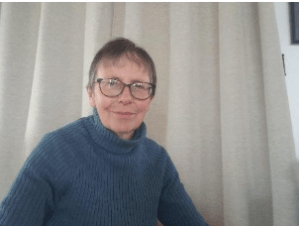
Anne M. Smith-Nochasak is the author of four novels. Her first, A Canoer of Shorelines (FriesenPress, 2021), was recognized as one of The Miramichi Reader’s Best of Fiction in 2021. The Ice Widow (FriesenPress, 2022) was shortlisted for the Whistler Independent Book Awards in 2023 and a semi-finalist for the North Street Book Prize. River Faces North (FriesenPress, 2024), the first book in the Taggak Journey trilogy, was a Seaboard Review Book Pick in 2024. She is currently a member of the Writers Federation of Nova Scotia and the Canadian Authors Association.
While she grew up in Nova Scotia, Canada, Anne taught in northern communities for many years. She now lives in rural Nova Scotia in an area not unlike her character Flo’s swamp, with logging trails and rivers to explore. When she’s not writing, Anne enjoys hiking routes like the ones her characters might travel.
What does literary success look like to you?
Literary success does not mean financial success, although there are excellent writers out there who are financially successful, too. To be a literary success, a person must write each word with conviction and with passion. The story must be honest, well-told, and structurally sound, but especially, it should honour the author’s vision of the world. Finally, it needs a recipient, that one person who receives and truly connects with the story. That is literary success.
What kind of research do you do, and how long do you spend researching before beginning a book?
My research does not follow a formula. Much of the groundwork is laid before the writing begins, but more takes place as I write and the questions start rising. (When exactly is the new moon in April of 2036 anyway?) My preliminary research is often drawn from past travels to the settings of my novels, and conversations with people who have lived there recently or who live there in the present. In River Faces North, most of the action takes place in familiar settings, but I had to cast a dystopian veneer over them. For River Becomes Shadow, I drove through the areas in which the characters would travel, bearing in mind that they would be sneaking through the bush, avoiding roads and open spaces. I noted the general topography and then researched maps showing the terrain. From these, I could determine where the open areas, swamps, and water systems were, and select routes for my travellers. Since I could not go jogging through someone’s property out there, I found areas of similar terrain locally, and my dog and I spent many winter mornings scrambling over logs, slogging along the edges of clear-cuts, and twisting ankles in ruts. All of this the dog enjoyed very much, and my blog Shay’s January has photos of some of our easier rambles.
Of course, there is also the ongoing research to discover answers to questions like “What are the typical symptoms of Lyme disease in humans?” Sometimes I would be seeking explanations, and other times confirmation. Research for me begins months before the actual writing and continues until the novel is finished.
Do you find writing therapeutic? Does writing energize or exhaust you?
I do find writing therapeutic. There is nothing quite like sinking into one’s writing space, entering the story, and letting it unfold. The action might be planned, but it changes again and again during the writing, the story flowing in my mind as I scramble to release it onto the screen. I try to simply write, but some days I will delete a passage and approach it differently, perhaps several times. Sometimes, I simply must insert new information or alter a passage immediately before continuing. At all times, I am absorbed in my characters’ world. There is an almost hypnotic quality to the process, and when I emerge, I am both refreshed and exhausted.
What’s the most difficult thing about writing a novel?
The hardest part for me is marketing my work. I do not have confidence in this area, and perhaps for that reason my inbox is crammed with offers from marketers, eager to help me with their charts and graphs and logistics. To be honest, that level of intensity does not interest me, and those who have read A Canoer of Shorelines will realize that. Mainly, I connect with readers at markets, craft fairs, and book fairs, often just spreading information that might lead to future sales. My online efforts are rustic at best, although I have received excellent coaching. Marketing is hard, time-consuming work, and although I work responsibly at it, I am learning that it does not define me as a human being.
Do you try more to be original or to deliver to readers what they want?
My approach is to write the story that is given to me. I do not try to change it or contort it from its natural shape. A reader told me recently that River Becomes Shadow was too violent for her, and she cited a particular passage that she found upsetting. There was, in fact, very little violence in that scene, but the hint of violence, perhaps the image suggesting its presence, was disturbing to her. I could not, though, remove anything. River’s future time is, by its very nature, cruel and disturbing. I cannot make it easier; I cannot be true to River’s story if the humanity she witnesses is just a little naughty and needs a good pep talk. She will lead humanity from its depths of darkness, and I think most readers will prefer honest storytelling to false information, even if it is intense at times. I also do not believe in changing details in the hopes of better sales. Again, I have faith in the target audience.
Is writer’s block real?
Yes, writer’s block is real, but not as the bane of writers, holding back creativity, rendering us powerless. Writer’s block is, instead, the place in which we find renewal. It is a signal to the mind that it is time to step back, to process and to meditate on our work; it is a time of reflection from which we emerge energized. When we fear it, when it becomes an object of dread, an enemy that thwarts us, we essentially block ourselves. Our anxieties rise, and we fail to use this time as we need to. When we embrace it, when we use it as a tool, then it can be a healing time.
What in particular attracted you to this genre?
I wrote A Canoer of Shorelines as a story grounded in the times between the 1950’s and early 2000’s. In The Ice Widow, my story began in 1982 but looked ahead to 2025, which was at the time of writing several years in the future. “What might be” has always fascinated me, and it seemed a natural progression to look around me and imagine the world as it might be ten years later. Thus, River Faces North was born. By the time I finished River Becomes Shadow, the dystopian landscape of my characters’ world had become quite familiar to me, and I note with some unease that it is becoming close to our current reality in many ways. I think it is the possibility for disaster but also for renewal, for despair but also for hope, implicit in the dystopian genre, that attracts me. Also, I have a degree in theology and completed my thesis in the study of the End Times (Eschatology), which shows I have a certain fascination with the future. But I must stress, I see a more elemental fulfilment, a natural one, not a scriptural one.
Tell us a little about how this story first came to be. Did it start with an image, a voice, a concept, a dilemma or something else?
River Becomes Shadow began for me with a phrase. The first book ended with Gran Flo’s blessing of River as she left the swamp, finally escaping the Elect. But then, a line I had written while dabbling with the Taggak Journey project—They begin with fire and they will end with fire, for the fire is always there—kept running in my mind. I began to see an old woman, looking back to the days when she had run with River, when they were young and daring as they set out to save the world. I knew this was Andrea, her companion, and then—the story simply began to take shape with the fire run of the first chapter. I knew that one must fall, and that all River’s supporters would come from the most broken pockets of humanity. I did not invent their stories. These were the only stories they could have.
What sort of a relationship exists between you and the characters you created in this book?
It is a relationship of trust. I do not so much create their stories as listen to them. I do not invent the characters; I record what I am given. As I picture them, I begin to describe them. They have their own voices, their own mannerisms. I have to listen and be observant; otherwise, I will not be true to their story. As Andrea explains in River Becomes Shadow: For that is what narrators do: They bear witness to the story and see that it is born into the world.
If asked, what would your friends and family say about you?
If asked, many people from home would probably say they wished I had kept writing about the people from home because they enjoyed the settings and characters of my first book and liked to link each to people, places, and events locally. Some would express concern that I am not writing about happy times, even though the River books (Taggak Journey trilogy) are filled with hope. I have friends, though, who follow my journey and are the best supporters a person could ask for. From neighbours down the road to correspondents on the other side of the world, they have carried me. I loved it when a couple dropped by to tell me they had tried to find some of the River settings as they hiked. Not many family members follow my writing, although a few stand with me and encourage me. I am blessed to have them.
***
 BookView Review
Leave a comment