Welcome to BookView Interview, a conversation series where BookView talks to authors.
Recently, we interviewed D.K. Kristof about his writing and soon-to-be-published book, Swanblade: Year Zero, an atmospheric, emotionally charged, and morally layered gripping origin story that examines the costs of heroism while heralding the rise of a new, haunted protector. (Read the review here.).
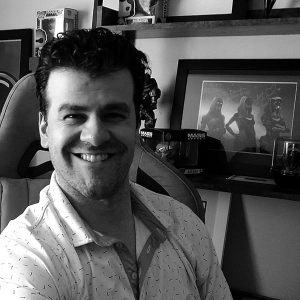
Born in Budapest, Hungary to a family of creatives, David “D.K.” Kristof immigrated to the United States as a refugee after the fall of the Iron Curtain and the end of the Cold War. A lifelong writer and reader, he earned his BA from the University of Washington in 2010. After a creative hiatus—including the turbulence of the COVID-19 pandemic—he returned to writing and poetry in 2025 with several active projects.
His most successful book to date, Bomboncita, is a 2025 NYC Big Book Award Distinguished Favorite and 2025 International Impact Awards Winner for science fiction.
Deeply influenced by the work of Isaac Asimov, Kristof’s stories explore the complex relationship between humanity and technology, often through the eyes of female protagonists navigating richly imagined worlds.
An ardent science fiction and superhero enthusiast, he is also a collector of sci-fi video game and film memorabilia. Outside his creative work, he advocates for the ethical development and use of artificial intelligence; by combining AI film with human talent through the lens of transparency, he hopes to foster and cultivate the use of AI as a tool and extension of human creativity.
He is also the creator of the triple amputee superhero SWANBLADE, an ongoing, multimedia project in collaboration with several other artists. You can learn all about SWANBLADE and her debut novel @official.swanblade on Instagram.
You can also follow Kristof @d.k.kristof
How often do you base your characters on real people?
I don’t base characters on real people in a literal sense often, but I do root them in real emotional truths. The feelings, fractures, and strengths often come from lived experience—mine or those close to me—but the characters themselves are composites. They’re shaped by memory, imagination, and metaphor rather than direct biography. I’m less interested in copying people than in honoring the way real people survive, adapt, and carry love forward. The character of John McAllister, for example, is inspired by the early life and military service of former senator and war hero John McCain, who I became familiar with at the age of 12 by means of my sixth grade teacher who, coincidentally, inspired the character of Eleanor, John’s wife.
What inspired the premise of your book?
The premise came from a collision of influences: my love of Batman and my fascination with humanity’s ever growing dependence on technology, paired with very personal questions about grief, legacy, and survival. I wanted to explore what happens after the heroic moment—after the city is saved, after the legend is built. Swanblade begins in the shadow of a hero and asks what it means to inherit that legacy while still becoming your own person.
Tell us a little about how this story first came to be. Did it start with an image, a voice, a concept, a dilemma or something else?
The story really began in a hospital room in December of 2023. I was visiting my stepfather after a serious accident. He lost his leg doing what he loved, which was mountain biking. Watching someone you admire suddenly have their life rewritten like that is a very specific kind of shock. I had never seen him afraid. Ever. For the first time, I saw fear in his eyes.
I didn’t start with a plot or a villain. I started with questions about what survives after loss, and how people rebuild without losing joy. From there, I created the idea of Swanblade, Kayla McAllister, and began to build the world around her. The images and ideas started forming: a daughter, a legacy, a body changed but not diminished. Swanblade grew out of that moment of grief, love, and stubborn resilience. The idea of creating a superhero with a severe disability always was on my mind, but that night I stayed in the hospital made me put pen to paper.
Which character was most challenging to create? Why?
The most challenging character was Simon Langley, the antagonist. He’s difficult because he isn’t born from imagination alone—he’s rooted in my own experiences with addiction, anxiety, and unresolved trauma earlier in my life.
Writing him wasn’t about judgment or redemption; it was about accuracy. Simon represents a version of myself that I had to confront honestly, and a version of myself that burned bridges. In that way, his creation became both symbolic and cathartic. Instead of positioning myself as the hero, I explored what it meant to understand the villain from the inside.
Which scene, character or plotline changed the most from first draft to published book?
Jezebel changed the most from the first draft to the published book. She started as a more straightforward antagonist, but with each revision she became more complex and sympathetic. The more time I spent with her, the less interested I was in treating her as a simple villain. I wanted all the villains to have depth, but Jezebel changed the most from the initial concept.
By the final draft, her role had shifted significantly. Without giving anything away, her arc deepened in a way that reframed her relationship to the story’s core themes of legacy, identity, and inherited trauma.
What sort of a relationship exists between you and the characters you created in this book?
My relationship with these characters is deeply personal, and I am in love with the world I have created around them. Some of them carry pieces of my history, my fears, and my love, while others represent questions I’m still asking. I don’t see them as stand-ins for myself so much as conversations I’m having with different parts of my life. Writing the book meant listening to them honestly, even when they challenged me or took the story somewhere uncomfortable.
How did you decide on this title?
I wanted a title that felt iconic and immediate—something simple and memorable in the way names like Batman work. At the same time, I wanted it to reflect Kayla’s background as a ballet dancer. Swanblade bridges elegance and violence, grace and steel, which felt true to who she is.
Within the story, the name itself actually comes later. Kayla is far more concerned with her impact than her identity at first, and the title reflects that journey—how a symbol is eventually named and embraced.
What’s next for you?
Work on Swanblade: Year One is already underway, and I’m excited to be continuing the collaboration with illustrators Paolo Reina and Roberta Sammarco. It didn’t take much to convince them. Structurally and thematically, I’m drawing inspiration from stories like Batman: The Long Halloween—darker, deeper, and richer. At the same time, Swanblade: Year Zero is being adapted into an episodic series planned for 2026. We’re approaching that adaptation thoughtfully, using the best ethical AI tools available to support the process while keeping human storytelling and artistic intent at the core.
***
 BookView Review
Leave a comment