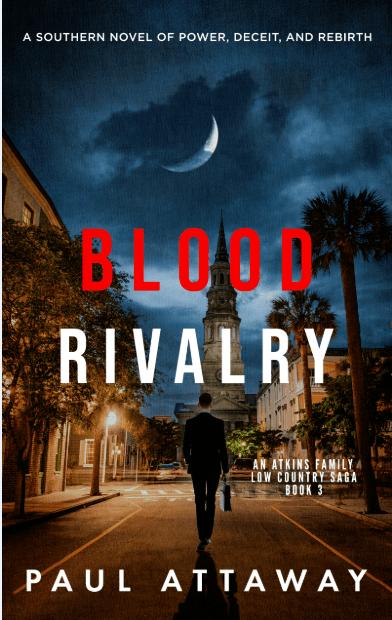
Book Blurb
Blood Rivalry, the third book in the Atkins Family Low Country Saga series, finds Walker and Eli Atkins, living in Charleston, South Carolina, fifteen years after the conclusion of Eli’s Redemption. Eli, a celebrated chef, and Walker, a lawyer, are brothers, building families and careers, each affected by the gruesome murder twenty years ago of Eli’s high school sweetheart. The hunt for the killer, in the public’s eyes, cemented Eli and Walker in roles neither wanted – Eli as the savior and Walker in need of a savior—thus casting a chill over their relationship.
Walker sees a chance to play the hero when, through his representation of two clients, he takes on the Governor of South Carolina, Johnny Dunsmore, the eldest son of Colin Dunsmore, the patriarch of a politically powerful family. For fifty years, Colin Dunsmore carefully crafted an image for the family, intent on placing Johnny in the White House. But Walker uncovers a history of deceit and murder that defines the family, and as he pulls at strings, Colin Dunsmore’s tapestry of lies begins to unravel.
Confronted with the Dunsmore’s ruthlessness and the knowledge that they will stop at nothing to win, Walker turns to Eli and together they embark on a cross-country race with the Dunsmores to secure the secrets, that if revealed, would upend their empire.
***
Chapter 9
Charleston, South Carolina Friday, June 3, 1994
Early Friday morning, Walker jogged to Burbages at the corner of Savage and Broad Street for his run with Mr. Eddie Wentworth—which Mrs.
Beasley had scheduled—and arrived right on time at precisely 6:30 a.m.
Already there waiting for him was Eddie: childhood friend, high school cross country rival, and all-around good guy. The last time they had seen each other in person was at their high school reunion nearly two weeks ago.
Eddie was sitting on the bench in front of the store, reading the morning paper, oblivious at first to Walker’s approach. Though Burbages would not open for another couple of hours, Al Burb, the family-run grocery’s second-generation owner and friend to all, could be seen through the shop’s broad picture window. The man was forever hard at work. Today, he was inside stocking the shelves.
Walker gently rapped on the front window and waved; Al returned the gesture. This exchange grabbed Eddie’s attention. He folded his newspaper and set it down on the bench, standing to greet Walker with a bright smile.
“You ready?” Eddie asked.
“Sure. What are we thinking?”
“Five miles or so work for you?”
“Sure, follow me.”
Eddie and Walker had been running and competing together since ninth grade. Hailed as two of the top runners in the Southeast coming out of high school, their duels were legendary, and their styles could not have been more different. Walker was the planner, never leaving anything to chance, always aware of his splits and his pace, and consumed by the latest shoes, running gear, and diet crazes for distance runners. Eddie, on the other hand, ate what he wanted, wore holes in his shoes before buying another pair, and didn’t even wear a watch while running. He employed a different philosophy: keep up with who was in first and then run faster than him at the end of the race. Throughout it all, they had become good friends—and now, almost twenty years later, they were great friends.
After a few minutes, they had settled into a comfortable pace and were able to carry on a conversation.
“I know you’re fond of asking the faithful-and-always-reliable Mrs. Beasley to make all of your appointments,” Eddie began, teasing, “but I’d like to remind you that you do have my phone number and can call me yourself whenever you’d like. Or are you too important for that?”
“Way too important. I thought you knew that by now.” Walker smiled and caught a glimpse of his old friend doing the same.
Eddie had worked for South Carolina’s Attorney General’s Office for the last several years. Eddie and Walker went their separate ways after high school—Walker to Georgetown University and Eddie to the University of Georgia. They were reunited in law school when Walker joined Eddie in Athens, Georgia, and they both graduated from UGA’s law school in 1986. Eddie’s plan was to get as much courtroom experience as fast as possible and then join a white-collar firm in Atlanta and begin a career in commercial litigation. During his summers in law school, he interned for the office of the public defender in Athens. His first job out of law school was with the Charleston County Prosecutors Office. He logged more time in a court room in his first two years than the top-ranked students in his law school class who joined the big firms did in their first five.
Eddie never made it to Atlanta, though. Why? Love. He fell in love with Charleston all over again, and upon his return, he fell in love with his high school sweetheart, Vanessa Rhett. They were married at St. Philips on Church Street—the church her family had attended for generations. In short order, he caught the political bug and was lured away to join the Attorney General’s Office, where he rose quickly through the ranks.
For the first mile or so, they caught up with each other, each asking about the other’s kids. Updates were hardly necessary. Their wives were the best of friends and spoke to each other almost daily. The elephant in the room whenever the four of them were together was whether Eddie would stay with the AG’s office. To keep advancing in the department—or, as some speculated, eventually run for the top position as the attorney general—they would have to move to Columbia.
Eventually they got around to the reason Mrs. Beasley set up this meeting.
“So, what do you need from the AG’s office?”
Without revealing their identities, Walker told Eddie about his new clients and about everything he had learned over the past two days concerning what he was calling the “Palmetto Enterprise”—that being Palmetto Prefab Homes, Palmetto Lending Tree, and Palmetto Quick Cash. He added that he suspected that Coastal Savings & Loan was involved as well.
Eddie stayed quiet throughout, never asking a single question.
Walker had led the two of them north on Ashley Boulevard, east on Calhoun, and down East Bay to the Battery. They were now heading up Rutledge and would be back in front of Burbages in a couple of minutes. They stopped talking with maybe a quarter mile to go and couldn’t help themselves—they sprinted up to the corner, Eddie edging Walker out by a stride.
As they were catching their breath, Al exited his store and brought each of them a bottle of water. “You two are nuts, you know that?”
“Thanks, Al,” they responded in unison.
“Don’t thank me. I put it on your tab,” he said as he walked back inside.
Eddie and Walker tipped their water bottles towards each other as if to toast. “To Burbages, the best neighborhood grocery store in the business,” said Eddie. “You know, I remember walking here as a kid and buying push-pops from Al’s dad.”
“To Burbages,” replied Walker.
Eddie gathered himself as his breathing and heart rate returned to a normal resting rate. He stood with one hand on his waist, his head tipped back as he drained the water bottle. Eddie was of average height but longer in the legs than most. His hair was still best described as sandy blond and tussled, but what set him apart from others—in looks, that was—were his eyes: one was green and the other blue. The effect fed his easy-going manner. Nothing ever seemed to upset Eddie, and he was everyone’s friend.
“Walker, some of what you told me today is news to me, but not everything. Our office has received complaints about the trio of Palmetto companies, ranging from defective workmanship on the prefab houses to predatory lending. We’ve also suspected a nexus with Costal S&L but can’t prove anything. Could you drop by our office this afternoon, say around 3:30? I have a standing meeting with the boss every Friday afternoon, and I’d like him to hear what you have to say.” “Love to. See you this afternoon.”
Eddie took off jogging back to his house on Legare Street and Walker towards his on Tradd.
* * *
Eddie and Joshua were already hard at work when Walker was shown to Eddie’s office at 3:30 that afternoon, as scheduled. Walker and Joshua weren’t strangers, so introductions were skipped. After hands were shaken, Walker took a seat in a chair next to Joshua, across the desk from Eddie.
Joshua wasted no time. “Walker,” he said, brusquely, “Eddie was just filling me in on your new client and the legwork you did this week. Wanna tell me what you’ve learned?”
“Prospective new client,” corrected Walker, “but yes, I’d be happy to.” “Prospective?” asked Joshua as he looked at Eddie. “Am I missing something here?”
“No,” said Walker. “Let me explain. I will in all likelihood take them on. It’s just that there’s one more thing I want to check out first before doing so. And, since we haven’t signed an engagement letter, technically, I can’t call them my clients.”
Eddie looked at his boss. “You good?” Joshua nodded that he was, and Eddie turned back towards Walker.
“What have you covered so far?” asked Walker.
“I told him about your visits to the various Palmetto enterprises and was about to tell him what you found at the Secretary of State’s office when you walked in. Why don’t you pick up there?”
“Sounds good,” said Walker. “Can I use the whiteboard on the wall over there?”
Eddie handed Walker a few dry-erase markers and turned his seat towards the whiteboard. Walker spent the next few minutes drawing a multilevel organizational chart of every partnership and corporate entity he had uncovered, including their places of domicile, with lines connecting the legal entities together in a way that made the entire architecture resemble an electric circuit board. While he was doing this, he occasionally glanced over his shoulder and couldn’t help but notice that Joshua was looking on in disbelief.
“So, it’s true, what they say about you,” said Joshua. “You have a photographic memory.”
“That’s probably an exaggeration, but concerning my work product, yes, my recall is pretty good.”
The AG was clearly impressed.
“You mind telling me your next step?” asked Joshua.
“No, not at all. First, in representing my client, if they become my clients, that is, I’ll wait until the lender files the suit to foreclose on their home. It’s my hope that between now and then, I’ll uncover grounds for a countersuit and damages in favor of my client.”
“Is a bankruptcy filing in their future?”
“I hope not, but it may come to that if I can’t convince a judge to forestall the foreclosure sale of their home.”
“Understood. Then what?”
“Answering that question, sir, is partly why I approached Eddie. I still have work to do before I can formulate the basis for a suit, but I expect to find the basis for complaints against the developer and the lender. That will start the discovery process and given what I learned about the domicile of the dozens of partnerships and corporate entities shielding the identity of the people running this operation, I anticipate a lengthy, cantankerous, and expensive discovery process. I know it shouldn’t matter, but since I’m taking this case pro bono, the reality of the expenses I will incur means that, at some point, it will matter. No doubt the defendants will sniff this out, and time will then become their ally—and delay, their weapon.”
Walker looked to Eddie and then back to Joshua. “I understand that your office has received complaints from others about these companies,” said Walker as he pointed at the whiteboard. “I’m wondering if your office has enough to bring criminal charges. Doing so would certainly help my client’s case.”
Joshua stood from his chair and started pacing before saying anything. He looked out the window and began speaking with his back to the room. “Walker, this office may be able to muster resources you don’t have, but at the same time, we don’t have the resources to root out every criminal in the state. On top of that, you have certain advantages we don’t have.”
Walker and Eddie exchanged curious glances, and then Joshua turned around, facing them again as he said, “I’m going to let you in on some-thing. We’ve been investigating some of these predatory lenders around the state. The problem is there are no usury laws on the books, so we can’t prosecute someone for charging some poor schmuck a ridiculously higher interest rate because traditional banks won’t lend the guy a dime. So, we’re left with pursuing these lenders on the grounds of fraud—which is very hard to prove. So, the answer to your question is: no, we don’t have enough to bring criminal charges. Now, if we can find a connection to Coastal S&L . . . well, that’s a game changer.”
“I understand, but what did you mean when you said I have advantages you don’t have?” Walker asked.
“You’re not us. Bad guys can smell cops and prosecutors a mile away. Look at what you’ve learned already. And you’re smart. We’ve got some real talent in our office, but it’s spread too thin.” He paused, scratching his chin for a moment. “This is what I’d like to do,” he went on, looking at Walker directly. “I want to hire you as a consultant. You share what you find with us, and we share what we find with you. Once we have enough to call a grand jury, we will, and if we issue an indictment, we can bring the weight of the State down on these guys. What do you say?”
Walker could hardly contain his excitement, but Joshua continued selling the idea before Walker could speak up.
“Eddie will be your contact. There’d be some paperwork for you to sign, and we can’t pay you the same hourly rate you’re used to, but it might help you carry this pro bono matter to a just end for your clients.”
Walker was ready to go all in, but as he said earlier, he had a little more due diligence to conduct. Joshua seemed to read his mind. “You said there was one more thing you wanted to run down before deciding whether to take on the couple you mentioned as new clients. Mind if I ask what that’s all about?”
Pointing at the diagram on the whiteboard, Walker answered the question. “In all my research to date, I’ve only found one name associated with any of these companies—a registered agent in the Bahamas named Anthony Ferguson.”
“And you’re going to track this guy down?” asked Joshua.
“Exactly.”
***
Chapter 10
Charleston, South Carolina, Friday, June 3, 1994
Walker sat on the screened-in porch with his feet up, enjoying a drink and reading John Grisham’s latest novel, The Client, while he waited for Isabelle to get ready.
They had a sitter, and Eli had promised to save them two specials that night, but dinner wasn’t for another couple of hours. The AG’s office had been Walker’s last appointment for the day, so he strolled into the house around 4:30, which gave him some time to play with Anna and Peter in the backyard before the sitter arrived. She had already left and taken the kids to the park across the street from Colonial Lake to play with some other children.
Isabelle walked onto the porch wearing a simple yellow sundress and flat sandals. She had her mother’s dark, thick, lustrous hair and her father’s green eyes. She usually wore her hair shoulder length but had cut it recently in anticipation of another hot summer. Walker had fallen in love with Isabelle the first time he saw her when she was working as a waitress at Wappoo Country Club all those years ago. She had spilled an entire pitcher of water across the table. Mortified and in tears, she shrank away to hide in the kitchen, but Walker was mesmerized; and he still was today. They were sixteen when they met.
“Honey, you want to play some dominoes before dinner? We’ve got plenty of time.”
“You think your fragile male ego can stand another ass-kicking?” she asked, winking.
“Baby Doll, I let you win last time. We both know that.”
“Ha! Sure, set ’em up. I’m going to pour myself a glass of wine and be right back.”
Walker followed her back into the house and freshened his drink. “How was your meeting with the City today?”
Isabelle worked for the Charleston Historical Preservation Society. This foundation was one of several in town dedicated to preserving the history of Charleston. They were most closely associated with ensuring that the historic homes across the peninsula were preserved, maintained, and not replaced. However, their charter extended far beyond the physical preservation of the city’s beautiful buildings and homes. The organization saw themselves as preservationist for the soul of Charleston and of the memories of the people who had lived and died in the Holy City. This meant preserving and, where appropriate, honoring the good, the bad, and the ugly of a city with stories and memories echoing back to the Colonial Era.
Isabelle had double-majored at the College of Charleston, earning one degree in American History and another in Historic Preservation and Community Planning. After she’d completed her four years of college, she received a doctorate in history. She wrote her thesis on the impact the migration of the Loyalists who fled the Southern Colonies during the Revolutionary War era had on life in the Bahamas. Isabelle was proud of her work but shied away from the pretense of calling herself a doctor. “Doctors save lives,” she’d say. Nevertheless, at her employer’s insistence, her business card read “Dr. Atkins.”
“Good. They’re going to let us use the old Ryan Slave Market on Chalmers Street for our photography exhibit later this fall.”
“That’s great news. So how is it shaping up?”
“We have a lot of work to do between now and then, but I’m hopeful and excited. Nailing down the location for the exhibit is a big step in the right direction.”
The Historical Preservation Society would be working with the Charleston Library Society to host an exhibit that would bring together underrepresented photographers from around the South. The exhibit would take place in October during the annual Fall home and garden tour, a time when many of the exceptional homes on the peninsula were opened to the public.
“How long has that building been empty?” asked Walker.
“About five years now. The city has plans to build a museum on the site, one that would explore and discuss the history of slavery in this country, but it’s still a couple of years out.”
“Good for you. I look forward to seeing what y’all put together. Okay, you ready to play?”
“Born ready,” she said as they each turned over a domino.
Walker turned over the higher-numbered tile and would go first. After they had each selected their seven dominos, Walker began by downing the double six, a spinner out of the gate. Isabelle surveyed her hand, and having only one six, surmised that Walker was long in that suit. Not liking her play but having no choice, she played the 6-0 domino, which drew Walker’s play as if he’d known it was coming. The 0-3 gave Walker 15 points. He smiled smugly and moved his peg three spots on the cribbage board, which was how they kept score.
As play continued over the next thirty minutes, Walker filled Izzy in on the Gastons, his investigations earlier that week, and his meeting with the AG. Walker had rounded the corner and had a commanding lead until late in the game. On the next round, Izzy played to her long suits by capping each row in a suit in which Walker was void, sending him to the boneyard. He pulled six dominoes before landing on one he could play. Izzy went out and took all the points Walker held, giving her a slight lead.
“So, you’d be working with Eddie?” “Yep.”
Izzy’s silence rang in Walker’s ears. “What? Do you see a problem with that?”
“The Boys & Girls Club. Your work with the church. All the other charities you’re involved with . . . Then there’s your professional organizations and your regular legal practice. Oh, and let’s not forget me and the kids.” Her voice was rising. “And now you’re going to become a crime fighter, too?”
Walker shut his eyes tight. He could feel his frustration level rising.
This was important to him. Why didn’t she see that?
Walker felt Izzy’s hand on his and opened his eyes to find her leaning over the game table and staring at him with a mixed look of love and concern. “Honey, I know you. You’ll go all in on this. Is this going to conflict with your representation of the Gastons? I mean, are you going to focus too much on helping Eddie jail every crooked businessman in the state and forget that your first job is to help the Gastons out of their mess?”
“I haven’t decided to take them on as clients yet.”
“Yes, you have. You’re simply doing all this extra work to fool yourself into thinking you’re making an informed decision, but you’ve already made up your mind. Haven’t you?”
Walker stared into his hands and mumbled quietly, “Yep.” “And you’re going to take up the AG on his offer, too.” “Yep.”
“I hope you find the peace you’re looking for. I do. I really do. Not just for you, but for our marriage. These kids don’t raise themselves and all too often you’re here in body but not in spirit.”
The silence returned.
“They need a father. They need you.”
Walker slowly nodded his head. “Just support me in this and when it’s done, I’ll slow down. I promise.”
Izzy cocked her head to the side and gently swept a loose strand of hair behind her ear. “I’m going to hold you to that.”
They each relaxed.
“Okay. Shall we finish this game or just head out to dinner?” asked Isabelle.
“We’re finishing, Baby Doll. I’m about to win.”
“Watch it, big boy, or that’ll be the last time you get lucky tonight,” she said, smiling right back at him.
* * *
Walker and Izzy had a wonderful dinner at The Abaco. They stayed late, and as the crowd dwindled, Eli and his wife, Rachel, joined them.
While the wives caught up with each other and talked about their kids and their work, Walker and Eli talked about the mess Major League Baseball had turned into, with league realignment taking shape and the looming strike. The Braves had won the last three National League Division titles and were due to win a world series. The timing of the strike was awful if you were a Braves fan. The stars had aligned; their pitching rotation was one for the ages. It would be a shame if they couldn’t capitalize on it. But after talking baseball, Walker turned to Eli to talk to him about what really interested him: a trip to Nassau.
“What’s in Nassau for you?” asked Eli. “I’m not sure. Answers, I hope.” “Answers? To what kind of questions?”
“I have some new clients. Not my usual trust and estate work, but they need help and I can help them. Well, the little work I have done so far has turned up what may be a criminal enterprise involving offshore companies and partnerships, many of them domiciled in the Bahamas. I’ve found the name of a lawyer in Nassau, who I want to track down.” He leaned in a little closer, lowering his voice. “I can’t tell you much right now, but I met with Eddie in the AG’s office, and they’re interested in what I may learn.”
“Then let them go,” Eli counseled, narrowing his eyes. “If it’s a criminal enterprise, I don’t think it’s a good idea for you to be looking into them. We have a state department for this type of work, Walker.”
Walker recoiled slightly, taken aback by his brother’s resistance. “Look, Eli, I’ve been in this business for a long time—”
“Then you should know better and stay out of this,” Eli countered, sipping his beer.
“I don’t need you protecting me.” It was an effort not to raise his voice. Who the hell did Eli think he was? Walker glanced at Izzy and Rachel to confirm they weren’t listening in and gave his brother a pointed look. “I know what I’m doing. This is white-collar crime stuff. It’s nothing violent or dangerous.”
“Oh, little brother—”
“Don’t give me that little brother crap,” Walker blurted, angrily peeling the label off the beer in his hands. “I’m no kid. I know how to conduct myself.”
To his chagrin, Eli shrugged, clearly not taking him seriously. “In my experience, folks get violent when you start messing with their money, and if they’re hiding behind banking secrecy laws, then they are hiding more than just money.”
“I’ll be all right. I’m going to visit an office or two and see what I can learn, that’s all. I’m just wondering if you still have any contacts in Nassau, what with all you went through there,” said Walker.
Eli sat quietly and stared at Walker. “Trying to save the world, are you?” he said eventually, voice neutral. Walker couldn’t tell if he was being genuine or mocking him. “Always looking out for the little guy.”
Walker shrugged. “They need help. I can help them.”
Eli remained silent for a little longer, looking at Walker in a way that was impossible for him to decrypt.
“I’ll make a call.”

Author of the Amazon Best Seller “Blood in the Low Country”
Paul was born and raised in the Atlanta, Georgia area. Paul and his wife, Lyn, met in college at Georgetown University and were married after Paul graduated from the University of Georgia School of Law. They moved to Phoenix, Arizona in 1988 where Paul embarked on a thirty-year business career before retiring so he could write fiction. Paul and Lyn raised three children together in Phoenix and now live in Charleston, South Carolina.
Blood in the Low Country is Paul Attaway’s debut novel. Writing this book, along with the move to Charleston, is a coming home of sorts, a return to the South. The history and culture of America’s South is rich, complicated, at times comical, sad, tragic, uplifting, and inspiring. Paul hopes that his novels capture even a small bit of this tapestry.
You can learn more about Paul, his upcoming appearances, and his next novel at http://www.paulattaway.com.
 BookView Review
Leave a comment