Welcome to BookView Interview, a conversation series where BookView talks to authors.
Recently, we interviewed Alejandro Torres De la Rocha about his writing and recently released book, Mortal Vengeance: A Grim Tale, a chilling coming-of-age thriller about fractured loyalty and the relentless consequences of revenge (Read the review here.).
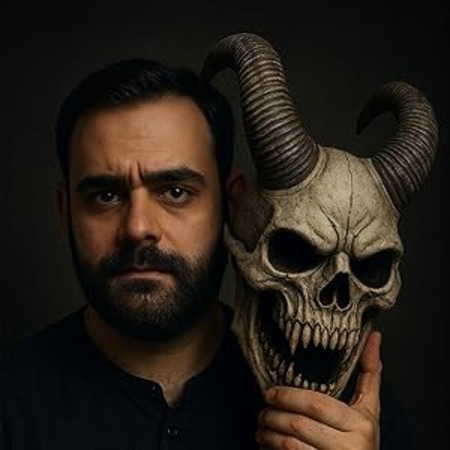
Alejandro Torres De la Rocha is a Dominican-born and raised writer, trainer, and creative strategist who has never fit neatly into a single box—and frankly, never tried to. He holds a Bachelor’s in Advertising Communications from UNIBE and a Master of Science in Public Relations and Corporate Communications from NYU. He also survived twelve years of Jesuit school, which gave him discipline, a moral compass, and an insatiable desire to question authority—all of which show up in his work whether he invites them or not.
His career has taken him everywhere from community manager to marketing director, thriving in roles that blend storytelling, corporate training, performance, and just enough chaos to keep things interesting (and HR slightly nervous).
His writing is unapologetically influenced by Kevin Williamson (Scream, Teaching Mrs. Tingle, Dawson’s Creek) and Joss Whedon (Buffy the Vampire Slayer, Angel, Dollhouse, The Avengers—back before the fall from grace). Expect sharp dialogue, psychological warfare, broken pretty people making worse decisions, and just enough emotional carnage to leave you wondering why you feel personally attacked.
His debut novel, Mortal Vengeance, was born out of literal, petty teenage revenge—written after being grounded for failing Spanish during his freshman year at Jesuit school. To avoid getting blood on his hands (a very Alex move), he poured the rage into storytelling. With no desktop, no internet, no Nintendo 64, and a house full of disappointment, he wrote. What began as a movie script meant to make characters pay for sins only he understood became something deeper: a reset button. Writing gave him a way to process emotions, reimagine his future, and gain control—not through violence, but through narrative. Mortal Vengeance was his personal auto-correct. And a warning shot.
He’s currently based in Barcelona, Spain, where he continues to write, train, create, and occasionally cause just enough trouble to stay interesting.
When he’s not writing, he’s probably judging you, binging shows (yes, even the trashy reality ones—hey Andy Cohen, call me!), or overanalyzing fictional villains like they’re his exes.
Because for him, they kind of are.
https://aletorr.es
https://mortalvengeance.com
https://www.linkedin.com/in/aletorres/
https://www.goodreads.com/author/show/57233705.Alejandro_Torres_De_la_Rocha
Do you find writing therapeutic?
Absolutely. I started writing seriously at fifteen, when I had too much time, a lot of anger, and no idea how to manage my emotions. What began as a petty revenge fantasy turned into something healing. Writing—whether a novel, script, poem, song, or article—helps me organize my thoughts, understand my feelings, and see situations from different perspectives. More than anything, it gives my emotions a healthy outlet. It doesn’t fix them, but it releases them—and that matters.
Does a big ego help or hurt writers?
Everything in excess is bad, and ego is no exception. Ego can help—you need a certain confidence to believe your story deserves to exist. But it can also get in the way. When I finished my first novel, I received feedback about unanswered questions, the antagonist needing more scenes that showed rather than told their cruelty, and the need for more quiet moments. My response back then was, “I wrote the story that I wanted to tell.” That was my ego doing the talking.
Once I “L’Eggo my Eggo” and really listened to what was being said, it helped me add a chapter I’m extremely proud of and that I believe improved the story completely—the B-Roll in Mortal Vengeance. Anyone who writes knows how impossible it is to see your own work with fresh eyes. I had to trust my readers, listen to their feedback, and put my ego aside. In the end, I stood my ground—but applied that feedback by writing Mortal Vengeance: A Grim Tale, a prequel that functions as the how-dunnit missing from book one, which is a whodunnit.
Do you try more to be original or to give readers what they want?
It’s not that it’s wrong to give readers what they want. It’s just impossible. You can’t make everyone happy; you can’t give everyone what they want. You have to acknowledge and deliver the best story that you can. Be true to your characters, make the universe and setting live, and trust your readers to enjoy it.
If you read Mortal Vengeance, you can easily see my influences: Scream, I Know What You Did Last Summer, and Teaching Mrs. Tingle. Back when I wrote the OG script in 1999, instead of the Grim Cojuelo, I had the Grim Reaper as a “Ghostface” knock-off. Perhaps you could say that in the whole it’s not that original, yet there are unique elements in the story that do make it stand out from my influences, such as the setting, the character depth and villain motive, the use of the B-roll, and trying to bring other visual mediums as prose.
How often do you base your characters on real people?
I’d say about half-and-half. It really depends on how the character is portrayed—and whether telling the person would complicate things. Even when a character is inspired by someone real, you inevitably take creative liberties, and at that point it stops being a one-to-one translation.
For example, in Mortal Vengeance there’s a gay character based on a straight person. Telling them, “Hey, this character is based on you,” could open the door to unnecessary tension—either because they might want changes since “that’s not them,” or because they might fear others assuming the character’s sexuality reflects their own. Context matters. The story is set in the Dominican Republic, where—even now in 2026—this concern is still very real. On the other hand, the character of Lucía in Mortal Vengeance: A Grim Tale is based on someone I once trained and coached at work. She gave me incredible feedback on Mortal Vengeance, and I told her I’d base the character on her. That felt right, and it was done with transparency and respect.
In the sequel, I also introduced a character inspired by a former boss. I never told them—and I’m keeping this description gender-neutral—because there were aspects I borrowed that they might not appreciate. That said, the portrayal is never mean, degrading, or insulting. It’s about observation, not revenge. Ultimately, basing characters on real people is a balancing act. Inspiration is inevitable, but discretion is often necessary. Once fiction takes over, the character belongs to the story—not the person who sparked the idea.
What’s more important: characters or plot?
One of my biggest pet peeves is the conditional “or.” Why do I have to choose? I don’t want this or that—I want this and that. You can have a great plot, but if the characters are weak, it will undermine the story and pull readers out of it. The same is true in reverse: a great character trapped in a plot that doesn’t work will ultimately be forgettable.
In Mortal Vengeance, you’re in the thick of the final confrontation and suddenly the forward momentum shifts. The next chapter takes you back in time to show you how the group of friends formed in first grade and how it developed until their senior year. It brings the plot to a halt, but the character work that happens here is needed. Everything that comes next—from seeing their innocence to the brutality they’re living now—is devastating. They go from being characters to being humans. Now, why did I put it there? Right in the middle of the final confrontation? Well, this chapter is told through a series of vignettes, and we have someone apparently opening those video files. The ending ultimately connects to the major plot and affects the outcome. That’s the balance—the chapter does deep character work while also serving the plot. It’s not one or the other. It’s both.
What’s the most difficult thing about writing a novel?
For me, the challenge is balance. I’m a big TV fan, and I often think about the difference between shows with eight episodes per season versus the old twenty-two-episode model. With eight episodes, you usually get a tight, efficient story. With twenty-two, writers had room for bottle episodes, detours, and experiments that weren’t strictly necessary to the plot but helped deepen character, expand the world, or take creative risks.
On one hand, those detours can make a story richer. On the other, I don’t want the side dishes to distract from the main course. The real difficulty is deciding what earns its place—and then making sure those detours connect back to the core story, even when they initially feel unnecessary or ridiculous. In Mortal Vengeance: A Grim Tale, the tone is dark and gothic, and then something happens that feels completely out of place. It was an intentional moment of levity, but it didn’t make sense initially. I couldn’t justify it to the reader, and at first, I couldn’t even justify it to myself. Until I did. Once it clicked, that “fun experiment” stopped being indulgent and became essential. Not only did it work within the story—it ended up shaping the direction of the sequel, Mortal Vengeance II: To Reel or Not Too Real? That is the hardest part: knowing when to let yourself experiment—and when to demand that every experiment earn its place.
What are common traps for aspiring writers?
Based on my own experience, one of the biggest traps is going straight from first draft to publication. Finishing a first draft is an achievement—shake your own hand, pop some champagne, enjoy the moment. Then step away.
Distance matters. Come back to the draft later and reread it with fresh eyes. Look for storylines that never go anywhere, scenes that don’t earn their place, moments that could be shortened—or expanded. Then revise again. After that, get beta reader feedback, ideally from more than one person. Don’t change something just because one reader didn’t like it. Look for patterns. If a majority of readers flag the same issue, it’s worth addressing. But also accept that you’ll never get everyone to like everything—and that’s fine.
Another common trap is over-explaining or holding the reader’s hand too tightly in the name of clarity. Writing should be clear, but clarity doesn’t mean spelling everything out. If a character doesn’t know whether something is real or not, why immediately clarify it for the reader? Let them sit in that uncertainty. Let them experience the story from inside the character’s head. Finally—and this is one I’ve been guilty of—relying too heavily on metaphors and similes. When they’re overused, they start to dilute the impact of the ones that really land. Balance is key. Restraint makes the language stronger.
What one thing would you give up to become a better writer?
Distractions. And by that I mean anything and everything. I started writing initially after my parents took my Nintendo 64, my dial-up internet connection, and my TV. I had nothing else to do. So when I sat down to write, well, I wrote. And did nothing else. I didn’t have one eye on the TV. Since it was late at night, no one was coming into my room, and since I was incommunicado no one was calling me, or sending me messages.
These days, the distractions haven’t gone completely, but I do my best—even if I’m writing on my phone—to not open any other apps unless it’s for research. Distractions don’t just steal time—they fragment attention. Writing requires sustained focus. You can’t hold a whole story in your head, track character arcs, and maintain tone if you’re checking your phone every ten minutes. During these times, you can imagine how “popular” I am with my family and friends when they try to reach me while I’m in the thick of it.
Do you read your book reviews? Can you learn from criticism?
People often say, “Never read the comments.” For authors, I guess that translates to “never read the reviews.” But if you put your work into the world, you can’t expect people not to have opinions. If you can’t handle negative feedback, then either don’t publish—or don’t read the reviews.
I despise criticism for the sake of being cruel. Saying “I didn’t like it” is fine; that’s taste. But saying “horrible villain” or “the main character was stupid” without explaining why is useless. Give me something I can work with. I look for the “why” behind the “what.” I welcome constructive criticism—even in one-star reviews. The rest, I ignore.
How hard is it to establish and maintain a career in fiction writing?
Once I’ve fully established a career in fiction writing, I’ll be able to give a more definitive answer. But from where I’m standing—in the barracks—it’s hard. Very hard. Getting your work seen can feel almost impossible. There are structural barriers everywhere: lack of connections, the reality of being far from New York, LA, or the UK where the industry is concentrated, and publishers who don’t accept unsolicited manuscripts. The gatekeeping is real.
There’s always the self-publishing route, which is the one I’ve taken. It allows you to get your book out into the world, but without an editorial team or publisher behind you, visibility becomes the real battle. Reaching your target audience, securing reviews, and promoting the book quickly turn into expensive endeavors. Even before publication, the hurdles start. Editors are essential, but there are many types—developmental, line, copy—and they’re rarely affordable for the average author. So yes, it’s possible. But it’s not romantic, it’s not easy, and it’s definitely not linear. Writing the book is only the first battle.
***
 BookView Review
Leave a comment