Welcome to BookView Interview, a conversation series where BookView talks to authors.
Recently, we talked to Karl Wegener about his writing and soon-to-be released spy thriller, Operation Nightfall: The Web of Spies, a taut, gripping exploration of covert operations, brimming with moral complexity and razor-sharp suspense. (Read the review here).
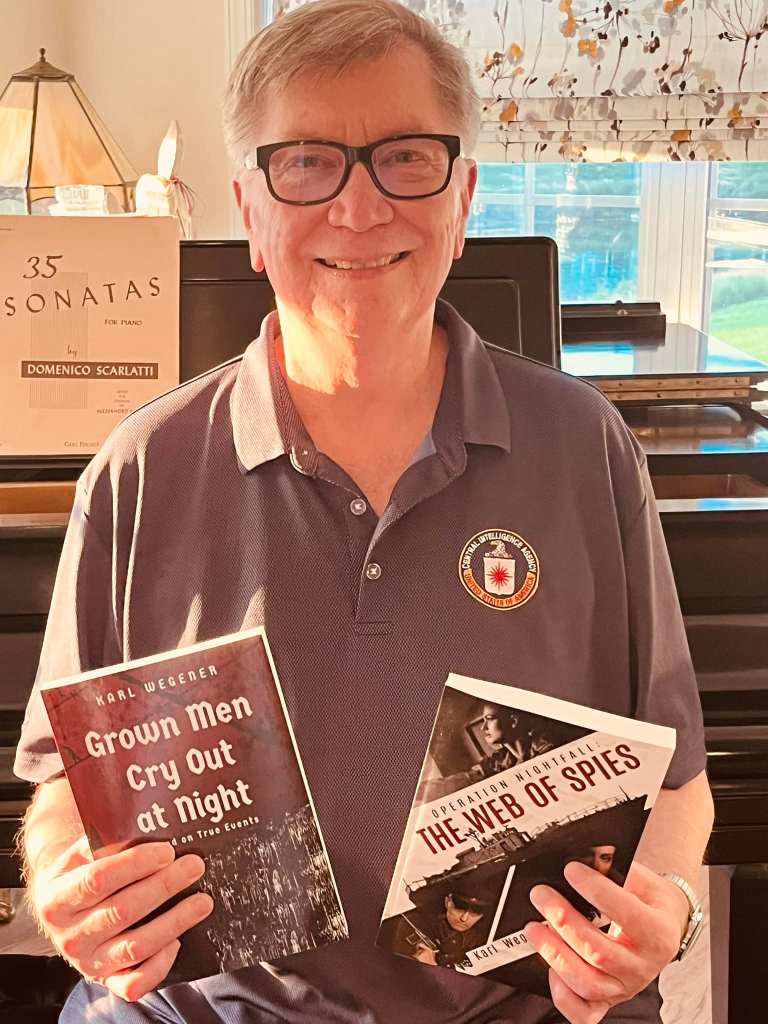
Karl Wegener is an American author who served as a Russian linguist in the United States Army Security Agency and with the Intelligence & Security Command during the Cold War. He also served as a combat interrogator in the United States Air Force Intelligence Service Reserve.
Upon leaving active duty, he served as an intelligence and targeting analyst and worked on issues that included Soviet and Warsaw Pact force readiness, Soviet tactical and strategic missile system deployment and doctrine, and nuclear weapons logistics.
With the end of the Cold War and the collapse of the Soviet Union, he began a nearly 30-year career in marketing and advertising,. He was a vice president of marketing and product planning for a large Japanese consumer electronics company. He also worked as a freelance content strategist, copywriter, and editor for more than 15 years until he gave it up for the good life. He retired and moved to be near the ocean.
Nowadays when he is not writing, he enjoys cooking for friends and family. Sunday night dinner is his favorite event of the week.
Grown Men Cry Out at Night is his first novel. He currently resides on the East Coast of the United States with his wife and two dogs.
What is the biggest challenge you’ve faced as a writer?
My biggest challenge has been my health. I was diagnosed with cancer in 2022, the year I published by debut novel, Grown Men Cry Out at Night. Over the course of the next year as I was working on Operation Nightfall, which is a sequel, my health deteriorated. I underwent nearly three months of chemotherapy and eventually surgery. I had to stop work on Operation Nightfall in the summer of 2023 and couldn’t return to writing until late November. It was a challenge to get back into the book, the plot, the characters.
Fortunately, I’m pretty disciplined so I was able to meet my deadline to complete the manuscript by April 2024 and submit it to my editor. She knew of my situation of course and worked very hard to ensure the story flowed. I was very worried the book would come across as if it was written by two different writers. But, I’m happy the way it turned out and the early reviews have been very favorable.
Why did you decide to write novels about the Cold War?
World War II and the Cold War shaped my life. Both of my parents were affected by the war. My father served as a soldier during the war. He met my mother when he was stationed in Occupied Germany after the war. My mother, who was born in Bremen, Germany lost her first husband during the war; he was a German soldier and was killed in what is today Bosnia. She had to raise two daughters, my half-sisters, on her own.
The Cold War, especially during the 1950s, dominated life in America. I still remember doing “duck and cover” drills in elementary school. There was a constant fear in the background of nuclear war between the Soviet Union and the United States. So, I was very surprised to learn several years ago when I was undergoing physical therapy for a shoulder ailment, my therapist had never heard of the Cold War. She vaguely had a notion that we had fought in World War II.
So, that is what made me want to write about the period. I’m amazed that despite the many thousands of books, films, television series, and so on written about the war, there are still stories to be told. And I decided to take it a step further by focusing on the lesser-known stories of the war and the Cold War. I want to bring those stories to a new generation of readers and make those stories accessible to them.
As a writer of historical fiction, how much research do you do, and how long do you spend researching before beginning a book?
I’ve only written two books and they each have taken about 15-18 months to write from start to finish. That includes the research, which in each case took me about 3-4 months. Thankfully, I have a degree in history, so I have a fairly good understanding of the events that transpired. I’m writing a series, and I know which events in history will provide the background for my books.
A bigger challenge is to not let research get in the way of writing and telling a story. As a former intelligence analyst, I love to do research. For someone like me, I can easily become lost in arcane facts and events that in the end may not push the plot forward. I can easily become so involved in research I would never get any writing done.
So, I no longer allow research to get in the way of my writing and storytelling. I learned this from listening to an interview with the writer Amor Towles. The interview was conducted not too long ago after he had published A Gentleman in Moscow. What he said completely floored me. He said he does not do a lot of research prior to writing. He does most of his research AFTER he completes a novel. Once I heard him say that, I adopted the same approach, and I no longer become mired in the minutia. I write and make corrections to historical details after I’ve completed the manuscript. This approach has become very liberating for me.
Does writing energize or exhaust you?
It’s a little of both, I think. I’m a slow writer. I take a long time to craft sentences and paragraphs, so the process can be painfully slow and exhausting to me. I’m not sure who said it, but I certainly agree with the quote, “I hate writing. I love having written.”
I will also say, however, that writing provided a therapeutic outlet during my recovery from cancer surgery. And now that I’ve been diagnosed with Stage IV cancer, and that a cure is effectively off the table and no longer possible, I am more determined than ever to complete the series of novels I had originally envisioned. Writing has given me a sense of purpose, a reason to get up each morning.
How often do you base your characters on real people?
All of the characters in my books are fictional, but most of them are based on historical figures, real people who actually lived. For example, the character Luba Haas who is featured in both of my novels is a fictional character based on the real-life hero and Special Operations Executive Agent, Krystyna Skarbek, or Christine Granville as she was known in Great Britain. Skarbek was the first woman to serve in the SOE during the war and served in combat longer than any female SOE agent. Caspar Lehman, who also appears in both of my novels, is a fictional character. But I based his military service record on that of American writer J.D. Salinger, who served in the U.S. Army Counterintelligence Corps as a special agent during WWII.
How do select names for your characters?
This is actually kind of funny. I’ve done extensive genealogical research into my family’s history. So, many of the names of characters in my books are the names of my ancestors. I like to think they are having fun with it, as if they are playing roles in a play. At least I hope they see it that way.
Is there anything in your life that you would like to “unlearn?”
I don’t think so. Like most people, there are many things I wish I could go back and change. I wish I could undo mistakes I made. But, there is a line from a play by Edward Albee that has always struck me. It comes from his play “A Zoo Story.” The character, Jerry says, “Sometimes it’s necessary to go a long distance out of the way in order to come back a short distance correctly.” I think that quote pretty much sums up my life. I’ve traveled a long and circuitous path to get where I am today. But, I’m exactly where I am supposed to be.
***
 BookView Review
Leave a reply to An Online Interview and Review – Karl Wegener Cancel reply