Welcome to BookView Interview, a conversation series where BookView talks to authors.
Recently, we interviewed Suzanne Domel Baxter about her writing and recently released book, Credentialed Dietetics Practitioners with Disabilities Get the Job Done, a practical and thoughtful volume that speaks to educators, students, employers, and colleagues alike, inviting them to reconsider how access, equity, and professional standards intersect in everyday practice (Read the review here.)
The business (or company) name for Suzi’s books is SDB Books LLC.
Suzi is a registered dietitian, author, and disability advocate who was born and raised in Texas. She now lives in South Carolina with her husband and their two Siberian cats. She is the middle child, with an older sister and a younger brother.
Suzi holds a BS degree and completed the Coordinated Program in Dietetics at Texas Christian University. She went on to earn her MS and PhD in nutrition from Texas Woman’s University and completed a post-doctoral fellowship in nutrition research at the Medical College of Georgia.
Her career as a dietitian has been rich and varied. Suzi began her professional journey working with children with disabilities in a residential school. She later worked in a hospital clinic for adults, in school foodservice, and for the Women, Infants, and Children Program. Most notably, she spent most of her career as a university faculty member conducting nutrition research.
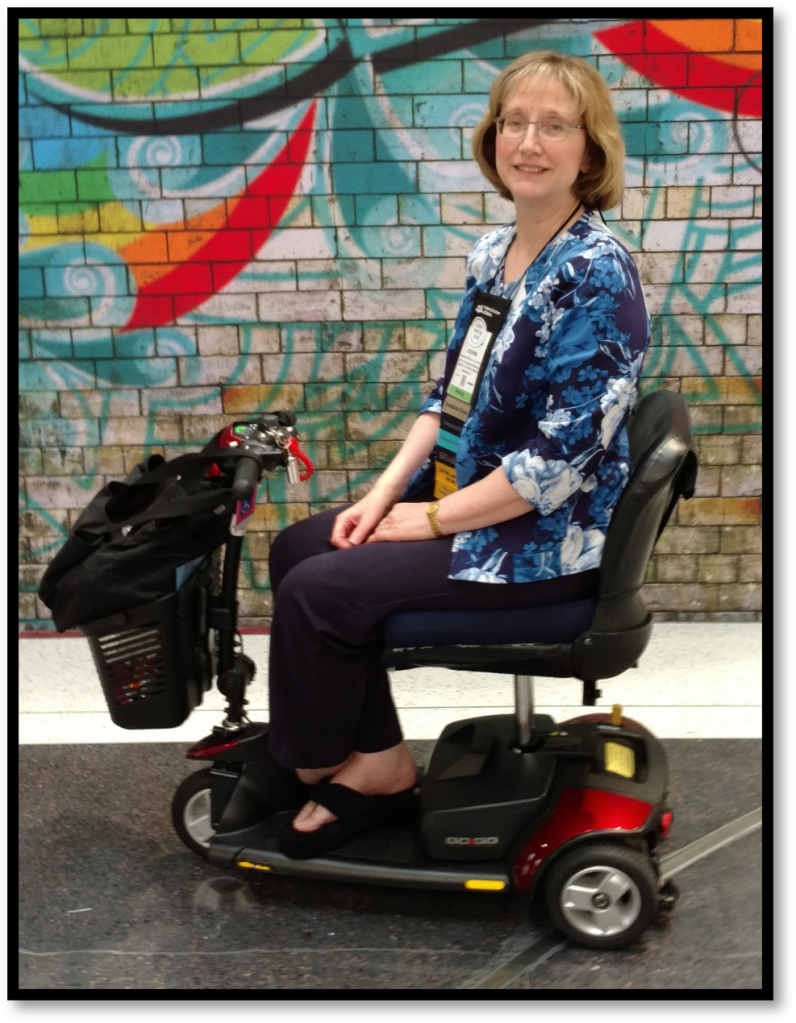
In 2010, Suzi acquired a mobility disability affecting her feet and hands, leading her to stop driving and begin using a power scooter. She stepped down from her faculty position in 2016. This life change deepened her connection to the disability community and fueled her passion for advocacy. Suzi co-founded the Disabilities in Nutrition and Dietetics Member Interest Group within the Academy of Nutrition and Dietetics, where she served as the Inaugural Chair and later as Past Chair.
Suzi’s contributions to the field of dietetics have been widely recognized. She was named the “Recognized Young Dietitian of the Year” by the Dallas Dietetic Association in 1987 and “Outstanding Dietitian of the Year” by the South Carolina Dietetic Association in 2012. Her scholarly work earned her the “First Author Publication Award” from the Research Dietetic Practice Group in 2016 and the Elaine R. Monsen Award for Outstanding Research Literature from the Academy’s Foundation in 2017. In 2025, she was named one of Today’s Dietitian magazine’s “Top Ten” dietitians.
As a book author, Suzi has self-published two impactful books. Her children’s book, When I Grow Up, I Can Be a Dietitian, introduces young readers to the diverse roles of dietitians. Her second book, Credentialed Dietetics Practitioners with Disabilities Get the Job Done, is written for teens and adults and highlights the lived experiences of dietetics professionals with disabilities. Both books are available in paperback, hardback, Kindle digital, and audiobook formats. Suzi donates 100% of the royalties from both books to support efforts that advance diversity, equity, inclusion, and accessibility in the dietetics workforce.
How did you decide on this title?
We chose the title Credentialed Dietetics Practitioners with Disabilities Get the Job Done to encourage people with disabilities to consider careers in dietetics and to educate able-bodied students, interns, and practitioners about disabilities and disability culture related to food. Although dietetics training emphasizes cultural competency, disability and disability culture have historically been overlooked. The word credentialed highlights an important message: people with disabilities can meet professional standards, earn credentials, and thrive in dietetics careers.
Tell us some more about your book.
The book features brief autobiographies from 15 dietetics practitioners with a wide range of disabilities. Each shares their journey through college, internship or supervised practice, credentialing exams, and employment, and the accommodations needed. Authors also describe their disability culture related to food, such as shopping, preparing and cooking food, and eating. In addition, the book includes eight educational chapters covering topics such as the Academy of Nutrition and Dietetics, the Disabilities in Nutrition and Dietetics Member Interest Group, pathways into the dietetics profession, disability statistics, and disability resources.
What inspired the premise of your book?
I worked as a registered dietitian for nearly 30 years before acquiring a disability, which eventually led to my resignation from a research professor position. I realized that my professional association, the Academy of Nutrition and Dietetics, lacked a formal community for disabled students, interns, and practitioners. I advocated for seven years to create the Disabilities in Nutrition and Dietetics Member Interest Group and served as its inaugural chair. Knowing the power of lived experiences, I recognized the need for a book centered on the true stories of disabled dietetics practitioners. I co-edited the book, contributed my own autobiography, and wrote the eight educational chapters.
How many rewrites did you do for this book?
The chapter about disability resources went through the most revisions, mainly because I kept discovering additional resources that are relevant and valuable for the dietetics profession.
What do you hope readers will take away from this story?
I hope readers with disabilities feel encouraged to pursue careers in dietetics. Also, I hope readers without disabilities recognize their role in making the dietetics profession more inclusive, equitable, and accessible for students, interns, practitioners, and the patients and clients we serve.
How does your faith life/ethical outlook inform your writing?
My Christian faith emphasizes service and sharing the blessings that I have received. So, I am donating all royalties from this book to the Disabilities in Nutrition and Dietetics Member Interest Group to support its purpose, mission, vision, and goals.
What life experiences have shaped your writing most?
I have always loved reading, and early family experiences helped foster that love. While advocating to create the Disabilities in Nutrition and Dietetics Member Interest Group, I immersed myself in learning about disability. Co-editing this book and writing the educational chapters significantly deepened my understanding, but I continue to learn! I became a volunteer with Disability Rights South Carolina, and, in December 2025, I joined the Board of Directors for Able South Carolina, the state’s largest Center for Independent Living.
What makes this book important right now?
People with disabilities experience higher rates of chronic disease than people without disabilities, and dietetics practitioners are trained to prevent, manage, and treat chronic diseases through nutrition. Yet there are only about 117,000 dietetics practitioners in the U.S. now — or roughly one practitioner for every 2,900 people. Although 29% of U.S. adults have a disability, only 2% of dietetics practitioners do. As the U.S. population ages and disability prevalence increases, dietetics practitioners with disabilities are uniquely suited to improve care for patients and clients with disabilities.
Has this novel changed drastically as you created it?
Not much in content because each autobiographical author responded to the same set of guiding questions. However, the formats evolved. The book began as a paperback, but we quickly added e-book and audiobook formats to enhance accessibility. The audiobook features a different narrator for each autobiographical chapter, and several narrators are from the Disabled Voice Actors Database! The hardback format was included because the book is intended for use in public schools, colleges, and libraries.
What’s next for you?
I would love to co-edit future editions of this book featuring additional autobiographies from disabled dietetics practitioners. Disability experiences are incredibly diverse, and each story adds depth, representation, and understanding to the dietetics profession.
***


Leave a comment