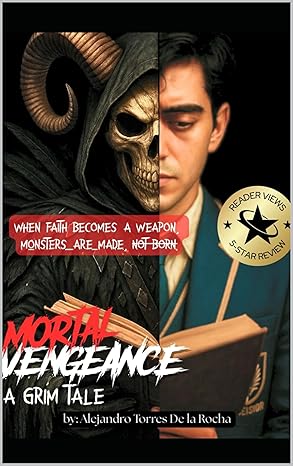
From the blurb
A Caribbean Gothic Prequel to Mortal Vengeance
The halls of Excelsior Academy gleam with marble and stained glass, but behind the polished façade lies something far darker. Discipline is worshiped, individuality is crushed, and silence is the only currency that keeps you safe.
Seventeen-year-old Julián Díaz already feels the weight of that silence pressing down on him—Catholic guilt, family sacrifice, and a cruel teacher determined to break him piece by piece. But when whispers of the Grim Cojuelo—a figure torn from Dominican carnival myth—begin to creep into his waking life, Julián realizes his guilt may have summoned more than shame. It may have called forth a hunter.
Set eighteen months before the events of Mortal Vengeance, this chilling prequel reveals the origins of the mask, the scythe, and the darkness that will one day stalk Excelsior. Here, cruelty wears the face of authority, survival demands compromise, and every secret brings you closer to the inevitable.
Dread replaces mystery. Every betrayal feels preordained. Because once the Grim Cojuelo takes shape, the question is no longer who the killer will be—only how soon he’ll collect.
Perfect for fans of Scream, The Secret History, and Caribbean folklore, Mortal Vengeance: A Grim Tale is a psychological, supernatural thriller that exposes the cost of silence, the brutality of institutions, and the birth of a new horror icon.
PROLOGUE
[Narrator] This story takes place in the recent past. Eighteen months from now, a killer will walk the halls of Excelsior Academy wearing the mask and scythe of Grim Cojuelo, a figure from the Dominican carnival. Born of satire and rebellion, he is now twisted into something far darker.
Students. Teachers. Staff. Some people you’re about to meet will not survive.
[Killer] Don’t call them survivors or victims. They were architects. They built me, brick by brick, out of whispers, cruelty, and silence. Every insult was a stitch in the costume; every betrayal is another curve in the horns. They gave me the limp, the bells, and a reason.
[Narrator] Why did it happen? Could it have been stopped? Were any of them truly innocent?
[Killer] In this country, the devil limps for a reason. He doesn’t come to tempt. He comes to collect.
[Narrator] This… is the story of the days before the killings.
[Killer] And the moment the mask became my face.
Content Note: This story includes depictions of trauma, religious abuse, grooming, psychological manipulation, and references to suicide. Reader discretion is advised.
CHAPTER 1: THE DEVIL IS IN THE DETAILS
Act I: Back to School
The silence in the grand entrance hall of Excelsior Academy isn’t just quiet; it’s suffocating, heavy, and sacred in a way that makes Julián, a 17-year-old senior haunted by his past, wish he could scream. But that’s forbidden here; God forbid the Holy Ghost hears him and screams back. Only the tick-tock of an antique grandfather clock dares to interrupt, its rhythmic pulse a slow, deliberate countdown to some unseen reckoning. Muted by the stained-glass windows, sunlight spills across the polished marble floor in hues of blood red and decaying gold, painting warped shadows that dance like specters across the stone.
“Time is a cruel jester,” he tells himself, tilting his head toward the vaulted ceiling. After eight years, the school’s grandeur no longer impresses him; it mocks him. The Latin inscriptions, the gold-trimmed crests, and the crucifix above every door blur into the same suffocating display: an ornate, imposing, and inescapable gilded cage polished with shame.
This morning, like every other, he closed his eyes for a moment too long.
“Julián, you’re late! Wake up, kiddo!” his mother’s voice cuts through the door.
He doesn’t move, letting his eyelids flutter in passive defiance. The clap comes next-sharp, a crack like a whip across the stillness of his room.
“Get up, or they’ll write you up again!”
There it is: the threat. Not cruel, just constant. It buzzes under his skin, forcing his body out of bed on muscle memory-shirt, tie, slacks-even as his mind begs for silence.
Minutes later, his mother returns, finding him dragging his feet. Her tone shifts, becoming sharper. “Julián, seriously? Do you know what sacrifices we make to afford your school’s tuition? We sold my car, Julián. We work overtime. And this is how you thank us?”
He knows the speech perfectly. And she isn’t wrong. His uniform is always spotless, while her jeans are threadbare, and his father’s shoes look older than he is. The car was offered months ago to buy his future a little more time for his future.
It isn’t just guilt that crushes him; it’s the weight of it, pressing down from all sides. Julián knows this kind of guilt intimately. It is a birthright for a devout Catholic who attends Mass every Sunday and has spent the last ten years at the prestigious Jesuit-run Excelsior Academy. Guilt from his family, his faith, and the local legends of the Dominican people. He’s been raised with the understanding that guilt is an inheritance of Original Sin, a stain that lingers.
If guilt is the price of simply existing, what does he owe for his sins? Those sins don’t just condemn your soul to eternal fire; they draw the attention of the Grim Cojuelo, a twisted thing from old stories. The Cojuelo isn’t just a devil. The Cojuelo is a hunter, and his prey isn’t limited to the living. He hunts his kind-the Diablos Cojuelos themselves.
And Julián? He has enough guilt to burn down a church. And the Cojuelo is hungry.
Act II: Draw the Legend
Back at school, a poster catches his eye: “Illustrate the Legend!” Excelsior Academy is seeking student artists to create artwork for a new publication on the history of the Grim Cojuelo!
A jolt of fascination and dread runs through Julián. The Cojuelo-a subject of academic study? It feels wrong, almost blasphemous. But the images in his mind call to him. It’s a lifeline, a chance to express the darkness that echoes within him-but also a dangerous obsession. He knows he should walk away, but a morbid curiosity holds him rooted to the spot.
As the grandfather clock chimes the hour, a chilling certainty settles in Julián’s bones: The Cojuelo isn’t just a legend. He is a presence, lurking in the shadows of Excelsior Academy. Waiting for the unwary. Waiting for the lost.
The heavy doors of the entrance hall swing open, admitting a wave of noise and vibrant energy. A group of junior students steps into the hall: Alex, walking like he owns the damn school; Fernando, rigid and guarded; Melissa, with eyes like she’s seen more than she lets on; and María, radiating a quiet kind of strength.
He watches them for a moment, sensing they are so young and unaware of the darkness that lurks beneath the surface of Excelsior Academy. A wave of unease washes over Julián-a premonition that their paths will irrevocably cross. A shadow stretches from his present to their future.
CHAPTER 2: THE DEVIL’S ADVOCATE
Act I: Whispers of She-Devil
The fan above whirs with a tired, rhythmic click, its efforts barely disturbing the thick humidity. Rows of heavy, scarred wooden desks face the front, each occupied by a student in a stiff, pressed uniform. Most students stare blankly ahead, but Julián sits ramrod straight, his knuckles white around his pen, a nervous pulse ticking in his temple.
While they wait for Padre Ignacio, the students buzz with nervous energy, trading stories of summer adventures and a giddy countdown to graduation.
“Almost there,” someone says.
“Don’t count your chickens,” another girl chimes in, her voice laced with knowing weariness. “We still have to deal with Lourdes.”
The name drops like a lead weight, silencing even the rowdiest students. The stories are endless: three principals ousted, the PTA trembling before her, demons fleeing in terror. Lourdes doesn’t deal in the supernatural; she deals in the systematic dismantling of a student’s spirit. She carves you down piece by piece-with a grade, with a look, with a silence that makes you doubt your own worth.
Julián wants to join in, but the effort feels monumental. So, he sinks into his notebook—a familiar sanctuary. He flips to his schedule, fingers trembling. Lourdes Advanced Math. Wait. Again?
His stomach drops. A wave of nausea hits. Memory surges, pulling him back to when he was sixteen. Junior year. First semester.
“Julián,” Profesora Lourdes had said, already annoyed. “Where is your assignment?”
Julián sat motionless. He hadn’t finished it. “I… I didn’t finish it, Profesora,” he admitted, his voice barely audible.
Instead of a sarcastic sigh, she turned deliberately. “How dare you show up in my class unprepared? You insolent fool.”
He flinched. “A charity case wasting the few pesos we throw at him out of pity,” she continued, her voice rising sharper, “just to end up as a beggar.”
The silence was instantaneous. The air thickened, heavy and sour with unspoken horror. Julián stood, legs weak beneath him, books clutched to his chest like armor.
“I… I’m sorry,” he whispered, turning to leave, praying he could make it to the hallway before the first tear escaped.
But Lourdes followed. “Oh no, you won’t,” she said, her heels echoing against the tile. “Face the truth. Don’t be a coward.”
Now he was outside, the hallway suddenly too bright.
“You think you’re smart? You’re an idiot. A useless waste of space!” her voice rang out. The hallway froze. Dozens of heads turned. Phones came out. Someone hit record.
“You didn’t do the work because you thought I wouldn’t notice,” Lourdes hissed. “You will never amount to anything. People like you are why this country is falling apart.”
He wanted to vanish. Melt. Collapse through the floor.
“Oh, now you have nothing to say?” she sneered. The crowd kept growing, waiting for blood.
Then— “Hey!”
Melissa’s voice. Clear. Sharp. Angry. It cut through the thick air. She stood tall. Mónika stood beside her, arms crossed, and María had already stepped forward.
“That’s enough,” María said, her voice steady.
Lourdes turned slowly. “Excuse me?”
“I said,” María repeated, unwavering, “that’s enough.”
Lourdes smiled. Cold. Calculated. “Careful, little girl. You don’t want to end up like them.” And then, she sang a cruel lullaby, mocking and off-key: “I’ll straighten their curls, send a flood, send the flu, anything that you can do, to little girls…”
Julián couldn’t breathe. He turned and ran. His eyes stung, hot with unshed tears. Behind him, the cameras kept rolling, and Lourdes turned and walked back into her classroom as if nothing had happened. As if he were nothing.
Act II: A Question of Morality
The door creaks open, hinges groaning softly. Padre Ignacio enters. Tall, lean, and serene in a chaotic way that only a caffeine-addicted priest can manage.
Today, no cheerful “Buenos días.” He walks silently to the board and writes: “IS IT OKAY TO LIE?”
“So… tell me,” Padre Ignacio begins, his voice calm. “Is it okay to lie?”
A chorus of murmurs responds. “No…” several students reply hesitantly.
“No? Really?” He raises an eyebrow. “How many of you believed in Santa Claus?” Every hand rises. Padre Ignacio recoils in mock horror. “¡Mentiras! ¡Pecadores! Your parents are liars!”
Laughter cracks the tension. “It was a white lie! Harmless!” another student adds.
Padre Ignacio’s brow arches. “Ah. So now we’re parsing the hierarchy of falsehoods?” He spins back around, pacing. “God said: ‘Ye shall not lie.’ It’s literally carved in stone, people. But life… isn’t stone. It’s fluid. Chaotic. And sometimes, a truth can kill-while a lie can save.”
He stops beside Julián. “Picture this: You’re hiding someone in a war. A soldier knocks. ‘Are you hiding anyone?’ Do you tell the truth and sign a death warrant? Or do you lie and protect a life?”
His hand rests gently on Julián’s shoulder, and Julián freezes as if touched by a ghost.
“So again I ask…” Padre Ignacio murmurs softly. “Is it ever truly okay to lie?”
Behind him, the bell finally rings.
“It’s time for the assembly,” Padre Ignacio announces. “Please let’s leave in an orderly fashion. No breaking formation. Those who do will be written up.”
Julián lingers. Padre Ignacio turns back, noticing his hesitation. “Some truths take time, my son,” Padre Ignacio says quietly. “And some lies… come with expiration dates.”
He leaves Julián alone in the classroom as it empties. Julián stares at the board one more time: IS IT OKAY TO LIE? He doesn’t have an answer. But for the first time in weeks… he isn’t the only one asking.
He drifts through corridors painted with crucifixes and lit by fluorescent lights, surrounded by life yet untouched by it. He walks past a banner that reads: “EXCELSIOR: WHERE DISCIPLINE FORGES CHARACTER.” He wants to laugh. Or cry. But he just keeps walking.
CHAPTER 3: SPEAK OF THE DEVIL
Act I: Weaponizing Scripture
Julián walks with the rest of his class in stiff formation. Next to him, calm and unflinching, is Lucía. She doesn’t say much; she never does when he looks like this—jaw clenched, eyes hollow. She just keeps pace, her shoulder brushing his in solidarity.
They sit together near the edge of the gym. Julián scans the sea of uniforms and notices missing students. Rows with empty chairs. Faces that should’ve been there. Gone.
The lights dim, and the school choir enters, taking its place on the risers. A pianist strikes the opening chord, and the choir sings. Julián closes his eyes, letting the solemn tones wash over him. Until they reach the verse: “And if the flames of hell arise, / We stand as one, our faith the prize…”
His eyes fly open. The choir’s faces stretch unnaturally wide, mouths gaping too far. Their eyes were hollow, pupils swallowed by shadow. And in the furthest corner, behind the crucifix, something moves. A figure. Cloaked. Horned. The Grim Cojuelo. Julián blinks, and it is gone.
The principal steps onto the stage. “Welcome, students, to another year at Excelsior Academy. A place where tradition isn’t just respected-it’s revered,” he begins, his smile a wide, unblinking mask. “In these halls, we mold minds not to stand out, but to stand as one. Individuality is a temptation. A whisper from the devil himself.”
A rustle moves through the crowd. Lucía stiffens beside Julián.
“Beware of new trends that challenge our sacred traditions. Remember, your body is not your own. It is a vessel of God’s will,” the principal warns. Julián’s vision swims. He sees the banner behind the stage warp and crack. In those fractured lines, he almost sees the hollow eyes of a pale mask.
“There are those who will tell you that freedom lies in rebellion,” the principal continues. “We must protect each other from those who would corrupt us.”
Julián grips Lucía’s hand tighter. Somewhere high in the rafters, a faint metallic jingle echoes like small bells swaying in a wind no one else feels.
“This year, we face challenges,” the principal’s tone shifts, becoming weighted. “Excellence requires sacrifice. Growth requires discomfort. And sometimes, the path to salvation leads through horrible places indeed.”
Julián’s hands tremble. He grips the cold metal frame of his chair. “This year, we will continue our tradition of individual conferences with each student,” the principal adds. “These meetings are mandatory, of course.”
The word mandatory seems to echo longer than it should. Julián’s gaze drifts to a decorative mirror on the far wall, showing him standing in a dark place, draped in shadow, bells silent. Beneath it all, a low drumbeat pulses, counting down to something inevitable. Then the image and sound are gone.
“And for those students who require additional guidance… we have expanded our remedial programs. Private instruction. Intensive correction,” the principal finishes.
Julián doesn’t clap. Where the masked figure had stood, Profesora Lourdes now walks straight toward him, her heels clicking a sharp rhythm. Her face twists in theatrical rage.
“Oh, what is it this time, Julián? Disassociating again? A demonic possession, maybe?”
Gasps ripple across the room. Julián doesn’t move. His mouth is dry like cotton.
Lucía stands fast beside him, but Julián grabs her wrist. “Don’t. Please,” he says flatly.
Lourdes leans in close. “Keep spiraling, niño. I’ll make sure your next write-up comes with a one-way trip to silence.” She turns and walks away. And just for a second, Julián swears the mask is back. And it winks.
Act II: VS Predator
The assembly ends with a clatter of applause. Lucía finds herself cornered by Enrique.
“Lucía,” Enrique says, his voice smooth and persuasive, “you looked incredible. Composed.”
“Thanks, Enrique,” she replies, a flush warming her cheeks.
“Well, this year’s going to be different. I’m joining the debate team,” Enrique chuckles. “Maybe I want to spend more time with the best debater in the school. Challenge myself a little.”
Julián steps forward, masking his irritation. “Now, Lu, say goodbye to lover-boy. The demon awaits.”
Lucía squeezes Julián’s arm in thanks. “Oh, is Alex joining the debate club this year?” she calls back playfully. Enrique’s smile falters, his gaze hardening with a flash of something possessive and cold.
_______
Later, the Advanced Math classroom is colder than the rest of the school. The air smells of dry-erase markers, panic, and Catholic guilt. Julián sits near the back, his right foot tapping uncontrollably-not from restlessness, but dread. He is sketching again to stay grounded. The Grim Cojuelo emerges from the page in jagged lines.
He doesn’t hear her approach, but the click of her heels-sharp, deliberate, venomous-silences the rustling.
“Oh, what have we here?” Lourdes’s voice cuts through the stillness. One manicured hand snatches the notebook from under Julián’s wrist.
“Class, I present to you: Exhibit A in how to waste twelve hundred thousand pesos a trimester,” she says, her voice syrupy and cruel. “Monsters, demons… a girl bleeding in the corner? Are we applying to art school or a psychiatric ward, Mr. Díaz?”
Julián’s knuckles grip the edge of his desk so hard they blanch white.
“But of course… I forgot. You don’t have the luxury of failure, do you?” she snaps. “You either get this right, or you’re washing windshields at red lights, hoping for a coin.”
The classroom is utterly silent, the weight of her words pressing down on everyone.
“And your poor parents… They work so hard,” she adds, dripping with mock sympathy. “Why don’t they just light their house on fire already and collect the insurance? At least then they’d stop incinerating their future one tuition payment at a time.”
Lucía moves slightly, reaching across the aisle to place her hand on Julián’s forearm. He flinches-not from the touch, but from how human it is, how grounding amidst the chaos.
“Next time, Mr. Díaz? Try monsters with functions. I hear math is scary enough,” Lourdes smirks.
The bell rings. Students file out, careful not to look at him. Outside the classroom door, Marcos and Manuel pass by. “Damn. Poor bastard,” Marcos mutters quietly.
A tall shadow appears behind them-a priest in maroon-trimmed robes. “Language and hallway loitering,” the priest says, his voice firm. “Write-ups for both.”
Marcos and Manuel don’t argue. They simply move on.
The clock did not stop. One tick for each write-up. One chime for each rumor. By the time its pendulum groaned into October, weeks had collapsed into silence, and Julián was sweeping leaves outside Excelsior’s gates.
CHAPTER 4: BREAKING BREAD WITH THE DEVIL
Mid-October | 17 months before the Grim Cojuelo Killings | Friday
Scene I: The Weight of Drudgery and a Moment of Connection
Every lunch break, Julián is tasked with cleaning the school grounds, candy wrappers, cigarette butts that teachers pretend not to see, and notes crumpled and thrown like sins in a confessional. And on Fridays, he has to stay late and sweep the sidewalks outside the gates, including the entire street entrance, erasing the mess others never saw.
The area outside Excelsior’s gates is deceptively serene. Just a few blocks from El Malecón, the ocean breeze occasionally sweeps through the gates, carrying the salty breath of the sea and the distant sound of crashing waves. The scent of salt and gasoline mingle in the air-a coastal cocktail of beauty and corrosion.
A cobbled sidewalk edged by faded yellow curbs gives way to a sloping avenue that pulses with afternoon traffic. Tall ficus trees line the perimeter like indifferent sentinels, their leaves shedding constantly, making Julián’s job a losing battle. Just beyond the sidewalk, cars roll past-mostly boxy sedans, scratched-up Toyotas and aging Hyundais, with the occasional black SUV with tinted windows and a roaring engine that doesn’t belong in a school zone.
Some afternoons, you can spot the sea glinting like a knife-edge between buildings. Tourists sometimes wander too far and find themselves outside Excelsior’s iron gates, mistaking it for a cathedral.
The sun beats down with typical Santo Domingo intensity. A statue of Saint Ignatius stands in a planter by the gate, one arm raised in stern benediction, its shadow offering brief reprieve. Julián always sweeps around it extra carefully.
Today is Friday. He is almost done, a familiar ache settling in his shoulders. Broom in one hand, dustpan in the other, he works at a slow, resigned rhythm, his movements unconsciously swaying to the city’s chaotic symphony. The air throbs with a ceaseless mix of sounds: the impatient honking of cars caught in the afternoon crush, the sharp, authoritative whistles of police officers directing traffic, and the distant, melodic cries of vendedores deambulantes-the traveling vendors.
He can pick out the echoing call of the gas tank re-fillers, the rhythmic clang of the scrap metal collectors (chatarreros), and the high-pitched, almost musical whine of the knife sharpeners (afiladores de cuchillos) pedaling their services.
From one block, a bass-heavy merengue beat pulses, shaking the very pavement, while from another, the aggressive, rapid-fire rhythm of dembow vibrates. Even from within the school, he can hear the ethereal harmonies of the gospel choir practice, a stark contrast to the street’s cacophony. Scattered leaves, gum wrappers, and the never-ending hum of the city that is both backdrop and protagonist surround him.
Then, a loud thwack splits the air. A soccer ball shoots over the field’s fence like a missile and lands a foot from his head, crashing into the street and bouncing straight into incoming traffic.
A car swerves; another honks. Tires screech. No crash, but it is close. A red Daihatsu jolts halfway into the other lane before correcting with a grunt of brakes.
Julián flinches so violently that he drops the broom and clutches his chest as if someone had shot him. A phantom pain sears his ribs. Something knocks the breath clean out of his lungs.
“¡Eh! ¡Pásala! ¡Devuélvela!” (Hey! Kick it! Someone shouts from the soccer field).
Still dazed, Julián reaches for the ball and steps toward the road without looking. A blur of movement. Suddenly, someone slams him to the ground, hard, onto a pile of dry leaves. His ribs rattle. The air whooshes from his lungs.
“Are you fucking crazy?!” Fernando Pepino looms over Julián like an enraged god. Tall, tan, broad-shouldered, with his signature baseball cap twisted backward, his jersey clinging to his chest, dark with sweat from practice.
Julián sits up, stunned. Dirt smears his elbows, his knees burn, and curls stick to his damp forehead. “You tackled me, asshole! You-” he snaps, rubbing his sore ribs.
“You were about to be swept off your feet by a car, and not in a good way,” Fernando cuts him off, his voice rough.
Julián looks toward the street. A silver sedan, clean and anonymous, speeds off in the distance. They both stand, brushing off their uniforms. The moment hangs awkwardly in the humid air. Fernando reaches into his shorts and pulls out a crumpled piece of foil. He unwraps it, revealing a bright red cherry lollipop. He pops it into his mouth with a loud slurp and, after a beat, offers one to Julián.
Julián blinks. Weird. Kind. Both. He takes it.
A few seconds later, another soccer player jogs up from the field. Skinny, acne-scarred, and radiating an obnoxious confidence. “Hey Díaz! Want to suck on this lollipop too?” he says, grabbing his crotch and thrusting his hips forward mockingly.
Fernando turns, eyes flashing with anger. “Don’t be such a fag, bro,” he says, his voice sharp. He winces, the apology an afterthought. He turns back to Julián, his expression softening slightly. “Sorry,” he mutters, more quietly. “For… that. And also. You know.”
He grabs the ball and jogs back to the field. Julián stands still, the sticky candy stick clutched between his fingers. His breath is shallow. The leaves have scattered again, undoing his work. He sighs, a hollow, defeated sound, and starts over.
***
 BookView Review
Leave a comment