Welcome to BookView Interview, a conversation series where BookView talks to authors.
Recently, we interviewed E.K. Bao about his writing and recently released novel, HAPPIA, a houghtful, ambitious, and emotionally grounded work of science fiction (Read the review here.).
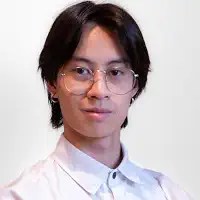
E.K. Bao writes speculative fiction examining institutional power, narrative control, and systemic failures shaping truth and reality. His debut work HAPPIA-MYRIA reflects years grounded in both personal experiences and historical patterns, translated into large-scale narratives centered on ordinary perspectives within extraordinary structures.
Website: https://www.ek-bao.com
Social Media Accounts: https://linktr.ee/ek_bao
What was an early experience where you learned that language had power?
Probably as early as I can remember. Though I was raised in the United States, Vietnamese was my first language before English, and so it quickly became apparent that it’s something I can use to talk in private with my family even when out in public without the need to move elsewhere. Not to mention the completely different concepts the two languages have between each other allowed me to make thoughts and realizations I wouldn’t otherwise have if I stayed monolingual.
How often do you base your characters on real people?
Very often, if not all of the time. I am all about making my characters as real and believable as possible, and for that to happen, they’re typically drawn and adapted from real experiences I have in life with people, including my own self. I’m more drawn and interested into the lives of the ordinary than I am to traditional heroes and protagonists.
How many unpublished and half-finished books do you have?
None. I currently intend to publish only HAPPIA, releasing this year, and its anthology sequel MYRIA, releasing next year. Both at this time are finished.
What does literary success look like to you?
Putting what I need to say out there into the world and have its impact still stick long after I’m gone.
What kind of research do you do, and how long do you spend researching before beginning a book?
My kind of research is very informal and accumulative across my years, so I can’t say that it was done specifically for the book, even if it all led up to it. More often than not the research would be done while writing, usually when I have a very specific question to ask about a very particular detail. In general, it can be very broad in scope.
Do you find writing therapeutic?
It can both be as therapeutic as it can be maddening. Sometimes I attain my flow, other times I’m staring at the screen pulling at my hair on what comes next.
What’s the most difficult thing about writing a novel?
Consistency. The act of writing is easy, but seeing a project to its end at full commitment is not. As passionate as the project is, there are many days in there in which I would rather have done something else. I still made myself reach my daily writing goals regardless.
How many hours a day do you write?
8-12 hours most days. Some days less, some days more.
Does writing energize or exhaust you?
It can be both. Some days, especially when I reach a part in the story I’ve been excited to tell for a while, I can feel compelled to do quite a lot. Other times, after prolonged writing sprints, I will end up with physical fatigue with aching eyes, head, and shoulders.
What are common traps for aspiring writers?
I would say noise and distraction. I see a lot of writers getting caught up with a lot of things (a lot of which can be fun) that ultimately don’t contribute much to the end goal of a finished work. Tools such as Notion and Obsidian in my opinion can easily pull writers away from the actual writing process from the sheer amount of different tools and options they can play around with. Or in some cases, writers get very in-depth to an unnecessary degree as to their worldbuilding and character’s details. Much of it I cut down to a minimum; everything is done in Google Docs and Windows Notepad, and past a certain threshold, I really don’t bother with additional worldbuilding details and trust that the reader will infer towards a bigger world left unmentioned.
This should also go without saying, but nobody with an ounce of integrity should be using AI to generate and write their work for them. Of all the things it’s useful for and good at, creative work is not one of them; it will create the most mediocre, cliche, and bland content ever and completely erase an author’s unique voice and style in exchange for something “safe and riskless”.
Does a big ego help or hurt writers?
In some ways both, so I suppose it matters how you use your ego. Don’t let your ego blind you from your flaws and critiques that you can improve from, but be confident and stand your ground where necessary, lest you lose your unique author’s voice.
How often do you read?
Surprisingly not as much as I should, at least in recent years. Most of the stuff I read are nonfiction in nature, actually.
Do you try more to be original or to deliver to readers what they want?
I will say I try more to be original, even if delivering to readers is still prioritized to some degree (since I know how it’s like being one, too). I really do not believe in fanservice or pandering to your audience, I think that dilutes the spine and integrity of one’s work. It stops being your own work and instead becomes a product of “people pleasing”.
Do you think someone could be a writer if they don’t feel emotions strongly?
Yes; I am that writer.
If you could tell your younger writing self anything, what would it be?
Practice more.
How did publishing your first book change your process of writing?
I would say gearing around structuring my story for longer forms and narratives, since most of the stuff I wrote before remained short stories, experimental, or incomplete passages. So it was making sure that everything holds up consistently from beginning to end over a much longer stretch.
What was the best money you ever spent as a writer?
So far, it’s early enough into this that I don’t feel I can make a definitive claim yet.
Have you read anything that made you think differently about fiction?I still remember reading Orwell’s 1984 back in high school and it remains one of my favorite books, not just from its concept, premise, and allegories but from how much you’re able to feel for the characters living it. It was also the only book other than The Kite Runner that managed to pull off a jumpscare, just from text on a page (the scene where Winston and Julia are caught by the Thought Police).
How do you select the names of your characters?
Surprisingly, of all the very intentional and deliberate decisions I put into every aspect of the book, the names were not one of them. They were all semi-random sounds I would put together in my head on the spot, making sure they sounded unique and unheard of from our world, but not too bizarre that it becomes unpronounceable. Unless a part of the story demands it for the sake of the plot, I put no emphasis on a supposed cultural origin of a given name and leave it up to the reader’s imagination; I follow more ordinary people as opposed to traditional protagonist heroes.
Do you read your book reviews? Do they please you or annoy you? Do you think you can learn a lot from reading criticism about your work?
I have yet to receive any book reviews, but generally speaking I would always seek to learn as much as I can from them, as long as I can tell it is genuine and a genre-reader match.
Do you Google yourself?
Only when I’m checking how I appear in search results when setting something up.
What one thing would you give up to become a better writer?
I don’t think there’s anything I’d give up over that. The way this is worded though, I guess I could say I’d happily give up being broke.
What are your favorite books?
1984 by George Orwell, and The Self by Sati Heyoka (pen name of my friend Dr. Jeremy Hall).
What is your favorite childhood book?
The one that always comes to mind would be Coolies by Yin and illustrated by Chris Soentpiet. It follows two Chinese brothers working on the Transcontinental Railroad in 19th century America and the challenges that they face. In a way, having a brother of my own and given my own family’s story of immigrant struggle felt relatable even if their story took place over a hundred years before ours began.
What is the most difficult part of your artistic process?
Holding trust, faith, and consistency in yourself.
Who and what ultimately inspired you to become a writer?
I would say it’s something that accumulated over time. My father let us watch a lot of great films growing up, which if anything were just stories told in a different medium. Throughout the years as a hobby I would express my own “stories” in different ways, whether through writing, worldbuilding, or what else. It wasn’t until recently under some very specific circumstances that I realized my strength as a writer that I went for it, though.
How did you decide which form or genre was right for you?
This wasn’t really a decision, but I always liked science fiction as a broad genre because it’s one that feels both fresh and unique enough to not be from our world, and yet just plausible and close enough in some ways, like it’s right there. It’s possible enough that given some steps, we could make it from science fiction into science reality, something that has happened many times with this genre. Other genres either gesture towards impossible scenarios or ones we’ve already encountered before.
Does your family support your career as a writer?
I am fortunate that they do and have been happy to, as long as the road to get here was.
If you had to do something differently as a child or teenager to become a better writer as an adult, what would you do?
Despite everything, I would not do anything differently and am content with how I am now.
How long on average does it take you to write a book?
It took HAPPIA about one year to start from laying down the first foundation of its framework to setting it up on Amazon and getting a physical proof copy in my hand. The actual writing process of typing in a document took six months total; two months of planning, and four months of writing a chapter out every day. Tweaking, editing, polishing, and formatting I would say cumulatively took about another month spread out, but I gave it time to sit before touching it again. If we counted the time that a lot of these ideas and concepts have already sat in my head though, then it would be closer to 7-8 years.
Is writer’s block real?
Yes, and it sucks. Remember to take a break, y’all.
What authors do you like to read? What book or books have had a strong influence on you or your writing?
I will say that for HAPPIA, surprisingly I took a lot of inspiration from Orwell’s 1984 and Remarque’s All Quiet on the Western Front. I also like H.G. Wells’ works in particular such as The Time Machine and War of the Worlds.
After the writing’s finished, how do you judge the quality of your work?
Aside from hearing how others think of it, I would say I judge it based on every metric, and I get very meticulous with it. Are details throughout the story consistent without contradictions? Do the characters’ actions make sense for who they are? Do the strategies depicted in the book hold up and make sense? Are the themes communicated effectively? Are these words and sentences redundant and repeated? Is that comma supposed to be there? Did we miss on italicizing this quotation mark with the rest of the quote? Does the text look good on the page? And so on.
How hard is it to establish and maintain a career in fiction writing?
I don’t plan on maintaining a “career” in fiction writing; writing HAPPIA is the first step for me. Now that I have the story and know how it goes, I’m aiming to adapt it into a visual form such as a manga, and then once I achieve that, I’d aim to have that adapted into a series/film(s). Fingers crossed that I can pull that off, because it’s asking for quite a lot.
What inspired the premise of your book?
Too many things to count. Late/end-stage empire. Imperialism. Colonization. Consumerism. Societal, cultural, and institutional decay. Fake wars. Monopolies over narratives and what is deemed “credible/legitimate”. Collective struggle versus individual will. Systems that become so entrenched in what they are they behave suicidally. Fighting over resources, and who benefits. Asymmetrical conflict between the besieged and the occupier. Really, a lot of things I see around me both today and throughout history. My own people’s history as a Vietnamese comes fresh in the mind.
How many rewrites did you do for this book?
Aside from editing during the process, I did not do any full rewrites of the book, and its core storyline with every event and scene is consistent with how it was planned from the beginning.
Tell us a little about how this story first came to be. Did it start with an image, a voice, a concept, a dilemma or something else?
If we were to go all the way back, it started from very different origins, a childhood game of “my guys versus your guys” between my siblings and I. It was back then that the Happians first became a concept, and later worldbuilding device, before the name “Happia” even formulated years later. It was then through the years that I became invested in this concept of viewing these superhumans through the lens of a collective, a society with its own cultures and histories, rather than the typical superhero stories we see following a single “special” individual. It was compelling to me that despite this superhuman strength that seems obvious at face-value, that they still struggled and suffered so much in war, a warrior race that in fact hates waging war, ironically enough. It wasn’t until I formalized it into the book as it is now, that then gave this “enemy” a clearer face, thus came the premise “what if their superhuman genes are the resources they’re fighting over?”
How do you come up with names for your characters?
The real answer is I don’t. I suppose in line with my thinking that I don’t like creating “special” or “chosen ones” type of characters, so too do I leave out any particularly meaningful “name origins”. I typically just come up with sounds in my head that would feel removed enough from our world without being too hard to pronounce, to still keep it somewhat believable.
Which character was most challenging to create? Why?
I would say out of the main four, General Hiau was the most challenging, and the one that underwent the most transformation during development. It was a difficult balance to strike, since I wanted to write a character that was both a menacing villainess yet was still complex, compelling, and conflicted in many ways of her own. I didn’t want one of those “evil for the sake of evil” antagonists, nor one there simply so the plot has conflict. There always has to be a good reason, and she needed her own motivations that goes against who and what she serves as well. Of the four, I feel that I leave her with the most unsaid and open to interpretation, and in many ways intentionally so. In the end, I am overall satisfied with how she turned out, and I hope readers will enjoy the allegories of her character as much as I did writing her.
Are any of your characters based on real people you know?
Absolutely, though never a direct one-to-one translation. Typically, each character holds a combination of different parts of different people, including myself. It’s from basing these characters from real experience that makes them more genuine, real, and authentic, in my opinion.
Which scene or chapter in the book is your favorite? Why?
Spoilers and a long answer ahead! By far, Chapters 16 and 19 of Part IV – Singularity, both of which come at the very end of the book (or chapters 76 and 79 if we are counting by raw count). Up to just before these chapters, we’re rushed through a very overwhelming and climactic final battle over the siege of the planet Happia after having gone through the entire book, and everything collapses into an infinitely dense point. You turn the page and you’re greeted with extreme negative space, eight words at the center of the page, “For a blissful moment, there was only emptiness.” And another several pages left completely blank. I loved the contrast this Chapter 16 creates with everything that came before it.
Chapter 19 either ties or beats Chapter 16 in my opinion, even if it employs the similar negative space technique. From the writer’s side of things, it was completely unplanned, and the book originally was going to end much more bleakly, but I ended up writing this in on a whim. One of the recurring motifs throughout the book was the rose, which comes as a great irony amidst this cosmic setting that a flower that everyone knows would still be relevant in such a world.
Lym had asked Vertan all the way back in Part II, “Are roses known for their beauty or their thorns?” and “was it the fault of the rose that it had to evolve thorns?” as an expression of how her people have become known for war rather than their culture and history. This motif resurfaces multiple times throughout the book, usually gentler moments punctuating the otherwise cold and harsh backdrop. I found it highly fitting then that when Vertan and Lym are at last reunited in this “afterlife” sort of setting (which I never made clear), that not only were they left intentionally nameless in that chapter and with their limbs whole again, that they stood together in an endless field of, specifically, thornless, roses. Not to mention, Parts I, II, and III each have exactly twenty chapters to them. Part IV is the only one that ends on nineteen, which I like to imagine signals the cycle breaking at last.
And the best part is, nothing that I mentioned above was planned at all; both chapters and the rose motif came out organically and was not accounted for in the planning/drafting stages of the book.
Which scene was most difficult to write? Why?
The most physically and psychologically challenging chapter to write would be Chapter 1 of Part IV, which I will not leave the spoilers to here. Although it did its job in really selling its point, I found it overall quite disgusting and abhorrent, and felt physically sick in some parts writing it, and was overall glad to have gotten it done and over with by the end.
Which scene, character or plotline changed the most from first draft to published book?
There were in fact no changes; the differences between the first draft and published book were largely tweaks, polish, and formatting made to have the book flow better, look cleaner, and present itself more professionally. The characters, scenes, and plot all remained the same as they are.
What do you hope readers will take away from this story?
Since there’s so much going on, I would say that I hope that readers take away at least something, and that it would sit with them, whatever that may be for each person.
How does your faith life/ethical outlook inform your writing?
I would say that consciously or not, it does influence my writing, even as I explore ethics that go against my own and allow those to clash in the story. I practice Buddhism to the best that I can, so you may notice similar themes regarding it, such as some characters arguing in favor of simple contentment over material wealth and ambition, or the fact that Parts I-III of the book end on exactly 20 chapters each while Part IV “breaks” this cycle with nineteen chapters only.
What life experiences have shaped your writing most?
A lot of pains, frustrations, mistakes made, and observations and interactions between myself and other people, I would say. Probably the first thing anyone would notice is the very distinct style in which I write dialogue, which is meant to be as close to a real-life conversation/banter as possible. In many of the scenes, save for a select few, the dialogue is very specific and based on what I’ve seen and experienced somewhere before.
What makes this book important right now?
I reckon that it discusses a lot of things that need to be said, especially in this day and age. It is, after all, a response to its time, as much as it is something I strive to make timeless. There are simultaneously a lot of things that have been said, are currently just being discussed, and then have yet to be discussed written in there, based on what I’ve seen out there in social discourse. It is both a cautionary warning as much as it is hopeful and inspiring, which I feel that it’s important to have both, rather than to naively have only one or the other.
Where do your ideas for this story come from?
Much of the time, real life. In fact, I quickly found out as the months went by after having finished the book, that it seemed the world got even more ludicrous than how I already depicted things in my fictional story. If not real life, I will say I’m greatly inspired by many works such as Warhammer 40k, Dune, Star Wars’ Andor, Akira, 1984, All Quiet on the Western Front, and historical examples such as the Cold War, the collective struggles of the Soviet Union during the Second World War (Great Patriotic War as they call it) or even my own people not so long ago (Vietnam).
What sort of a relationship exists between you and the characters you created in this book?
Even though different characters inhabit different parts of myself, strangely enough, I consider myself to not really have a relationship with any of my characters, and hold my own detached opinions of them as a reader, despite having intentionally written them. They are their “own people”, people who I don’t personally know. That said, occasionally there will be such cases in which I have sympathies for them, feeling the sense of “you must have gone through so much” even if “how much” that is, is left technically unknown, even to myself.
Has this novel changed drastically as you created it?
Not really; everything that was planned and figured out in the beginning was what was eventually written out into the book. There were times however when writing each individual chapter out that something may organically arise, but this would not change the overarching plot of the book.
How did you decide on this title?
Spoilers ahead! “Happia” is the name of the Happians’ home planet, and of which they are the overarching mystery of most of the book. “Who are the Happians? What is Happia? Why does nobody know about this?” It’s what the book is about, and you go into it knowing the title, but you don’t know the meaning behind it, or even hear it mentioned until it suddenly jumps at you a fair distance into the pages. I overall wanted to keep it to one word, something “simple and iconic”, rather than something like “The Mystery of Happia” or “The Lost Planet of Happia” which would be telling too much. As to how or why I came up with that name, I’ll leave that to mystery for now as well.
What’s next for you?
What’s next for me would be to take care of the last bits of publishing this book and getting the word out as much as I can, and then later doing the same for MYRIA. Otherwise, it’s onto the next phase of this project, which would be to adapt and illustrate HAPPIA into a manga, which I have already planned out my pipeline and workflow for. This one I expect will easily take at least a few years for, 3-4 times as long as it took for writing the book.
***

 BookView Review
Leave a comment