Welcome to BookView Interview, a conversation series where BookView talks to authors.
Recently, we interviewed Mo Conlan about her book, The Lost Books: Romance and Adventure in Tudor Times, a pleasant romance and an exhilarating adventure. (Read the review here.) Mo worked for more than 30 years as a journalist wearing various hats on her hometown daily newspaper—reporter, copy editor, columnist and features editor.
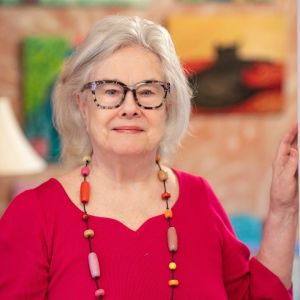
Mo Conlan began her career as a writer when she became a story gobbler at an early age. She began reading through the entire children’s section of the local library.
She worked for more than 30 years as a journalist wearing various hats on her hometown daily newspaper—reporter, copy editor, columnist and features editor. “That was when it was still thrilling to be in newspapers, working with a bunch of idealists and word nerds,” she said.
One of the highlights she recalls, during her stint as Books Editor, was riding in the back seat of a car interviewing author Tom Wolfe. “He wore his crumpled white linen suit. When he got over being shy, the wit just poured out of his mouth.”
Since leaving newspaper work, Mo has been writing poetry and fiction and editing books. She also is an artist and was recently Featured Artist in the Poetry East magazine.
Mo has a close extended family. Some of her siblings still call her Maureen, reminiscent of the days when she was a quiet mouse in starched white blouse and uniform being scared by the nuns at Catholic School. “That kind of upbringing almost guarantees you will become a writer.”
facebook: facebook.com/mo.conlan
Website: moconlanwordsandart.com
In The Lost Books, the protection of knowledge is an important theme and mission. Why was that important for you to write about?
Protection of and passing on of knowledge is one of the most essential tasks and sacred tools of humanity. From stories around the fire to runes, from scrolls to books. I feel that deeply both personally and as a student of history. My characters are ordinary people who become heroes for understanding the acute need to save the books, and for daring to do so.
What are your favorite books?
I will never forget the first book I ever received as a gift. It was Christmas. I was about 6 years old. As my many siblings opened games and sports equipment, I untied the bow of a beautifully wrapped box that I thought might be a sweater. Inside, wrapped in layers of tissue paper, was the most beautiful book I had ever seen – a hardbound edition of A Little Princess with three-color illustrations, each protected by a tissue page. My own book! I have been in love with books ever since and read and loved so many it is hard to choose. Among them: A Tale of Two Cities, Les Miserables, the entire Sherlock Holmes canon, On the Road, Catcher in the Rye, the entire P.G. Wodehouse canon (one of the greatest humor writers), Trinity, Angela’s Ashes, Diary of Anne Frank, Slaughterhouse Five, War and Peace (despite all those Russian names). I am rediscovering the brilliant writing of Agatha Christie and of M.C. Beaton. I loved every LeCarre book I’ve read. As books editor at a daily newspaper, I often read a book a day – loving especially the mystery and detective genres. The series by Sue Grafton, Sara Paretsky and Michael Connelly are so well written. The Harry Potter books are classic stories brilliantly written. And there are so many more…
The Lost Books is a historical fiction novel set in Tudor-era England. Why did you decide on this setting? What kind of research did you have to do to bring the setting to life?
Fortunately, I have a writer friend who lives in Cornwall where my story is set. He is an avid historian and was able to direct me to books for research. He directed me to Tudor Cornwall – Portrait of a Society, by A.L. Rowse, which I found online in the U.K. I read The Hidden Lives of Tudor Women, A social History, by Elizabeth Norton, and Black Tudors by Miranda Kaufmann. There are many Tudor sites online, and that made online research easy for specific questions, such as: what fruits were eaten in Tudor era? (Pears were popular.) My best reference I found in my own library, a cherished copy of The Smithsonian Book of Books, by Michael Olmert, which explains in detail how these precious illuminated manuscripts were made, with lavish illustrations.
Whereas most depictions of the Tudor era in popular media focus on the royal figures and courts of the time, The Lost Books is interested in the lives and adventures of everyday people. What drew your interest to writing about more “everyday” characters?
I was curious about Tudor life beyond the silks and furs and plots of court life. There was a multitude outside the palace walls – enduring, suffering, thriving and prevailing, despite the treacheries at court. I came to love these characters – often oppressed with odious laws, privations and taxations, yet enduring and even managing, at times, joy.
Are any of your characters based on real people you know, or on real historical figures?
My characters are not based on individual historic figures, rather imagined ones who must deal with losing their homes and their livings (monks and nuns), illnesses, burdensome laws and taxation. Human qualities transcend historic eras – such as ingenuity, friendship and courage. My main characters display these.
The Lost Books is infused with quite a lot of humor! Does writing humor come naturally to you, or was that something you had to work on in the manuscript?
When I began this story, I set out to write something lighthearted. As I delved more deeply into the era in which my characters live, I became engaged in their struggles and dilemmas. I decided to address these, but still with a light tone. I believe in “whistling past the graveyard” in life and, sometimes, in my writing. I have always loved humorous writers. So often, in any era, humor helps us through the hard parts.
What was an early experience where you learned that language had power?
When I watched/heard on TV Martin Luther King, Jr. deliver his “I have a dream” speech. Listening to my father in court speaking up for the rights of people with intellectual disabilities – a silver-tongued oration that helped bring state laws out of the Dickensian era into a new age of respect for individual rights.
In addition to being a writer, you are a visual artist. Have you learned anything from doing visual art that you carry into your writing? If so, what was it?
Story and visual art are twins. The early cave drawings, I am sure, came with stories. Written stories are a bit like painted words. I can visualize my characters moving about in my stories – the colors of their clothes, the sky. I sometimes add words to my paintings and sometimes illustrate my writing.
What do you hope readers will take away from this story?
I hope readers will appreciate the goodness, the humanity, the courage and ingenuity that exist in a world that often seems so harsh and otherwise. I hope they come to increased appreciation for those who make and preserve books. I hope they enjoy my characters and will read more about them in a sequel I am working on now.
***

 BookView Review
Leave a comment