Welcome to BookView Interview, a conversation series where BookView talks to authors.
Recently, we interviewed John Gregg about his writing and recently released debut book, Altamara’s Gift, a gritty, heartfelt war novel distinguished by vivid atmosphere and deep affection for its characters (Read the review here.).
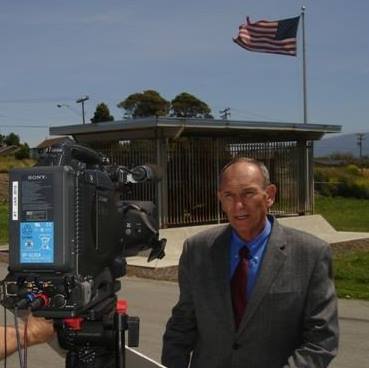
I am a Vietnam veteran, and I served in the Unites States Army from 1967-1971. I graduated from San Diego States University on the GI Bill. With a background in journalism, I spent more than four decades as a writer, reporter, and anchor, for NBC, ESPN, Stanford University (sports) and ABC. Most of that time I spent covering sports, or as people in the newsroom called it the “Toy Department.”
I covered Major League Baseball, the NBA, NFL, major college sports, horse racing and boxing. The last six years before I retired, I was the senior producer and senior writer for PBS in San Francisco. Over the course of my career, I have been very fortunate and earned 18 Emmy nominations and won 4 Emmys for my writing and reporting. I am married to my college sweetheart, and we live in San Diego, California.
There is a link to John Gregg Author on Facebook and Altamara’s Gift. There are also links to 10 voiceovers, where I read excerpts from the novel. Those VOs run between 45-seconds and 2 minutes and 52 seconds.
How often do you base your characters on real people?
Altamara’s Gift is based is based on my experiences in combat in Vietnam. The characters are often based on real people, or several people together that become one character in the novel. One of the lead characters is Patterson “Doc” Hood. He is based on several medics that I knew with I was in the Central Highlands.
Have you read anything that made you think differently about fiction?
I carried a beat-up paperback of “Catch-22” in my rucksack in Vietnam. I must have read that novel a dozen times. We would set up ambushes often on the Cambodian Border and in the fading light I would read excerpts repeatedly. It always resonated with me because of the absurdity of war and the use of Heller’s language.
When I was in college I read everything, I could that Kurt Vonnegut wrote. It was the simplicity of language but also taking on difficult topics about humanity. You don’t always need big words to convey emotion. Finally, I read just about everything written by Ernest Heminway, including “Death in the Afternoon,” about bullfighting (not my favorite). His novel that still resonates with me is, “Farewell to Arms.” Once again it is the directness of language and the simplicity of sentence structure to tell a story.
Who and what ultimately inspired you to become a writer?
This may sound strange, but it was my rection to how Vietnam vets were portrayed in films. I just hated that images of either Rambo, a super-sized muscular misunderstood killing machine looking for vengeance, or vets as Baby Killers. Almost all the guys I knew in combat were, 18, 19, or 20. They missed their homes, and they missed their families. They were just out of high school. Often, they were sort of scrawny and more like boys than men. I have vivid recollections of guys getting wounded and crying for their moms.
Secondly, I spent decades in the press box covering games. And I would be watching the game, especially baseball and I would sort of noddle in my notes between pitches. The bulk of “Altamara’s Gift,” was crafted in press boxes during various baseball seasons.
After the writing’s finished, how do you judge the quality of your work?
I don’t know if other writers experience this, but the characters seemingly take over the novel. After a while, I feel like I am just along for the ride. I would keep thinking, I wouldn’t do that, or I couldn’t do that, I wouldn’t make that choice. However, they go in a different direction, and you are just serving them. It is very odd. I felt more like a conduit, and you are just channeling their story as best you can. And when they are done, you are done.
I have no idea about the quality of the work. To me it felt as if someone else wrote the novel. It took on a life of its own. I spent close to 4 decades in a press box writing that the Dodgers beat the Giants 4-3 in nine innings, or the Lakers knocked off the Warriors in overtime 125-120. You wrote the story and moved on to the next game, the next fight, the next race and the characters (athletes) always changed. The novel took several years, and it didn’t finish until they finished telling their story.
Tell us some more about your book.
I have a friend named Tim Bagwell from the Iowa Writers Workshop. He read the novel which was about 600 pages at the time, and he said, “John you have two books, you need to cut them two.” So, the first book was about Vietnam combat but also the love stories of the two main characters Sgt. Left Altamara and Doc Hood, and the women in their lives. The second novel picks up with many of the same characters from the ages of 21-45, after they return home. The second novel is called, “The Fastball that Sings,” and it is about baseball. However, it really is about PTSD and how men and their wives and families deal with their experiences in Vietnam. There are still love stories and sex, and bad language, but I think the second novel is lighter and to me funnier. I am about 100 pages into the third part of the trilogy, and it continues to follow many of the dame characters from 45-65. The entire experience took on a life of its own. Once again, I am just sort along for the ride.
***
 BookView Review
Leave a comment