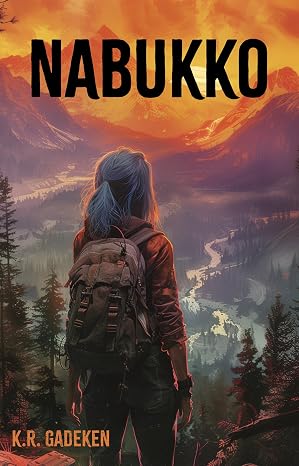
From the blurb
Eff is stranded on an unfamiliar planet. Her memories have been tampered with, leaving her with only snippets of information. With no recollection of how she arrived, why she’s there, or what happened to the rest of her crew, all she can do is try to stay alive.
After months of surviving and exploring the alien landscape, she’s awoken one night by two human scouts. They bring Eff back to their settlement, a rustic colony base whose people treat her with suspicion rather than open arms. The more she observes them, the more certain she is that these colonists know something about her lost memories.
Even as Eff grows closer to several of the colonists, she learns that trust is impossible when everyone has something to conceal. And within the colony, someone isn’t interested in answers at all.
They’re out for blood.
For fans of The 100, Aurora Rising (The Aurora Cycle), and Across the Universe.
If you crave:
scifi mystery with locked‑colony tension
a heroine who might be the key to their secrets
a slow burn connection with the man who dislikes her
a closed‑circle colony where everyone has something to hide
survival stakes that tighten with every chapter
a world where the tech is broken, memories are missing, and the truth is lethal
then Nabukko will pull you in and refuse to let go.
Trust no one.
Uncover the truth before the colony decides you are the next threat.
Buy now
Read the review
As I pried open the squeaking, rusty metal door, the first thing that hit me was the smell.
“Ack—there better not be something rotting in there,” I said, pinching my nose.
It was three steps beyond musty. A gag reflex warped my insides as the stench settled into my lungs. I stepped back to give myself a minute more of fresh air and to let some of the sodden, contaminated air dilute through the open door.
There was probably fabric or bedding inside—a delightfully thick, plushy material that served as an excellent breeding ground for mold.
Alien mold.
I wondered what the biologists and mycologists back on Earth would give to study the mold from … well, wherever this planet was.
My eyes scanned the orange-tinted sky as I sucked in a breath of mold-free air. It was late afternoon, but the light was as dim as early dusk on Earth. From experience, I knew the sky would remain this way for at least another few hours.
Although it had been difficult to get used to at first, I felt I was properly acclimated to the dimmer sunlight. In fact, it was one of my best clues as to where I was. The slightly-more-orange-than-yellow sunlight and the lower solar intensity had me believing this planet orbited around an orange dwarf star.
But … that really didn’t narrow it down much. Orange dwarfs were one of the most common stars in the galaxy, second only to red dwarfs. And plenty of them had habitable planets.
I let out a deep sigh, hopefully pushing some of the airborne mold spores farther away. It didn’t matter which one of those habitable planets I was on, I still had to survive. And, unfortunately, surviving meant sifting through musty and abandoned pods.
Clutching my shirt over my mouth and nose, I poked my head through the narrow doorway. The pods were small and rectangular, not much more than one by two meters. As I suspected, a small group of sickly green emergency blankets was stacked in a corner. I didn’t bother with them. If the smell hadn’t already warned me, the black polka dots covering the green fuzz would have.
A pile of plastic shards took up the other side of the pod, likely the remains of a storage crate. It was useless to carry or store anything now. Not that there was anything inside to protect. Except for the twisting purple vines with matching leaves, the rest of the pod was empty.
“Europa’s Ice!” I swore, kicking one of the vines.
This whole pod was a bust! There were no supplies, no tools, no ultra-preserved nutritional provisions. I’d been traveling northwest for three months, and the closer I got to the mountains, the more wrecked and empty the pods were.
It might be time to change my route. Perhaps I should head south instead?
“It would be warmer at least,” I said, rubbing my arms. It was mid-fall on this planet already. Summer had lasted for only two months, so I knew this hunk of rock was probably closer to its star than Earth was to Sol. Which was to be expected for a planet orbiting an orange dwarf.
The closer proximity to a star was somewhat concerning due to the potential for higher levels of solar radiation, but I figured if the orange dwarf was stable enough to support the wildlife I saw around me, then there wasn’t much to worry about. And if my assumptions were wrong, then …
Best to ignore that train of thought for now.
The barren pod taunted me as I swept my gaze over it again. Those menacing purple vines completely covered two whole sides of the pod, inside and out. Skegs, that was some serious vegetation.
I wiped my sleeve against the edge of the door. Dozens of frantic scratches littered the frame. It didn’t take a genius to realize it had been pried open, likely by something with lots of muscles and lots of claws. Thankfully, there weren’t many large predators on the planet—at least on the parts I’d seen so far—but the few predators I’d come across were not to be trifled with.
“A bloody munkrave pack must have gotten in,” I muttered.
I would have left the pod right then and there, but my supplies were getting low, which was inspiration enough not to give up so easily.
Crouching down, I began digging through the purple vines. Something could have been left behind, after all. A stray nutrition pack accidentally kicked to the side. A handheld solar heating unit hidden under a blanket. A boring extendable wrench. I would have accepted anything, really.
But, after thirty hopeless minutes, I scolded myself for having any optimism in the first place.
“Forget it. I know there’s nothing here,” I said to the vines as I stepped back outside. My back ached as I stretched, loosening the taut muscles.
Compared to the inside of the pod, the foreign woods were inviting, the air fresh and rejuvenating. The trees were strangely similar to Earth pines, but the needles were bigger and glistened a menacing shade of black, the smooth bark a deep maroon. The low-growing grass underneath my boots was black and brown, with hints of red.
The way the orange light hit the forest was actually kind of beautiful. And a bit surrealist. I didn’t remember ever taking the time to admire nature this way back on Earth.
Then again, I didn’t remember much at all about my life back on Earth. Just little snippets of personal memories here and there.
Yet, I knew with certainty that I was from Earth, and that Earth had pine trees that looked different from these pine trees.
My only solid memories began about three months ago. I’ve remembered a few inconsequential things during that time, like how on my sixteenth birthday my parents finally consented to me genetically altering my hair so that it naturally grew with shades of pale blonde and snowy blue, my favorite color. Or how I recalled staying up late reading and studying for something that was important to me. I just had no clue what that something was.
Overall, I knew my parents were not too shabby, and that I could work hard for something I cared about. And what Earth pines looked like.
But none of that useless information actually told me why I was here, what had happened to me, or how I could get home and find my parents.
Hopefully, my brain would continue to dredge up more memories. Or maybe I would find answers somewhere on this planet. There had to be something here that linked me to my past, right?
I glanced back at the pod. It would be a decent shelter for the night, although I didn’t fancy sleeping with all the mold and vines. Shaking my head, I quickly scrapped that idea. No, I’d be better off setting up camp outside, using one of the walls as a barrier against both the wind and potential predators.
Another six or so hours of low daylight were still left, but there was no point in moving on farther today. Better to set up camp and lay a few traps for small game.
The small bag fastened across my back held the last of my supplies. I slid the bag off, setting it down on the brown grass, still expecting a soft crunching noise that never came. The grass was very much alive, even though my brain kept telling me it looked dead.
After riffling through the bag for a minute, I found a braided length of rope to use for my snare. The rope had been a prize from one of the first pods I’d found back in the plains. That pod had been the motherload! So pristine, so plump with rations, clothing, solar lights, and tools. I hadn’t left the area around that pod for nearly a month. Probably wouldn’t have if the munkraves hadn’t gotten to it.
I absolutely hated munkraves. Their curling talons, their rat tails and beady rat eyes, their triangular canine teeth, their ashy skin and drooping red fur, their screeching howls. And, Luna bless me, that awful stench. A pack of munkraves might as well be a cove of rotting bodies. They were that disgusting.
Surviving in the wilderness I could—apparently—do, but would I call myself a fighter? No, I would not. Sure, I could throw a punch, but hand-to-hand combat and expert marksmanship were not within my skill set. It was probably just pure luck that I hadn’t yet needed to go toe-to-toe with some crazy alien creature. Pure luck that I was still alive at all.
I rapped my knuckles on a nearby tree trunk. I relied on pure luck a lot. No need to jinx myself now.
After grabbing my rope, I twisted it into a loop with a slip knot. Snare ready, I hoisted my bag over my shoulder and wandered through the woods for several minutes until I found a suitable location for the trap.
I plopped a few pink and black berries down as the bait. They weren’t poisonous, though they had an odd and bitter, pickle-like flavor to them. I ate them whenever I found them, but only because they were food. However, the kreeplets I hunted went nuts over them.
Kreeplets reminded me of Earth rabbits, but longer with salmon pink fur, and three tiny horns on their heads. Those horns really hurt to get stabbed with, as I’d found out not three weeks ago. The little animals scurried along close to the ground, always twitching their front legs for some reason, creeping around like they were trying to pull off a robbery. It was almost comical. That, and their obnoxiously pink tufts, made them semi-cute. In an ugly sort of way.
Kreeplets tasted like under-cooked crawdads with too much dill. But, like the berries they favored, the rabbit-wannabees were not poisonous, and they saved me from starving to death.
Once my snare was set up, I meandered through the woods, collecting a few plants I knew from experience were edible. When I finally made it back to the pod, a few stalks of a blue and black relative of lettuce and a small vegetable that marginally resembled a turnip were tucked beneath my arms.
I set the plants down near my dormant fire pit before gingerly pulling a tarp out of my pack, taking a few extra seconds to unfold it. The tarp was weathered and sported several small rips. It’d been my only blanket for the past month, as well as my makeshift tent, my protection against a violent rainstorm, my extra storage bag. But it was nearing the end of its life. I’d been hoping to find a replacement in this pod.
“Maybe the next one,” I said ruefully as I continued setting up my makeshift camp, humming the tune to some ancient Italian opera.
Which reminded me …
I stood, glancing around the clearing for a small rock. After finding a suitable candidate, I snatched it up and walked to the front of the pod. Clutching the rock like a stylus, I etched my symbol onto the wall by the door.
Early on, I had the bright idea to mark each pod I came across. Not that there were that many of them—only a dozen or so—but I hadn’t known that at the time. Plus, it helped me keep my bearings whenever I got turned around.
I finished my chicken scratches and stepped back to make sure my tag was legible. It was the letter F, followed by a tilted pound sign. My parents loved the pun, and they used to reassure me that I was no “accident”. I didn’t remember much about them, but I liked that they had a sense of humor.
Task complete, the rest of my evening was spent skinning and cooking my kreeplet and vegetable dinner. Once the night sky had become more shadow than muddied golden hues, I fetched my snare and another piece of braided rope from my pack and hooked little bits of shredded metal onto them, orienting the metal scraps so that they would clang against each other any time the ropes moved. It was my makeshift alarm.
I hung the rope and bell security system low to the ground between a few trees nearby. It wouldn’t do much, but it would warn me if an animal got within ten meters or so while I was sleeping. I finally had a situation where being a light sleeper was practical.
Alarm system successfully deployed, I snuggled into my worn tarp and stared up at the stars. They sparkled cheerfully at me, but I found it difficult to be cheerful back. Not a single constellation was recognizable.
There was no moon to dampen the stars’ brilliance tonight, but that was because this planet didn’t have a moon. It did, however, usually have a substitute: a large gaseous planet orbiting even closer to this solar system’s sun than the current cosmic island I was stuck on. It whisked around the sun every two months or so, but tonight it was a “New Jupe.”
I called it Jupe for short and as a precaution in case I ever did get back to Earth. I didn’t want to confuse everyone—or myself—by calling it Jupiter. Plus, whenever it hid behind this system’s sun, I got to say “New Jupe” in my head … which was unfortunately something I looked forward to now.
As the cooler temperatures settled in, I burrowed deeper into my tarp, closing my eyes against the unknown. I really, really hoped the next pod I found would be more fruitful than this one.
***
An eerie green glow surrounded me. There was a whirling noise like an engine sputtering, but it sounded far away. Small lights flashed in front of me, but they disappeared so quickly I couldn’t tell where they were coming from.
The green glow shifted into a strange shade of blue, condensing onto every surface of my skin. The weight of the blue light became heavier and heavier until it pressed down all around me. And kept pressing.
Fear bubbled up inside me as the strange blue light squeezed tighter.
It was going to crush me! I tried to reach out, tried to get away. But my hands kept hitting an invisible wall.
Panic replaced the air in my lungs. I couldn’t even scream.
I pounded my fists on the invisible wall, but it wouldn’t budge. A soft metal tinkling noise overwhelmed the whirling background noise, growing louder and louder until—
My eyes flew open. I lay still, unmoving, unthinking, gasping softly for breath until I realized I was outside under an open sky.
An open sky that was still swathed in empty outer space and far-off hope.
The suffocating blue light was gone, but the metal tinkling noise remained.
I didn’t hesitate. I snatched the rusty dagger next to my head, rolled upright, and scanned the area for the animal. I blinked hard, forcing away my mental grogginess from the nightmare, allowing adrenaline to flow through my veins.
Only trees and shadows were visible, but there were strange, hushed noises—almost whispers?—coming from the opposite side of the pod. The predator must have been behind me!
I spun, risking a peek around the edge of the pod, but couldn’t see anything moving. Munkrave packs usually wouldn’t be so stealthy. Was this a new creature local to the hills and mountains I hadn’t encountered before?
If so, I needed to find better cover before they got to me. I knew I only had seconds.
Fortunately, I was surrounded by trees under a Jupeless night, lending me plenty of hiding spots. Leaving everything in my camp behind, I sprinted as silently as possible to a cove of trees a couple of meters behind the pod. Dagger angled away, foot and hand perched against the tree, I was ready to either climb to safety or fight whatever arrived.
Or so I thought.
I was, in fact, monumentally not ready for the two humans who walked out from the woods into the small clearing by the pod.
I gasped, the sharp sound echoing and bouncing around the trees like they, too, were surprised at the sight. Both humans whipped their heads in my direction, led there by my sounds of shock. I was ensconced in my hiding spot, so they didn’t immediately see me. My limbs were frozen from disbelief, otherwise I would have jumped out and introduced myself.
There were other humans here! Europa’s Ice, I wasn’t alone!
Were they here to rescue me? Would I finally find out what happened to me? To my parents?
Tendrils of warmth filled my chest, and I could feel a grin stretching my lips almost unnaturally.
And then, almost instantly, all of my budding happiness saplings shriveled up and died when one of the humans shone a light directly into my eyes—where did he get that?—and shouted, “There’s a person!” at the same time the other one yelled, “Get her!”
My brain hadn’t entirely caught up with the situation, but my instincts knew how to pick up the slack. I was running away from the two humans before I even registered what I was doing.
Behind me, twigs snapped, leaves crunched, and shouts rang out, but I didn’t dare look back. I sprinted harder, feet thumping against the black pine needle floor, suddenly terrified that these two members of my own species might be worse than munkraves.
I wove through the gothic forest, ducking under branches, jumping over exposed roots and felled trees. I may not be a great fighter, but I had enough endurance to keep running until they fell behind, giving me a chance to hide and figure out what in Luna’s name to do next.
My heart pounded, sweat beading on my forehead as I plotted an escape plan in my head. An odd stinging on my arm distracted my thoughts. I ignored it at first, thinking I’d scratched it on a prickly bush or accidentally rubbed it against pine sap.
But that was too much blood for a few scratches.
My hand was getting wet now from the dribbles of blood rolling down my arm. How did I manage to do this much damage to myself? I glanced up just in time to see the answer.
An old-fashioned arrow was sticking out of a tree only a meter in front of me.
Europa’s Ice, they had bows and arrows! What kind of backward humans—
A twang whooshed above me, and I instinctively ducked behind a tree, banging my injured arm in the process. I let out a muffled grunt of pain, clutching my wound with my free hand as I tried to stop the bleeding. It hurt like a son of a slagger, but not as badly as it could have. The arrow probably only sliced through skin, but I couldn’t be sure until I properly inspected it. And now was not the time for that.
“I think I got her!” one of the humans yelled. It was a man’s voice.
A crunching noise and a woosh of air told me he had dashed past my hiding spot.
Did the other human follow him?
I quietly turned to run in the other direction while I had the chance, but I froze almost immediately.
The other human stood in front of me, a knife level with my eyes.

K.R. Gadeken was born and raised in Northern Colorado, where she found a love for the mountain wilderness and exploration at an early age. She traveled around the world before returning to Colorado to earn a Bachelor’s in Astronomy. She later moved to Tennessee with her partner and earned a Master’s in Geography. As an author, she uses her career as an excuse to read far too many books. She is the author of the Nabukko Trilogy, and you can visit her online at krgadeken dot com and on social media.


Leave a comment