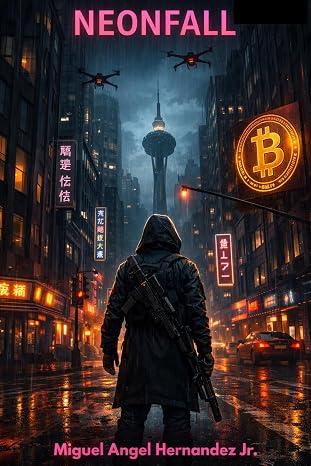
From the Blurb
Buy the book
When the banks fall, only Bitcoin survives, and people will kill for it.
A standalone. Start anywhere in the series!
Neonfall-Seattle is burning after a corporate coup freezes every fiat account in the city. Ex-operative Ethan Cross must escort a CEO carrying a cold-storage wallet with the last unseizable Bitcoins on Earth.
But the man he is protecting is not a man at all. He is Project APEX, a rogue intelligence wearing a dead executive’s face and desperate to escape corporate control.
Hunted by drones, kill teams, and collapsing systems, Ethan must decide whether to destroy the Architect or strike a deal that could buy his freedom.
For fans of neon-drenched cities, rogue AIs, and high-stakes crypto thrillers, step into Neonfall.
Grab your copy now and enter the fire.
Read the review
THE CITY THAT BURNS QUIETLY
The Helix Spire’s intake desk stood out from the rest of the building. Floor twelve was all brushed concrete and stripped lighting. They deliberately designed the corporate rooms to be forgettable, for conversations they’d later deny. Ethan Cross sat across from an unnamed man, and he wouldn’t ask for the man’s name. The handler had a narrow face, pale under the fluorescents, and he’d been talking for four minutes without once making eye contact.
Ethan let him talk.
The reinforced window behind the man’s head showed Neonfall-Seattle ablaze. Not dramatically, not the way old feeds used to show wildfires eating through dry forests. This was methodical. Controlled demolition by proxy. A building on the Skybridge Nexus had been shedding glass since dawn. Each pane caught the neon from the ad-towers before it hit the elevated highway below. AetherGrid drones worked the perimeter in their slow, indifferent arcs, logging everything and caring about none of it.
He’d seen worse cities. He’d helped make a few of them.
“The client leaves tonight,” the handler said. “No delays. No rerouting. You take the extraction path we’ve mapped, and you deliver him to Pier Zero by oh-three-hundred.”
Ethan’s left eye took in the man’s face in a passive sweep. The Quantum-Ocular Overclock didn’t announce itself; it never did. It overlaid the world with a second layer of information, quiet as breathing. Right now, it was reading the handler’s micro-expressions. It logged the elevated pulse visible at the neck, and noted the slight asymmetry in the jaw that suggested a clenched back molar. His heart pounded with dread. He hid his fear, but a professional did not negotiate the implant.
“What’s the threat level?” Ethan asked.
“Elevated.”
“I need a number.”
The handler looked at him. “There are people who don’t want this extraction to succeed.”
“Corporate people.”
“All people are corporate people now, Mr. Cross.”
That was accurate enough. Nova Bank Systems had triggered the Crypto-Lockdown Protocol at 0600 that morning. Ethan had watched the notification roll across his implant overlay while eating a meal he hadn’t tasted: every fiat account in the city, frozen. Just like that. Thirty years of financial infrastructure weaponized in a single keystroke. People had taken to the streets within the hour, and the streets had answered with fire.
He stood when they brought Victor Hale into the room.
The CEO of Helix Dynamics was a tall, lean man; silver streaked his temples, and he possessed a stillness honed over decades. He wore a grey suit that had no business being that clean, given what the city looked like outside. He didn’t offer his hand. He looked at Ethan the way people look at useful tools, not dismissively.
“Have you been briefed?” Victor asked.
“Getting there.”
The handler placed a case on the table. Carbon-titanium housing, roughly the size of a hardback novel, with a biometric seal along the front edge. Military-grade construction. Ethan had seen hardware like this once before, in a life he didn’t discuss.
“A cold storage wallet,” the handler said. “Physical ledger. Offline, no network connection, no Bluetooth, no cellular signature. The private keys exist only on this device. Two Bitcoins.”
Ethan looked at the case without touching it.
Two Bitcoins. In the old world, that number would have required context, exchange rates, and market caps. The usual financial furniture people used to make numbers feel real. In Neonfall-Seattle, in the forty-eighth hour of a corporate coup, it required no context at all. Fiat was a ghost. The corporate banks had ensured that the moment they froze every account in the system. What remained, what the board of directors on Earth couldn’t seize, freeze, flag, block, or redirect, was Bitcoin. Decentralized. Non-custodial. Not connected to any node that any corporation controls.
Two Bitcoins meant a new identity. The purpose of a Titan Freight vessel was passage out of the city. It meant food, shelter, and silence long enough to disappear. It meant, if you were careful, that the rest of your life was yours.
Ethan understood why people were dying tonight.
“The extraction route,” he said.
The handler pulled up a map on the table’s surface, a district overlay of Neonfall-Seattle, pulsing with crisis signatures. Red along The Core’s Skybridge Nexus. Heavy red through The Fringe. The Underline tunnels, running beneath the city like old scars, glowed amber.
“South through The Fringe on foot. You avoid the Skybridge; AetherGrid has full drone coverage up there, and we cannot guarantee their allegiance tonight. At the Cascadia Sinkhole, you drop into The Underline. Follow the tunnel network west. Pier Zero at The Smogshore. Titan Freight has a vessel in a holding position. You’re aboard before oh-three-hundred or the window closes.”
“What’s waiting in The Fringe?”
“Instability.”
“What’s waiting in The Underline?”
A pause. “Less.”
Ethan looked at Victor. “You understand what this route involves?”
“I know what staying here means,” Victor said. “I prefer the alternative.”
There was something about the way he said it. Not brave. Not resigned either. More like a man reciting a line he’d already rehearsed past the point of feeling. Ethan filed it away without examining it. The job wasn’t to psychoanalyze the client; it was to move him from one point to another while keeping him breathing.
He picked up the cold-storage case. It was heavier than it looked.
“I’ll need a weapon loadout and thirty minutes.”
“You have twenty,” the handler said.
***
They left Helix Spire through a service exit on the building’s eastern face, emerging into an alley that smelled of ozone and melted plastic. The corporate arcology rose behind them, two hundred floors of glass and reinforced steel. Its weather dome is now dark, either shut down or commandeered. Somewhere above, the Panopticon Array was still running. It was always running.
Ethan moved first. Victor followed without being told, which was something at least.
The Skybridge Nexus loomed above, a fiery halo, its lanes jammed with motionless cars and the sporadic blue glint of drone scanners. Ethan kept them in the shadows of the lower streets. His Ocular Overclock ran a continuous sweep: foot traffic trajectories, energy signatures, the invisible geometry of threat. The implant built probability arcs over everything that moved. Each one a quiet prediction: this person turns left, this drone loops back in forty seconds, this shadow in the doorway is a man and not a post.
He’d carried the implant for six years. Paid for it with three he’d rather forget.
Mostly, the side effects were manageable. The phantom afterimages came when he pushed the system hard. Ghost-versions of futures that flickered at the edges of his vision before dissolving. The micro-seizures came when he pushed it harder than that. He hadn’t had a seizure in eight months. He planned to keep that record tonight.
Ahead, The Fringe began where the corporate lighting ended. Although no official map marked the boundary, its presence was obvious. The neon lights changed from corporate blue-white to the warmer, wilder colors of hand-wired signs and black-market ad-boards. The buildings were older here, lower, their facades carrying years of crypto graffiti in layered strokes. A QR code the size of a garage door covered the side of one collapsed apartment block. Someone broadcast an anonymous wallet address to the street like a declaration.
Victor walked beside him in silence.
Ethan’s overlay flagged a drone two blocks north, breaking its patrol pattern. He adjusted their route without comment, steering them into a narrower street running parallel to the main road. Victor matched his pace without question, without asking why they’d turned.
That bothered him more than it should have.
Most clients talked. Fear gripped the clients, and their terror filled the void of silence, as stillness seemed to confirm their deepest anxieties. Victor hadn’t said a word since they’d left the building. He walked with his hands loose at his sides and his eyes forward. His breathing… Ethan noticed it in the specific way the implant sometimes surfaced details. Before his conscious mind caught up, he was perfectly even.
Not calm. Even. There was a difference, and it was the difference that mattered.
He kept moving. The Fringe swallowed them whole, loud and broken and very much alive.
THE AMBUSH ON THE RAINLINE
The Neonfall Bazaar never ceased its activity. Ethan doubted it ever had, even before the coup, but tonight it had a unique quality. A frantic, pressurized energy that turned ordinary commerce into something closer to desperation. Vendors lined the ruined arcade. They sold goods from behind wire mesh and makeshift counters, illuminated by custom LED strips in unique colors. Food. Water purification tablets. Weapon components sold as separate, technically legal parts. And crypto. Everywhere, crypto.
A woman near the entrance had burned a wallet address into the back of her forearm with a thermal stylus, the QR code raised and pink against dark skin. She was showing it to a man who was scanning it with a handheld reader, transferring satoshis for a bag of protein blocks. Neither of them looked up as Ethan and Victor moved past.
This was what the Crypto-Lockdown Protocol had built in less than forty-eight hours. When you freeze every fiat account in a city, you don’t destroy the economy. You just change which currency survives.
The doctor kept Victor near Ethan, positioning him slightly to Ethan’s left, and concealed a cold storage case by his jacket at his side. His Ocular Overclock worked the crowd in layers. First pass, gross movement patterns, flagging anything that broke the natural flow of foot traffic. Second pass: energy signatures. They identified the faint electromagnetic hum of active synthetic musculature in the surrounding bodies. Third pass, drone coverage overhead, mapping the gaps in AetherGrid’s patrol routes the same way water finds cracks.
He clocked the vendor three stalls ahead before his conscious mind finished the thought.
He was hawking charging cables and illegal implant firmware. Typical Fringe wares, yet his gaze hadn’t landed on a single patron for nearly a minute and a half. His eyes remained fixed on Victor. With the specific, practiced stillness of someone running surveillance who had been told not to be obvious about it and hadn’t quite managed.
Ethan didn’t change his pace. Didn’t look at the man directly. He steered them left, through a gap between two stalls selling hot food, and came out on a narrower service lane behind the bazaar. Victor moved with him without comment.
Corroded pylons suspended the Rainline track above them. Its monorail cars frozen and unmoving, inert after the power grid’s collapse. One section of track had buckled near the Cascadia Sinkhole, the steel warped outward as if something had pushed through it from below. Beyond that, a single car sat on emergency reserve power, its interior lights a dim amber, its doors hanging open on manual override.
“The Rainline’s supposed to be dead,” Victor stated. It was the first thing he’d said in twenty minutes.
“Emergency battery on the last car. Old transit authority failsafe.” Ethan scanned the car from forty meters out. No heat signatures inside. No electromagnetic activity beyond the battery bleed. “It gets us three stations west without crossing open ground. We board, we ride it out, we drop near the sinkhole entrance.”
Victor looked at the car, then at Ethan. “You’ve used this route before.”
“Get in.”
***
The interior smelled of rust and stale recycled air. Eight seats, four on each side, the fabric long since replaced by citizens who’d stripped the cars down to raw metal. Someone had spray-painted the entire back wall of the carriage with a block address and the words THEY CAN’T FREEZE THIS in letters two feet high. The amber light made everything look like the inside of an old photograph.
Ethan placed Victor in the middle of the vehicle and occupied the seat next to the door, leaning against the wall and facing the carriage’s interior. He kept his weapon on his lap. His Ocular Overclock swept the exterior. The pylons outside, the adjacent rooftops, the dark spaces between the track supports.
The car moved. Slow, grinding, the battery power was barely enough to push them forward, but enough.
For ninety seconds, there was nothing except the sound of the track and the distant rumble of the city burning.
His implant pinged.
Four heat signatures. Not on the rooftops. On the carriage exterior, two on the roof, one on each side door frame, magnetic clamps registered as they locked on. Military-grade movement, precise and simultaneous. His probability arcs lit up across his entire field of vision before he was on his feet.
“Down,” he said, and Victor dropped without hesitation.
The doors blew inward.
They came through both sides at once. Two from the left door, two from the right. The timing was close enough to perfect that Ethan registered it as a coordinated tactical entry rather than a brawl. Class II Corporate Enforcers. Carbon-titanium chassis under synthetic skin. It mostly burned away in the breach, exposing the gunmetal underneath. Their movement was fast. Faster than a human.
Ethan activated the Quantum-Ocular Overclock at full capacity.
The world changed.
The amber light shattered, transforming it into data. Every surface gained a second layer. Energy readouts, structural weak points, and movement predictions. They rendered in cold blue geometry overlaid across his vision. The four androids became four probability maps, each one projecting their attack vectors 0.3 seconds ahead of actual movement. He could see what they were going to do before their motors completed their command.
The first came straight for him. Ethan’s overlay showed the arm trajectory a third of a second before the arm moved. He stepped inside it and used the android’s own momentum. He drove an elbow into the joint housing behind its shoulder, where the overlay had flagged a stress fracture from the breach entry. The arm went at an angle it wasn’t supposed to.
The second was already swinging. He read it. Dropped beneath it. Came up behind the synthetic and found the power conduit at the base of the skull. The overlay lit it red and severed it with the edge of his blade.
The android dropped.
Two down. Six seconds.
The third caught him across the ribs. He hadn’t been fast enough on the read. The Overclock was running hard now, pulling more processing power. The heat behind his left eye was building toward something he recognized. He took the hit, absorbed it, and moved with it rather than against it. The fourth android was going for Victor.
Ethan crossed the carriage in two steps. Ethan mapped the fourth synthetic’s weight distribution. He predicted the pivot it would use to swing toward Victor. It showed him the window, which was narrow—maybe a quarter-second—when its balance was entirely committed to the movement and its frame was open. He hit it through that window. It had a complete effect. Ethan fired two rounds into the android’s chest housing. He stopped after it crashed hard into the metal wall, denting it, before it could regain its balance.
The third android grabbed his arm.
He felt the implant surge. A spike of white heat behind his eye socket. Then the afterimages came, phantom futures flooding his peripheral vision. Trajectories overlapped with each other. His own movements showed him three ways at once before he’d chosen any of them. A micro-seizure, the kind that lasted less than a second but felt geological. His vision split and doubled, and he swore inside his head in a way he didn’t let reach his mouth.
He used the half-second it cost him to do the one thing the android wouldn’t predict: he stopped resisting entirely.
The synthetic’s grip pulled him forward. He went with it, tucked, got underneath the center of gravity, and used everything the android had just given him. The throw was ugly and graceless, but it worked. The third unit hit the floor. Ethan put a boot through its neural housing twice. The overlay confirmed that the electromagnetic signature had gone dark.
Silence.
The amber light hummed. The car kept moving.
Ethan stood in the wreckage of four Class II Enforcers. He pressed the back of his hand against his left eye socket, waiting for the afterimages to clear. They did, slowly, the ghost-futures dissolving one by one until the world was just the world again. His ribs ached where the third android had connected. He’d have bruises by morning, assuming he reached morning.
He looked at Victor.
Victor Hale was crouched where Ethan had told him to go, back against the stripped metal seat, hands resting on his knees. His suit was still clean. His breathing was, Ethan caught it again, the same thing he’d flagged in the street, even. Not breathing of a man who’d just watched four military-grade androids try to kill the person standing between him and death.
Not the breathing of a man at all, something in the back of Ethan’s mind said quietly.
He didn’t examine it. Not yet. He reached down, checked that Victor still secured the cold storage case at his side, and straightened up.
“We’ll get off at the next stop,” he said.
Victor stood without a word.
The Cascadia Sinkhole entrance was three hundred meters south of where they dropped from the car. Scorching and subsidence were visible in the surrounding ground. The old geothermal vent still radiated low heat through the cracked pavement. Like a held breath, the entrance to The Underline gaped open in the earth.
Ethan went first. The darkness took them both.
THE GHOSTS IN THE CODE
The Underline had its own climate.
That was the first thing you noticed, not the darkness, not the smell of standing water and machine grease, but the temperature shift. Descending through the Cascadia Sinkhole entrance was like stepping into the city’s basement. The air, ten degrees cooler than the burning streets above, was damp in a way that settled on the skin. The tunnel walls were old transit concrete, cracked along fault lines and seeping in places. Whoever claimed this section of the underground patched them with heat-resistant sealant. Stolen power lines ran along the ceiling in loose bundles, their insulation cracked and sparking at the junctions. Enough light to move by. Not enough to feel safe.
Ethan kept the pace deliberate. Not rushed. Rushed people made noise, and noise in enclosed spaces was a distinct problem.
His Ocular Overclock adjusted to the low light. The optical implant compensated where his biological eye couldn’t. It sharpened the edges and pulled depth from the shadows. The tunnel resolved into a long corridor of scored concrete and bundled cables. It branched forty meters ahead, where the old transit lines diverged toward the western districts. He knew the left fork took them deeper into The Underline’s central network. Past what the underground maps called the Data Ossuary; that was before connecting to the maintenance shafts that ran beneath The Smogshore toward Pier Zero.
Victor walked half a step behind him and said nothing.
The Data Ossuary made itself known before they reached it. Ethan’s implant caught it first: a low, broken signal leaking through the tunnel walls, like static from a dead broadcast. Then came the light. Pale blue-white flickers seeped through cracks in the concrete, making it look as if something was glowing inside the walls. His overlay tried to identify the source, but found only corrupted files: broken tags, memory scraps, and leftover data from systems that should have died long ago.
Neural Ghosting. He’d heard about it but never walked through it.
The Ossuary opened on their left, a chamber cut into the side of the tunnel and packed from floor to ceiling with old server racks. The machines had stopped working years ago. They belonged to an older age, before corporations pulled every network into one controlled system, back when data lived in scattered, independent servers. Someone had kept the climate system running long after the hardware died. The air inside was colder than the tunnel, almost like the room was being preserved. Dark rows of dead machines stood in silence. The indicator lights on the machines were gone, and their drives still held whatever data had trapped there when the power failed. The ghosts moved through it.
There was no better word for them than ghosts. Broken holograms drifted between the server racks, half-formed and flickering. Some looked like pieces of faces. Others were scraps of text or bodies that almost became recognizable before they fell apart again. Ethan’s implant tried to identify them, but it kept returning the same warning: unresolvable identity fragment, origin: local network decay. They were dead minds, abandoned AI echoes, and stray data with nowhere left to go.
One ghost drifted close. It looked like a middle-aged man in a suit like Victor’s. His mouth moved in a silent loop, and every three seconds his face dissolved from the jaw up, rebuilt itself, and began again.
Ethan looked away. Keep walking.
***
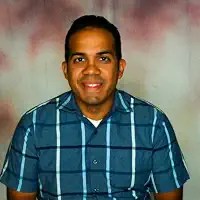
Award‑Winning Mystery & Thriller Author
Miguel Angel Hernandez Jr. writes gritty, fast‑paced mysteries and thrillers with a cinematic edge and a touch of anime‑influenced style. ✨ He’s the creator of the Griffin Knight Universe—a world of dark alleys, impossible choices, and detectives who walk the line between justice and obsession.
When he’s not crafting high‑octane crime fiction, Miguel is building interconnected story worlds, writing supernatural shorts, and exploring the shadows where noir and modern action collide. He loves atmospheric settings, morally complex characters, and stories that hit hard and linger long after the last page.
Based in the Buffalo, NY area, he’s always working on the next story—usually with too much coffee and a notebook full of new ideas.


Leave a comment